246,000
bikes stolen per year
Bike thefts recorded by the police in Germany — Polizeiliche Kriminalstatistik (PKS) 2024, the German police crime statistics.

Lock, security marking and insurance — how the three pillars work together, which lock types are worth it and what to do immediately after a theft.
Over 4.5k satisfied customers
— Become part of the Europe-wide BikePass community.
Made in
Germany
Professionally organised offenders, few solved cases, rising losses: the statistics show why prevention in layers is a must.
246,000
Bike thefts recorded by the police in Germany — Polizeiliche Kriminalstatistik (PKS) 2024, the German police crime statistics.
< 10 %
Fewer than one in ten reported bike thefts is solved (PKS). You stand a better chance if you documented your bike beforehand.
€1,270
Average payout by insurers per bike theft according to the German Insurance Association (GDV) — and rising.
Every pillar can be beaten on its own — only the combination of mechanics, identity and cover makes your bike a poor target.
The first line of defence: a high-quality lock delays the theft long enough to make the risk too high for the offender. Cheap models, by contrast, are open in under a minute with bolt cutters — the table below shows which lock types are worth it.
Even the best lock falls with enough time and tools. Security marking plus registration make your bike permanently traceable to you — instead of one among millions of anonymous bikes. The BikePass is the free basis: your digital proof of ownership in less than 3 minutes.
Register for freeIf every layer fails, insurance absorbs the financial loss. Specialist policies usually replace the bike at its new value — without the tight limits that many home contents insurers apply to bicycles.
Rule of thumb: invest at least 10 % of the value of the bike in the lock. Up to a bike value of €500 a good folding lock is enough; from €1,500 — especially on an e-bike — two different locks belong on the bike.
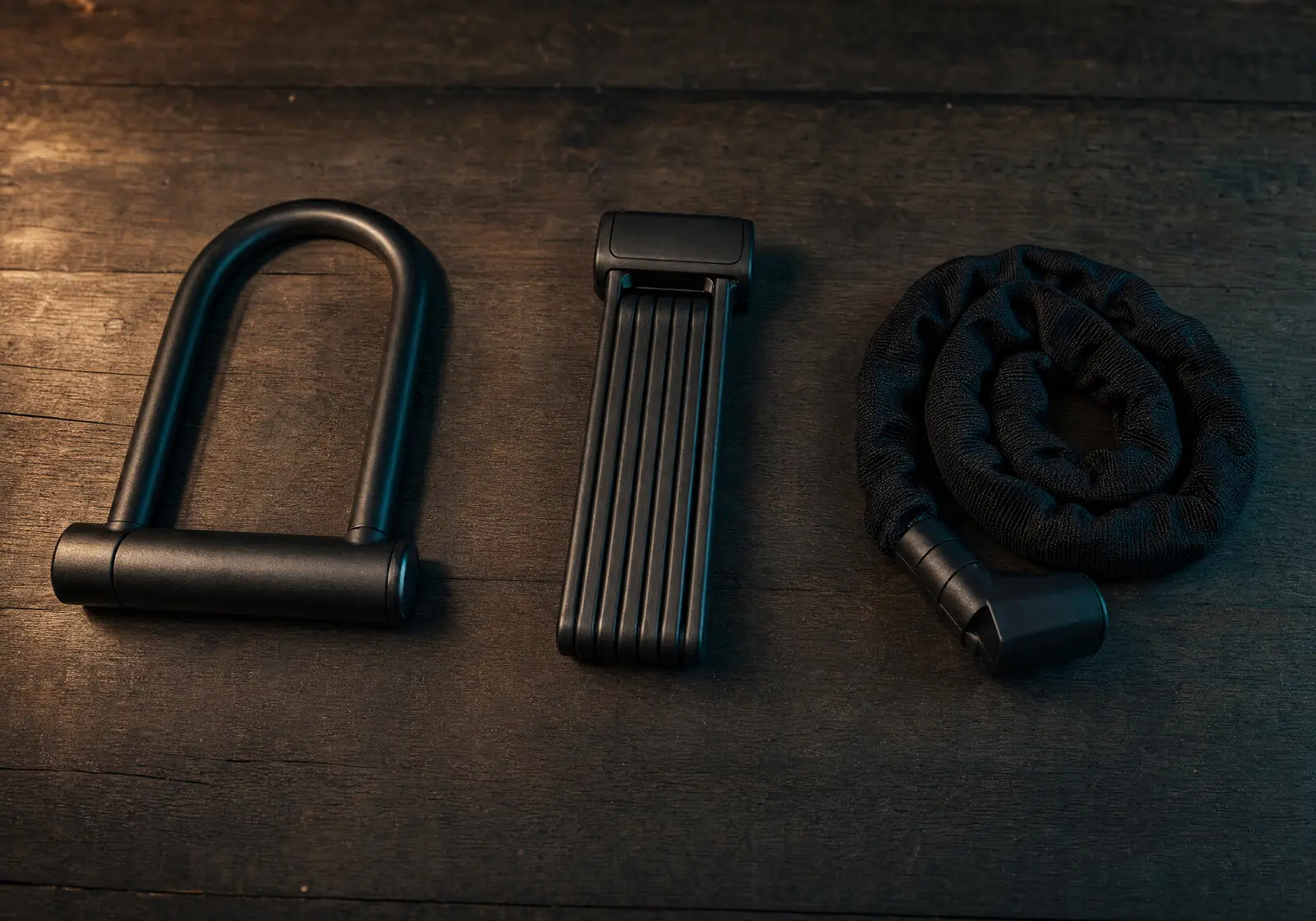
| Lock type | Security | Weight | Flexibility | Price |
|---|---|---|---|---|
| D-lock | ★★★★★ | high | low | €80–250 |
| Folding lock | ★★★★☆ | medium | high | €60–180 |
| Chain lock | ★★★★☆ | very high | medium | €70–200 |
| Armoured cable lock | ★★★☆☆ | medium | high | €40–120 |
| Frame lock | ★★☆☆☆ | low | low | €20–60 |
Test winner at Stiftung Warentest, the German consumer testing organisation (3/2025): the D-lock ABUS Granit Super Extreme 2500 with a score of 1.2 — the best bike lock ever tested. When locking up, the rule is: always secure the frame plus a wheel to a firmly anchored object — not just the front wheel, and not to lampposts or construction fencing.
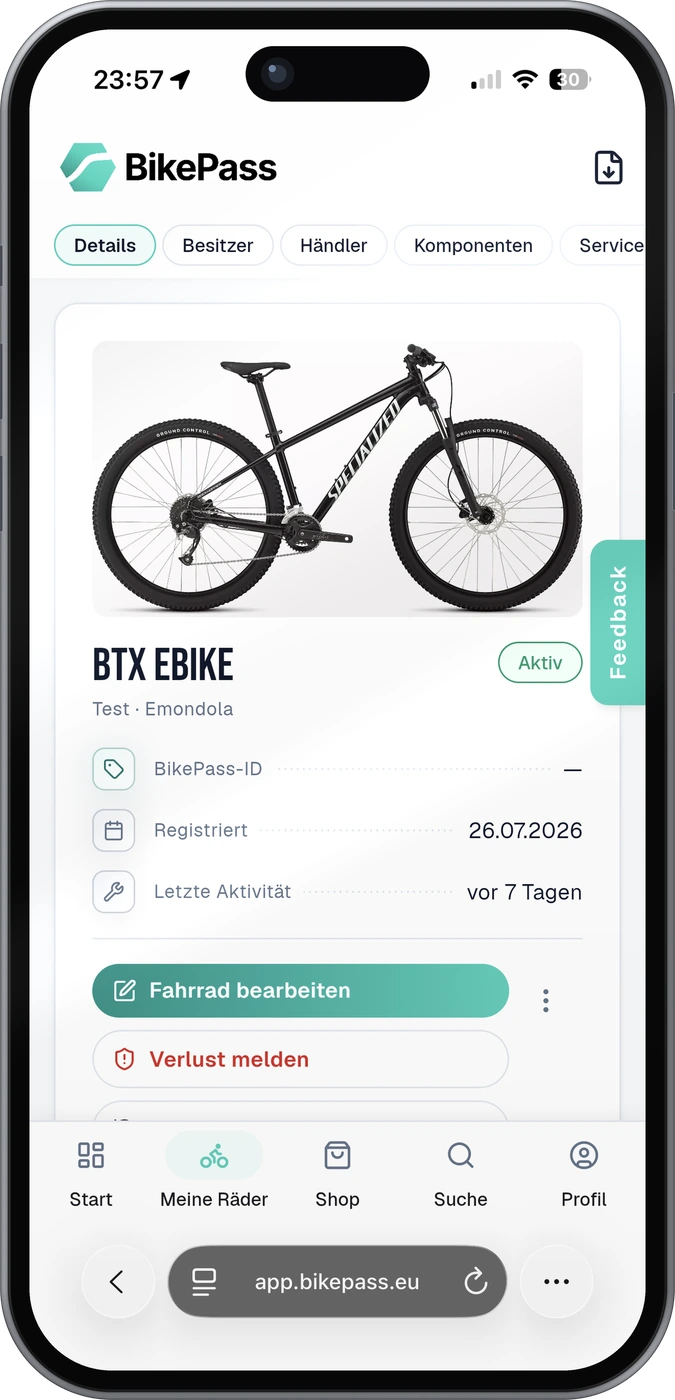
Free in your BikePass: frame number, photos and receipts as digital proof of ownership for police and insurers — accessible EU-wide, even without a sticker.
Register your bike for freeA professional opens a lock with tools. Security marking with stored proof of ownership stays with your bike permanently — and spoils the resale for thieves, because marked bikes stand out on marketplaces.
Free and in less than 3 minutes: frame number, make, photos and receipts are ready as digital proof of ownership for police and insurers. It works without a sticker too, for any number of bikes — and existing markings such as the ADFC stamping (approx. €15) can simply be recorded alongside.
The marking set (€34.99) contains two tamper-proof QR stickers for frame and battery: 30 × 30 mm, UV-, weather- and heat-resistant, protected against abrasion by a laminate and impossible to remove without traces. You can fit them at home — without an appointment and without voiding your warranty.
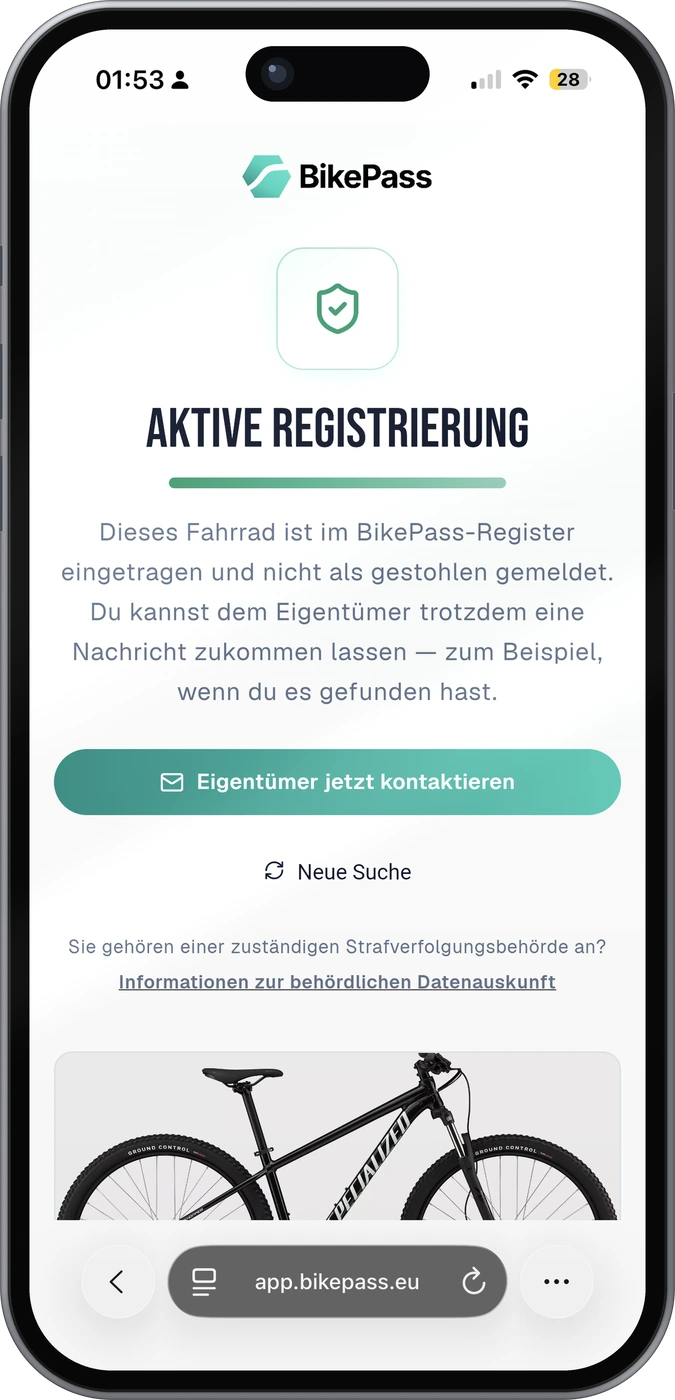
When you report your bike as stolen, the status becomes visible to the authorities. Anyone who scans the QR code — finder, buyer or police — sees the alert immediately and can contact you anonymously, without any personal data being disclosed.
From a bike value of around €1,500 usually yes — and at the latest with an e-bike. What matters is the difference between home contents cover and a specialist policy.
Many home contents policies also cover bike theft — but often only up to 1 % of the sum insured. On €50,000 of contents that is just €500. On top of that there is often a night-time clause that excludes theft away from the home at night. For high-value bikes that is rarely enough.
Standalone policies usually cost €5–15 a month and typically offer new-for-old replacement instead of current value, 24/7 cover without a night-time clause and often extras such as battery cover or breakdown assistance. The usual condition is an approved lock; some policies additionally require security marking or registration — and BikePass documentation makes the proof easier in every case.
The first 24 hours decide it. Work through these steps in order.
First make sure: sometimes the bike has only been carried a short distance away or removed by the local authority.
Online or at the station — have the frame number, BikePass ID and purchase receipt to hand. You need the case number for your insurer.
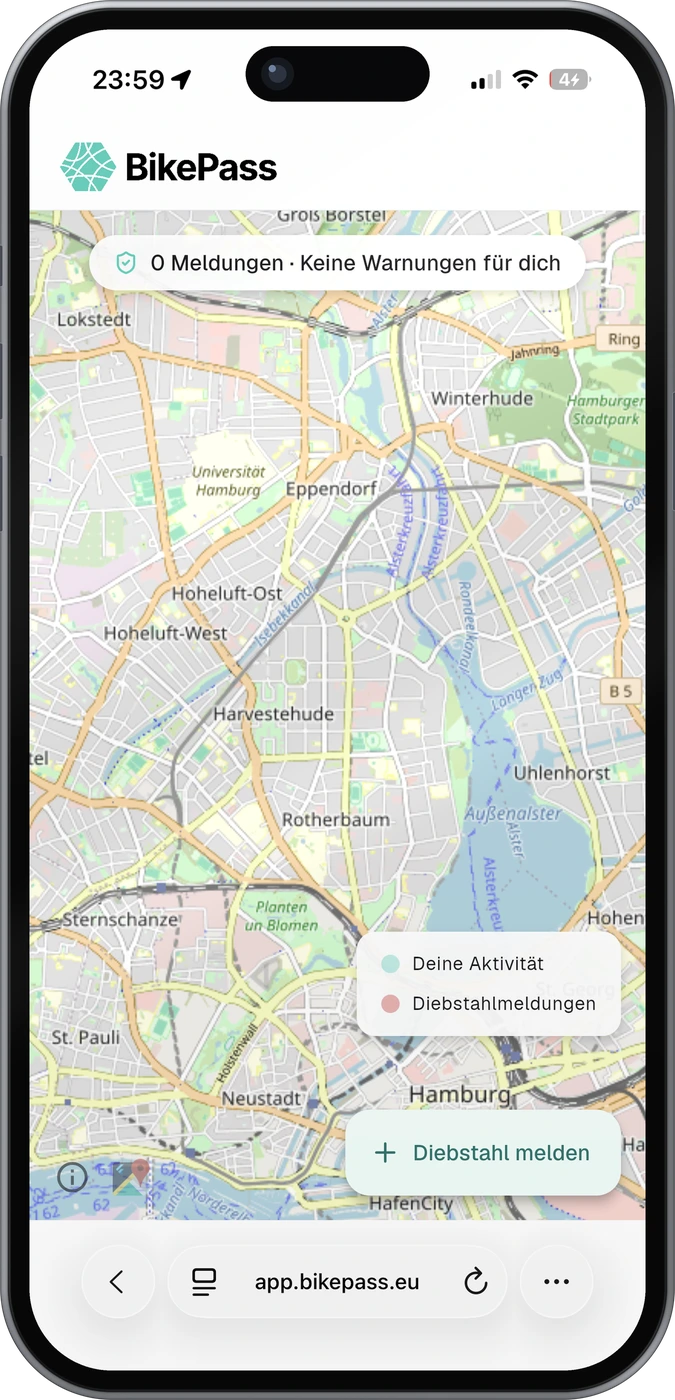
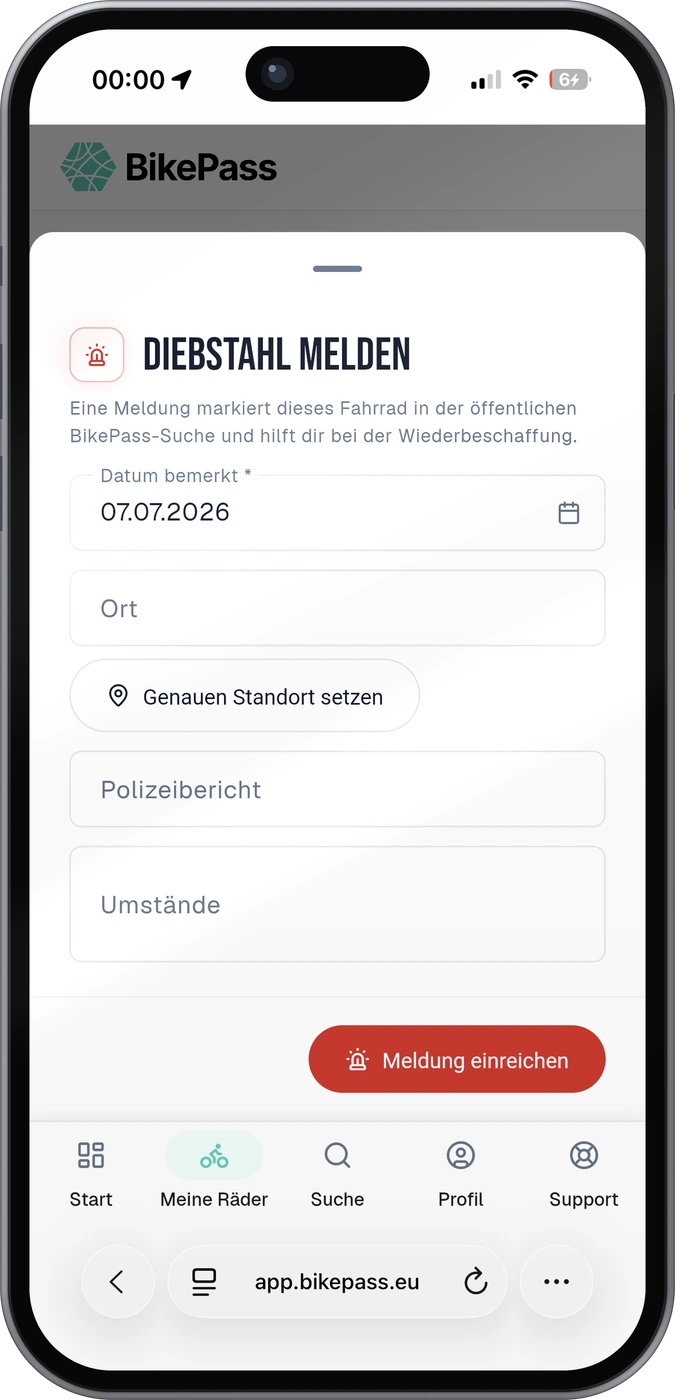
One click in the BikePass web app: the ID becomes visible to authorities in the Register Europe-wide — and anyone who scans the QR code sees the theft status immediately.
Many policies require notification within 48 hours. Enclose the police report — otherwise you risk the payout.
Kleinanzeigen, Quoka, Facebook Marketplace: search regularly by make, model and colour — stolen bikes often resurface there.
Local Facebook groups, Nextdoor or nebenan.de: a post with a photo, the frame number and the theft location puts many eyes on the case in your neighbourhood.
Some offenders try to trade bikes in at dealers. A quick word to workshops and shops nearby can stop the resale.
E-bikes are especially popular with organised gangs — three additional rules apply.
Without its battery an e-bike is worth considerably less on the black market — many thieves then leave it where it stands.
From a bike value of around €2,500, one lock is no longer enough: combine two different types — ideally a D-lock plus a folding lock.
Hidden in the frame, it supplies the live position after a theft. €100–300 one-off plus a small subscription — worthwhile from a bike value of €2,500.
Order your EU-wide bike security marking now.
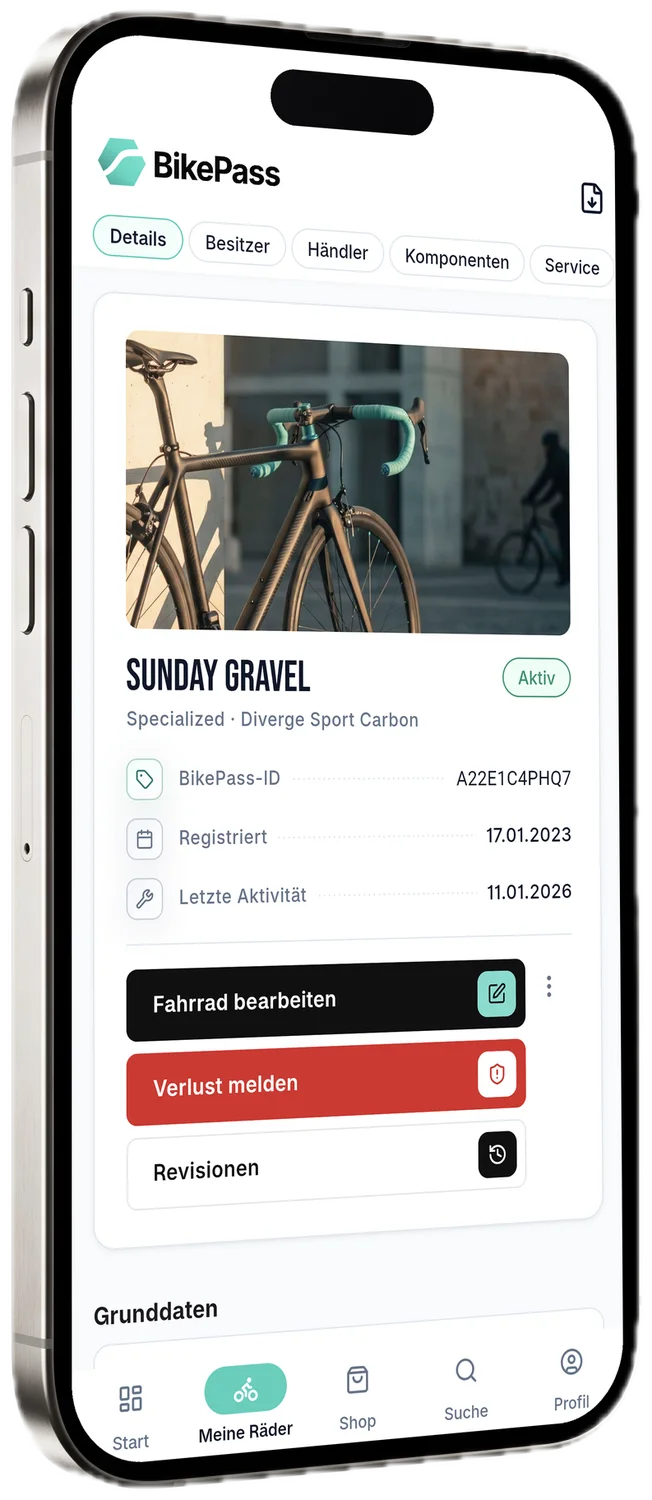
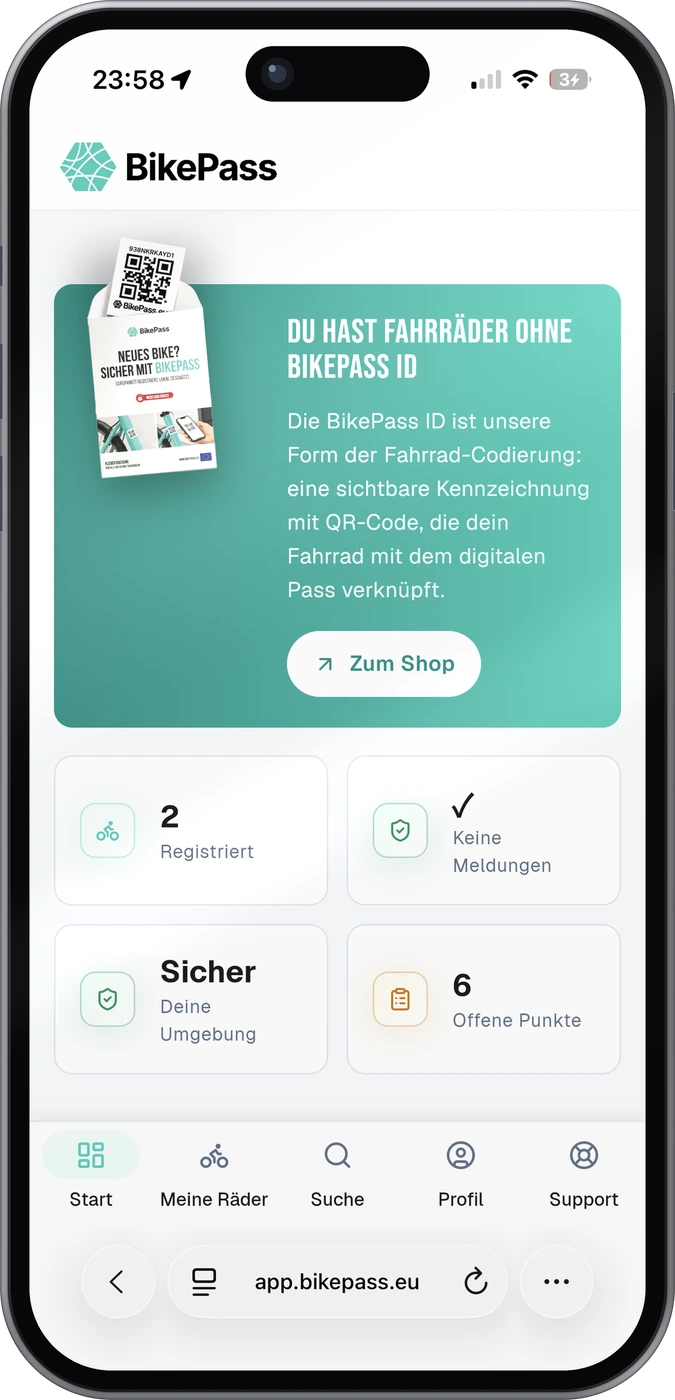
The BikePass ID is our form of bike security marking: a visible identifier with a QR code that links your bike to the digital passport.
from €27.99incl. VAT
More about the BikePass IDReal voices from the BikePass community.


According to Stiftung Warentest, the German consumer testing organisation (issue 3/2025), the ABUS Granit Super Extreme 2500 is the best bike lock ever tested, with a score of 1.2. Important: even the best lock only protects you if you lock up properly — frame plus wheel to a firmly anchored object.
With home contents insurance, often not: many policies contain a night-time clause that excludes theft away from the home at night. With specialist bicycle insurance, on the other hand, 24/7 cover is usually standard. Always check the policy conditions before you sign up.
There is no obligation. What does make sense is registration in a verifiable database such as BikePass: it works EU-wide, can be updated instantly and provides proof of ownership for police and insurers when it matters.
An excess of €0 to €150 is common. Policies without an excess cost more, but are less stressful when you make a claim.
Specialist bicycle insurance usually costs between €60 and €180 a year — depending on the value of the bike, where you live and the scope of cover. E-bikes are often charged at a premium.
Yes — provided the usual conditions are met: a police report, a properly locked bike, timely notification and a lock that meets the requirements of the policy. Miss one of these points and you risk the payout.
For an old city bike you ride to the bakery, perhaps. For high-value bikes and e-bikes, no — there the rule of thumb applies: invest at least 10 % of the value of the bike in the lock.

Bought a lock? Then the identity is still missing: register your bike in the BikePass now, for free — your digital proof of ownership, valid EU-wide.