
In short
On most bikes the frame number sits under the bottom bracket, otherwise on the seat tube, the head tube or the rear dropout; on an e-bike the motor often covers the classic spot, in which case it is on the down tube or in the display menu. Note it down character for character, photograph it and store it together with your proof of purchase. Without this number, a recovered bike is just a bike to the police.
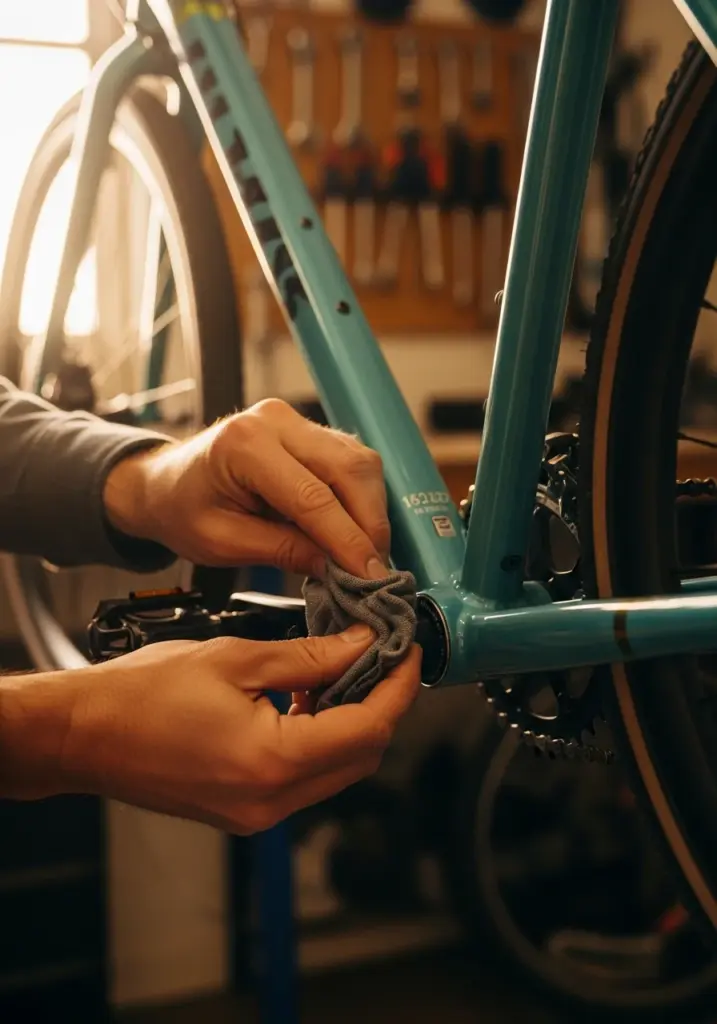
The bike stands upside down on an old towel in the kitchen, your phone clamped between your teeth as a torch. Under the bottom bracket: road grime, old grease, and somewhere beneath it supposedly a number. Ten minutes and one rag later, there it is, shallowly stamped and half worn away.
That moment later decides more than it should. In 2025, around 214,000 bicycle thefts were reported in Germany, and only about one case in nine was solved (source: the German police crime statistics, Polizeiliche Kriminalstatistik 2025). Anyone who cannot produce anything afterwards has no argument, only a memory.
A quick definition, so we are talking about the same thing: the frame number is an identifier of letters and digits permanently stamped or engraved into the frame by the manufacturer. It makes a single bike identifiable, links it to a proof of purchase and keeps it distinguishable from thousands of similar bikes after a theft. It is not a vehicle registration plate and not proof of ownership: it is only on the bike, not in your name. Only the combination of number, receipt, photos and a register in which both are assigned to you turns it into evidence. The number is the key, not the lock.
Where do I find the frame number on a bike?
On most bikes the frame number is under the bottom bracket, that is on the shell through which the pedal axle runs. There is no binding rule for this, so every manufacturer deviates when that spot gets in the way of the design. In practice that means: you have one likely spot and three to four alternatives.
Which alternative comes first depends on the type of bike. On a road bike with a low-slung down tube it sits somewhere other than on a cargo bike with a long frame. The table shows where to look first depending on your bike and what typically slows you down.
| Type of bike | Look here first | If nothing is there | What slows you down |
|---|---|---|---|
| City and trekking bike | Underside of the bottom bracket | Seat tube directly above the bottom bracket, head tube | Dirt and grease on the bottom bracket; the stamping is often shallower than expected. |
| Road bike | Underside of the bottom bracket | Rear dropout, down tube near the bearing cup | Layers of paint and decals partly cover the characters. |
| Mountain bike | Underside of the bottom bracket | Head tube, rocker link or dropout on the rear end | On a full-suspension bike the shock mount and chainstay protector cover the spot. |
| E-bike and pedelec | Down tube or seat tube | Head tube, dropout, display menu, purchase documents | The motor housing sits exactly where the number would otherwise be. |
| Cargo bike | Seat tube or head tube | Frame tube behind the transport box, dropout | Box, rack and panelling cover half the frame. |
| Folding bike | Frame directly at the folding joint | Seat tube, underside of the bottom bracket | When folded, you often cannot reach the spot at all. |
You need little for the search: turn the bike over, wipe the spot clean with a rag, shine light on it flat from the side. Raking light is the trick, because a stamping only becomes legible through its shadow. Lit head-on, it disappears.
Some bikes also carry the number as a sticker on the seat tube or down tube. That comes loose, fades and can be peeled off. Rely on the stamping.
Where is the frame number on an e-bike?
On an e-bike the frame number is usually on the down tube or the seat tube, because the mid-drive motor occupies the bottom bracket. Otherwise the same applies as on a bike without a motor, just with one extra source of error: an e-bike has several numbers, and most of them are not the frame number.
There is a separate drive number on the motor housing, another on the battery and one more on the display. For a police report and for insurance, the number on the frame counts. The drive number is still valuable, because a stripped e-bike lives on in parts and the motor is the most expensive of them.
If you find nothing on the frame, follow this order: first the display menu with the vehicle data, then the purchase contract and invoice, then the drive manufacturer's app, and finally the dealer. In the end, note down both numbers, the one from the frame and the one from the motor. What to do specifically after a theft is set out step by step in the guide “Bike stolen, what now?”.
Is the serial number the same as the frame number?
On a bike, in practice both terms usually mean the same identifier, namely the number permanently marked on the frame. They are still not cleanly separated: many dealers also call the number on the invoice, the box or a sticker the “serial number”, and that can be identical or a second manufacturer identifier.
In the end, four different numbers can be attached to the bike. Anyone who mixes them up reports the wrong one when it matters. This overview sorts out what each of them proves and where it stops.
| Number | Where it is | What it proves | What it does not prove |
|---|---|---|---|
| Frame number | Stamped or engraved into the frame | The identity of exactly this frame, permanently and not changeable without tools. | Who owns the bike. The number knows no name. |
| Serial number on the receipt | Invoice, purchase contract, box, sticker | That you bought a bike with this number, including date and dealer. | That the number on the frame is the same. Check both against each other. |
| Motor or drive number | On the motor housing of the e-bike | The identity of the drive, even if it is removed and sold on. | The identity of the frame. It does not replace the frame number. |
| Security marking or registration code | Visible on the frame, as an engraving or sticker with a QR code | That the bike is listed in a register and a keeper is on record. | The manufacturer data. It supplements the frame number, it does not replace it. |
The rule behind it: for a police report, insurance and registration, the number permanently fixed to the frame counts. Check once whether the number on your invoice matches the one on the frame. On bikes bought online it differs more often than you would think.
How do I read and store the frame number correctly?
A frame number only helps if you have read it without errors and stored it away from the bike. The most common mistake does not happen while searching, but while copying it down: the zero and the capital O look identical in many stampings, as do the one and the capital I, the five and the S, and the eight and the six on worn characters.
Here is how to go about it:
- Clean the area. A cloth, and if needed a little brake cleaner on the cloth, never sprayed directly onto the paint.
- Use raking light. Hold a torch flat from the side, then the characters cast shadows and become readable.
- Read character by character and say them out loud. Mark any doubtful characters and check them against your purchase receipt.
- Take sharp photos. One photo of the number, one of the whole bike, one of distinctive features such as scratches, fitted parts or stickers.
- Store it digitally. The number, photos and purchase receipt belong somewhere you can reach even when you are standing at the station rather than at home.
The last step is the one almost everyone skips. A note in the cellar is out of reach precisely when the police ask for the number. The guide “Filling in your bike passport” shows you how to build a complete bike profile.
Tip: While photographing, put a note with the typed-out number next to the stamping and shoot both together. That way you can see at a glance whether you mistyped, and you have the stamping and the plain text in one image.
How do I use the frame number to check whether a bike is stolen?
You check a bike by asking to see the frame number, the purchase receipt and credible proof of ownership, then comparing the number on the frame with the paperwork. There is no single public register in Germany where anyone can look up every stolen frame number. The police can check a number in their systems; you cannot.
That leaves three routes: check the paperwork, check the register status, and involve the police if in doubt. This overview sorts out what counts as a good sign and what does not.
| What you check | Good sign | Warning sign |
|---|---|---|
| Number on the frame | Clearly readable, undamaged paint all around, matches the receipt. | Ground off, painted over, stamped in later or not findable at all. |
| Purchase receipt | Invoice with dealer, date and the same number. | “It was a present”, “it is at my parents’ place”, no paperwork at all. |
| Registration | The bike is registered and the seller transfers it to you digitally. | Registered to someone else, transfer is refused. |
| Sales situation | Handover at home, the bike suits the person, calm questions are welcome. | Meeting in a car park, strikingly low price, pressure for a quick cash handover. |
| Accessories and condition | Keys for all locks, accessories and manuals included. | A broken-open lock remnant on the frame, missing keys, freshly removed stickers. |
A registered bike makes the check easy, because the number is assigned to a keeper and passes to you with a few clicks on sale. The Bikefinder search also shows you whether a bike has been reported stolen. If a bad feeling remains, the simplest rule of buying used applies: do not buy.
What do I do if the frame number is missing or illegible?
If you cannot find a number anywhere, that is not an alarm signal but usually a question of dirt, paint or frame geometry. Older bikes and custom builds carry it in unusual places, for example on top of the bottom bracket shell.
Work through it in order: the locations from the table above, then the purchase receipt and sales contract, then the paperwork from the box, and finally the manufacturer or dealer with the model and year. On bikes from a specialist dealer, the number is often in the sales system and can be looked up.
If it stays lost, you need a replacement that does the same job: a unique, permanent identifier on the frame. That is exactly what security marking delivers, giving the bike its own identifier that sits visibly on the frame. The guide “Getting your bike security-marked” explains how marking works and what it achieves.
And if the stamping has visibly been ground off or welded over? Then do not buy. Nobody removes a frame number by accident.
Where does the frame number reach its limits?
The frame number prevents no theft at all. It is an identifier, not protection, and three of its weaknesses usually only become clear when the worst happens.
It does not know your name. A bare number only proves that this frame exists. Without a receipt, photos and a link to you, a recovered bike stays a found item without an owner. That is exactly where many returns fail.
It is not visible from the outside. Anyone looking at your bike sees paint, not a number. A thief weighs up the risk based on what they can see: lock, parking spot, conspicuousness. An invisible number deters nobody; a visible code on the frame does.
It only helps if someone looks. The number only takes effect when a bike is checked, seized or offered second hand and somebody compares the identifier with a register. If your number sits on a note in the cellar, that comparison never happens.
The honest answer is uncomfortable: the frame number is necessary, but useless on its own. It needs a place where it is linked to you. The guide “Recovering a stolen bike” shows how the search for a missing bike works.
How does the frame number become genuine proof of ownership?
Proof of ownership emerges when the frame number, your receipts and your identity come together in one place that you can share when it matters. The number is the constant; everything else builds on it: the purchase receipt as origin, photos as description, registration as assignment.
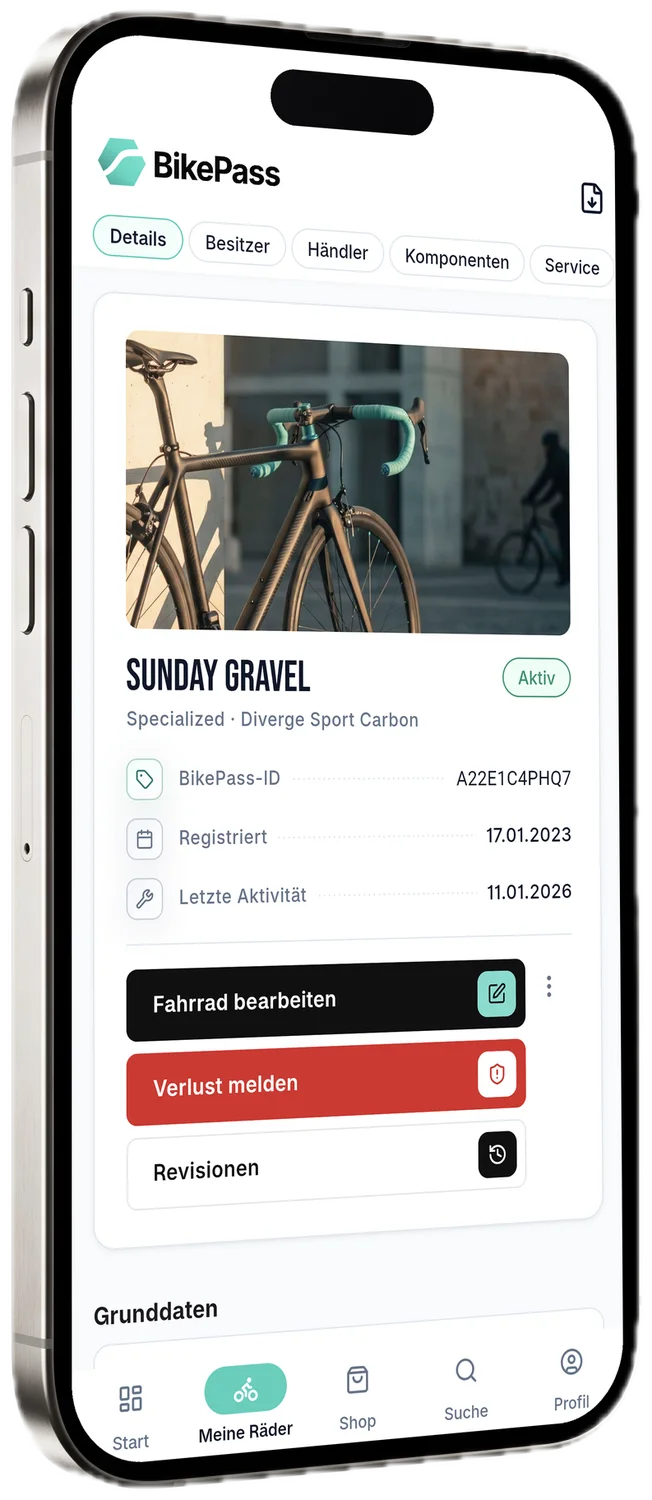
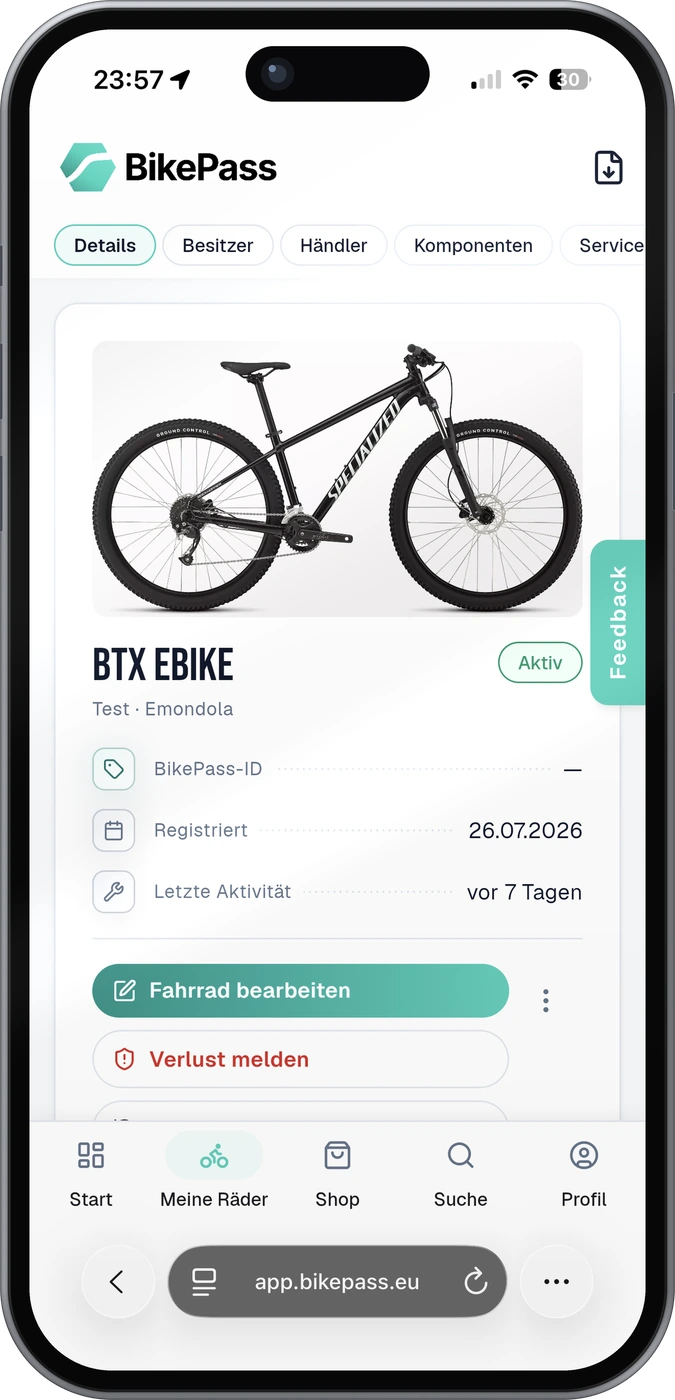
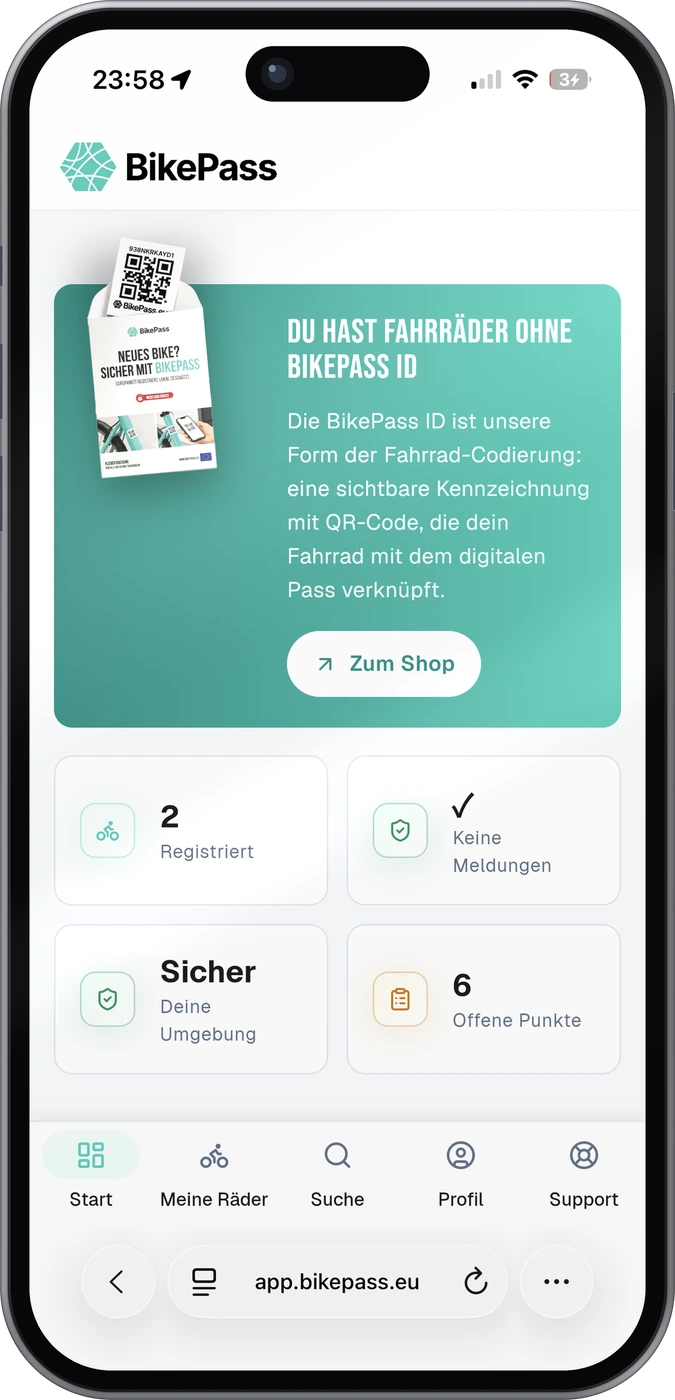
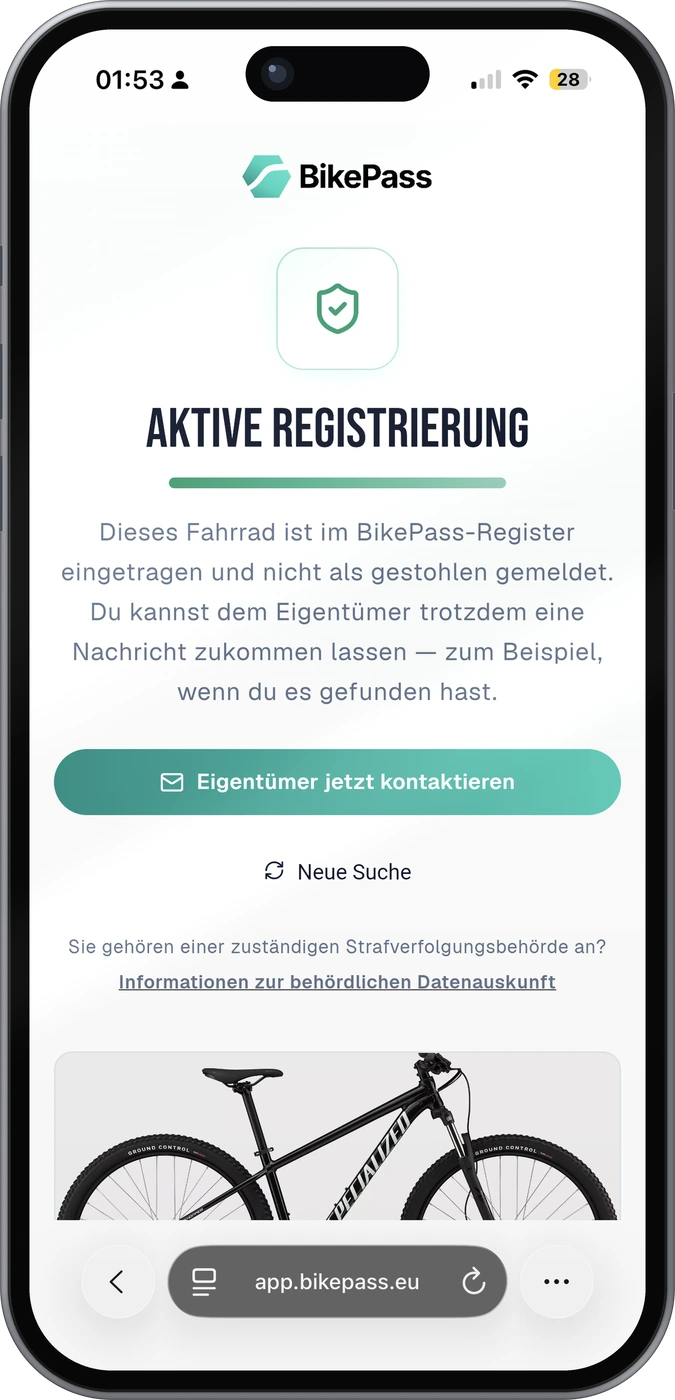
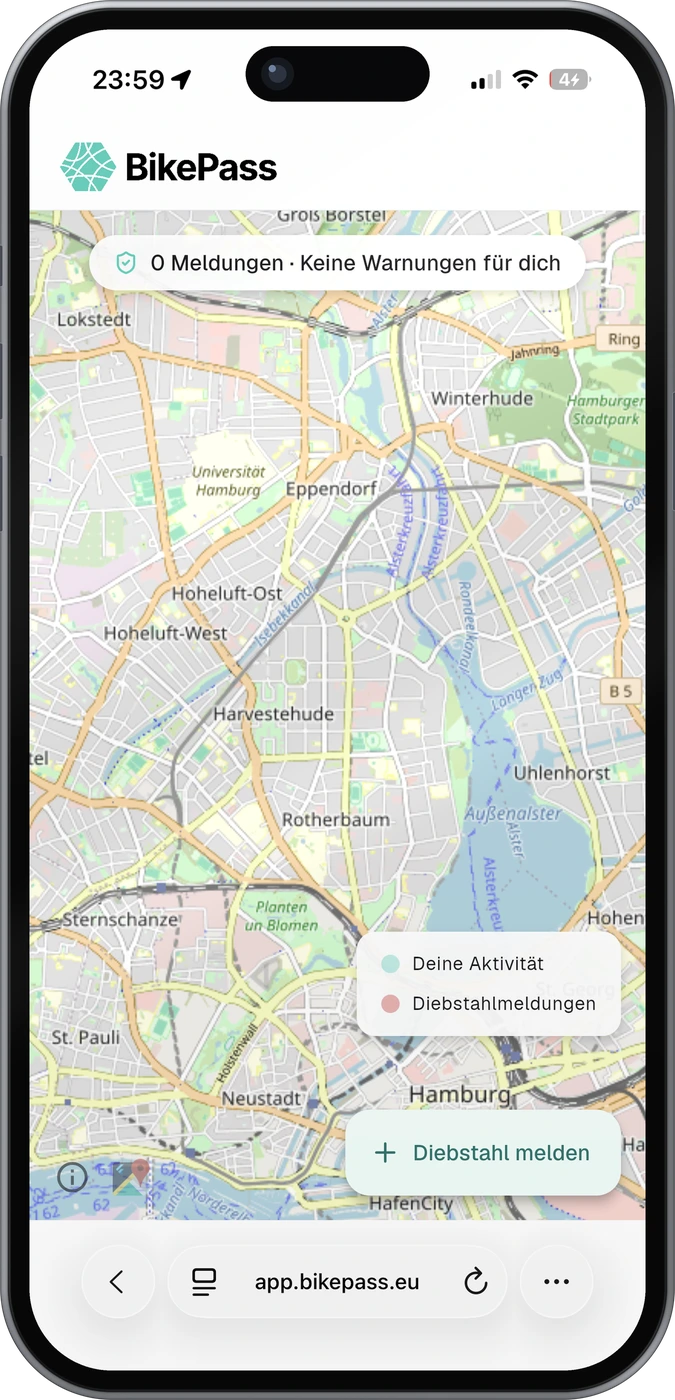
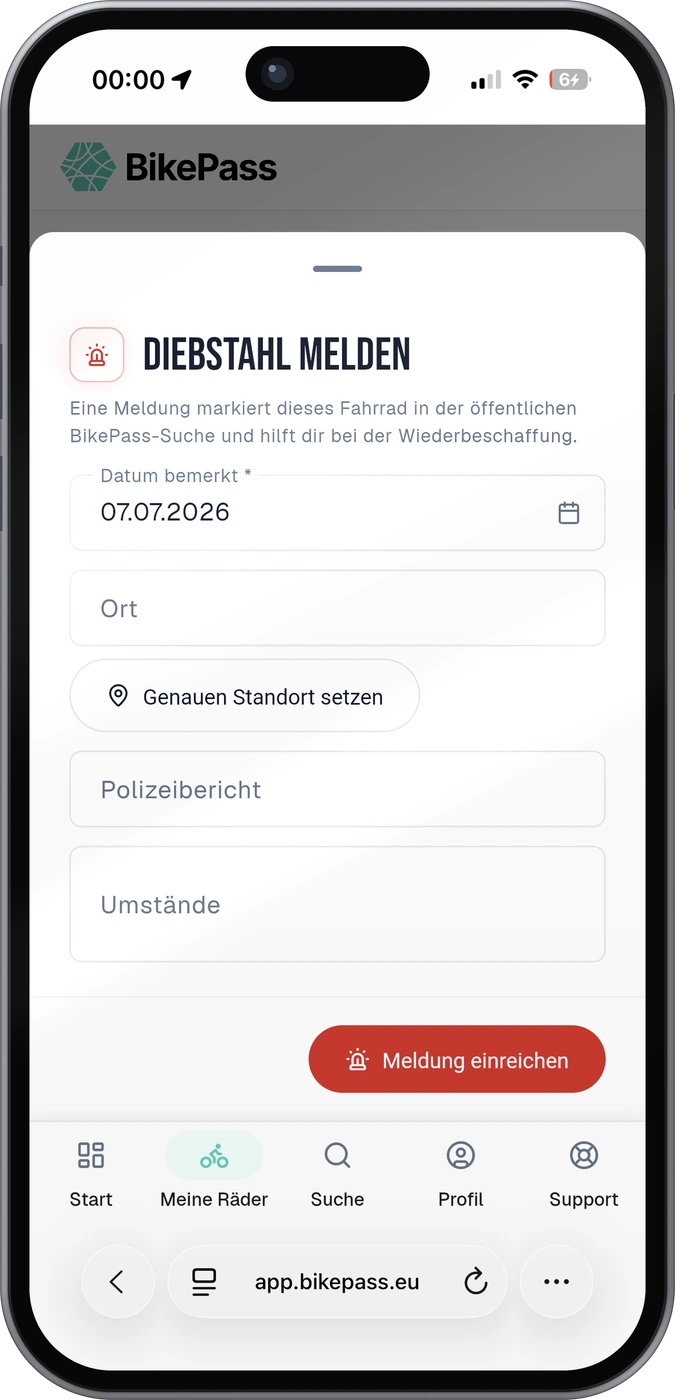
With BikePass you store the frame number, photos and purchase receipts free of charge in a digital bike passport, across the EU and for as many bikes as you like. If you report a bike as stolen, the ID becomes visible to the authorities, and finders can get in touch anonymously. When you sell, you transfer the passport with a few clicks, and you can simply add existing security markings. The guide “Register your bike” explains how the registers differ.
You make it visible with a marking set consisting of a tamper-proof sticker and QR code, which you fit yourself at home, with no appointment and no tools. The hidden stamping becomes a statement on the frame: this bike is assigned.
What remains is the evening in the kitchen, the bike upside down on the towel. In the best case you spend those ten minutes with a cloth and a torch exactly once. Typed out, photographed, stored: after that the number is no longer only under the bottom bracket, but where you can reach it in seconds when it matters.
Your frame number checklist
- Found the frame number, first under the bottom bracket, otherwise on the seat tube, head tube or dropout?
- On an e-bike, also noted the motor number?
- Checked doubtful characters against the receipt, so zero against O and one against I?
- Photographed the number sharply, plus an overall shot and any distinctive features?
- Secured the receipt and compared it with the number on the frame?
- Stored everything digitally so you can access it when you are out and about?
We write about bike theft, security marking and digital theft protection – practical, without scaremongering and with real steps you can take.
See all guides