In short
Check the parking spot first, gather the frame number and your receipts, file a police report and note the reference number, report the loss to your insurer, and then keep searching online and on the ground. If you registered your bike beforehand, you have every document to hand within a minute.
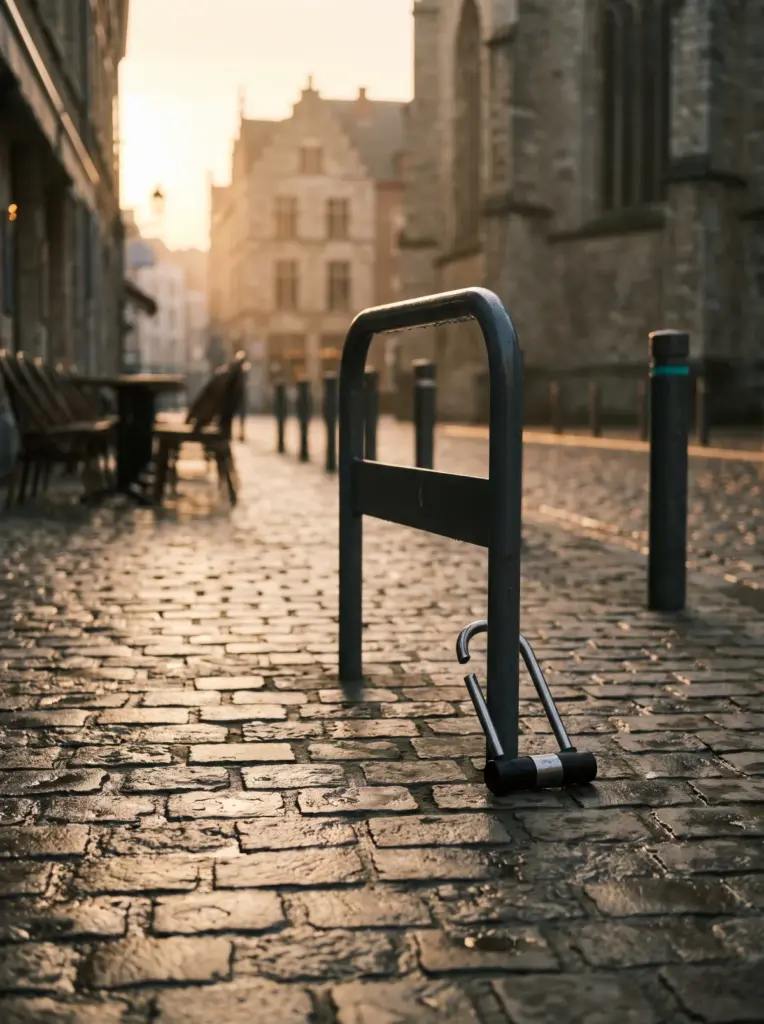
The stand is still there. Your lock lies next to it, cut clean through, as if with scissors. And where your bike stood this morning, there is nothing.
You are not alone with that feeling: in 2025, around 214,000 bicycle thefts were reported in Germany, and roughly one in nine cases was solved (source: German police crime statistics, Polizeiliche Kriminalstatistik 2025). Even so, what happens in the hours afterwards makes a big difference.
First some context, so it is clear what this is about: immediate action after a bicycle theft is a fixed sequence of seven steps that secures your insurance claim, gets your bike onto the police register and later links it clearly to you. It is not a search operation, it is an evidence operation: in a short space of time you gather everything you will need later, if your bike turns up somewhere. It cannot bring your bike back. It makes sure the bike stays yours.
01What do you do in the first few minutes?
Walk around the parking spot and the immediate area before you do anything else. At stations, in courtyards and at events, security staff or caretakers move bikes around, push them closer together or shift them into a side rack. And the neighbour who rolled your bike out of the way is more common than you think.
If the spot stays empty, note two things: exactly where the bike stood and when you last saw it. The police will ask for both. Both blur in your memory faster than you would like, so it is best to type them into your phone straight away.
Also look around for cameras pointing at the spot and for shops that overlook the area. Both belong in the police report if they are there.
Only then is it a theft.
02Which details do you need to hand now?
The frame number, the purchase receipt and photos are the minimum the police and your insurer can work with at all. The frame number is the most important of these: a stamped sequence of characters, usually on the bottom bracket, that distinguishes your bike from millions of identical ones. Without it, a recovered bike is just one blue trekking bike among many. The guide “Finding and checking the frame number” shows exactly where to find it and how to check it.
Not every document does the same job. This overview shows what you need each one for and what happens if it is missing:
| Document | What it does | What it does not do | If it is missing |
|---|---|---|---|
| Frame number | Links your bike clearly to you at the police and the lost property office. | It does not trigger a search, it only makes a match possible. | You can still file a report, but a recovered bike rarely finds its way back to you. |
| Purchase receipt or invoice | Proves ownership and value to your insurer. | It says nothing about the bike’s current condition. | The claim stalls; some providers accept a bank statement or a dealer confirmation, but you cannot rely on that. |
| Photos of your bike | Make the description in the police report and any appeal concrete. | They are no substitute for proof of ownership, anyone can photograph a bike. | You describe it from memory, and exactly the fitted parts that identify your bike get left out. |
| Lock and keys | Show your insurer that the bike was locked up. | They do not help the police with the search. | Many policies reduce or refuse payment; how strictly is set out in your contract. |
Also note the make, model, frame size, colour and anything that stands out: the retrofitted pannier rack, the scratch on the top tube, the basket with the broken strap. Details like these set your bike apart from the standard build.
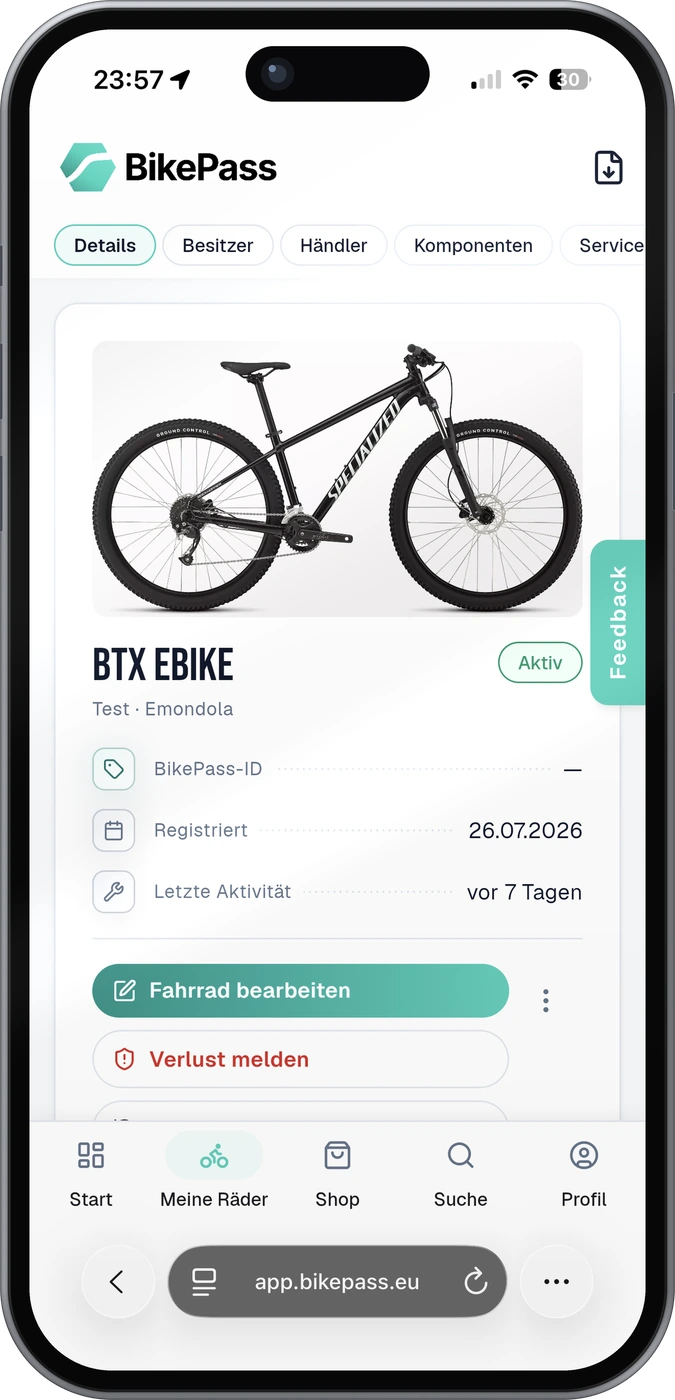
Tip: If your bike is registered with BikePass, the frame number, photos and receipts sit together in your account and can be shared with the police and your insurer. Instead of searching through drawers, you open one page.
03How do you file a police report, online or at the station?
Both routes carry the same weight, and without a report nothing else moves: the police only add your bike to their search records once it is filed, and your insurer will ask for the reference number in practically every case. The legal framing matters too. If a lock was broken open, this is usually an especially serious case of theft (§ 243 StGB), which gives the matter a different seriousness than an unlocked bike simply taken away.
Which route suits you depends above all on how complete your documents are:
| Route | What it can do | What it cannot do | When it makes sense |
|---|---|---|---|
| Your federal state’s online police portal | Available around the clock, you enter the details at your own pace and attach photos or receipts. | Clear up follow-up questions on the spot; the reference number often only arrives later by email. | When your frame number and receipts are together and there are no witnesses. |
| Local police station | Settle questions directly, clear up inconsistencies immediately, usually take the reference number away with you. | It is no substitute for your documents; without details the conversation drags. | When receipts are missing, there are witnesses or there are leads on the offenders. |
For either route, have the frame number, purchase receipt, parking spot and the approximate time of the theft ready. And then the most important thing: write down the reference number as soon as you have it. It is the key to every further step, from your insurer to the lost property office. The full instructions for both routes are in the guide “Reporting a bicycle theft”.
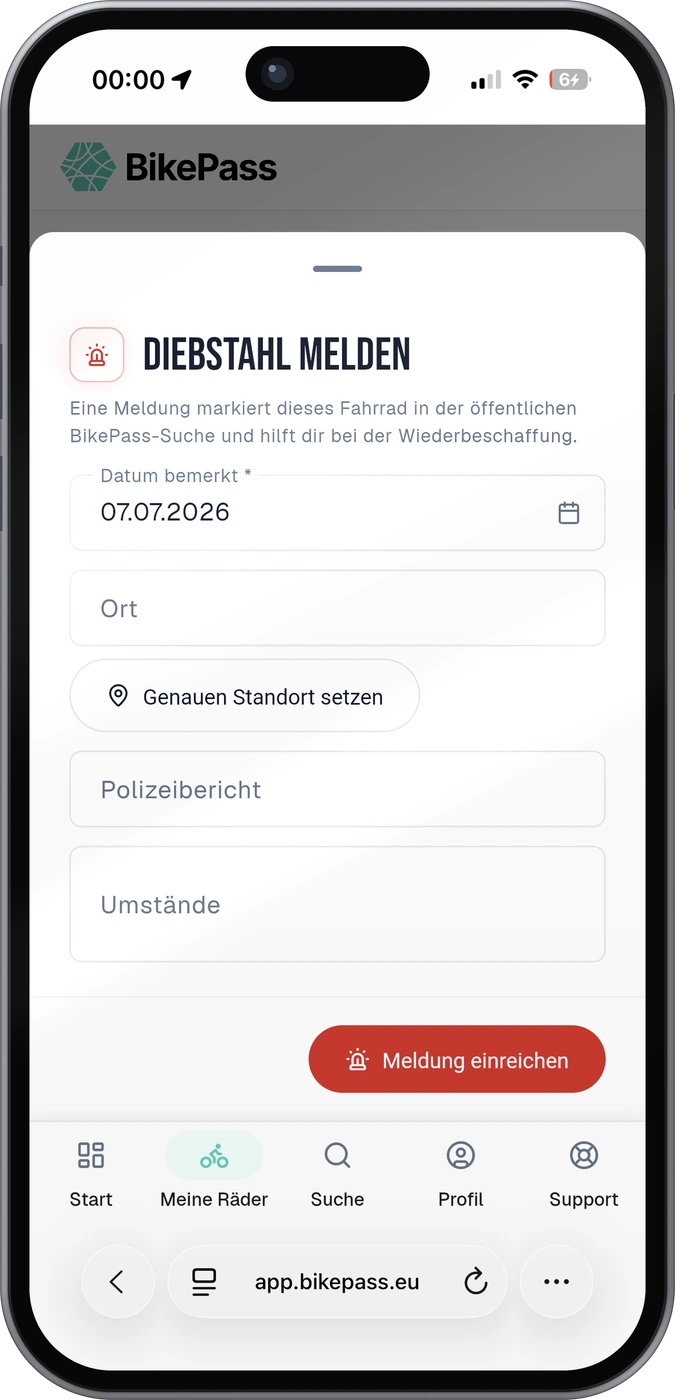
04How do you flag your bike as stolen?
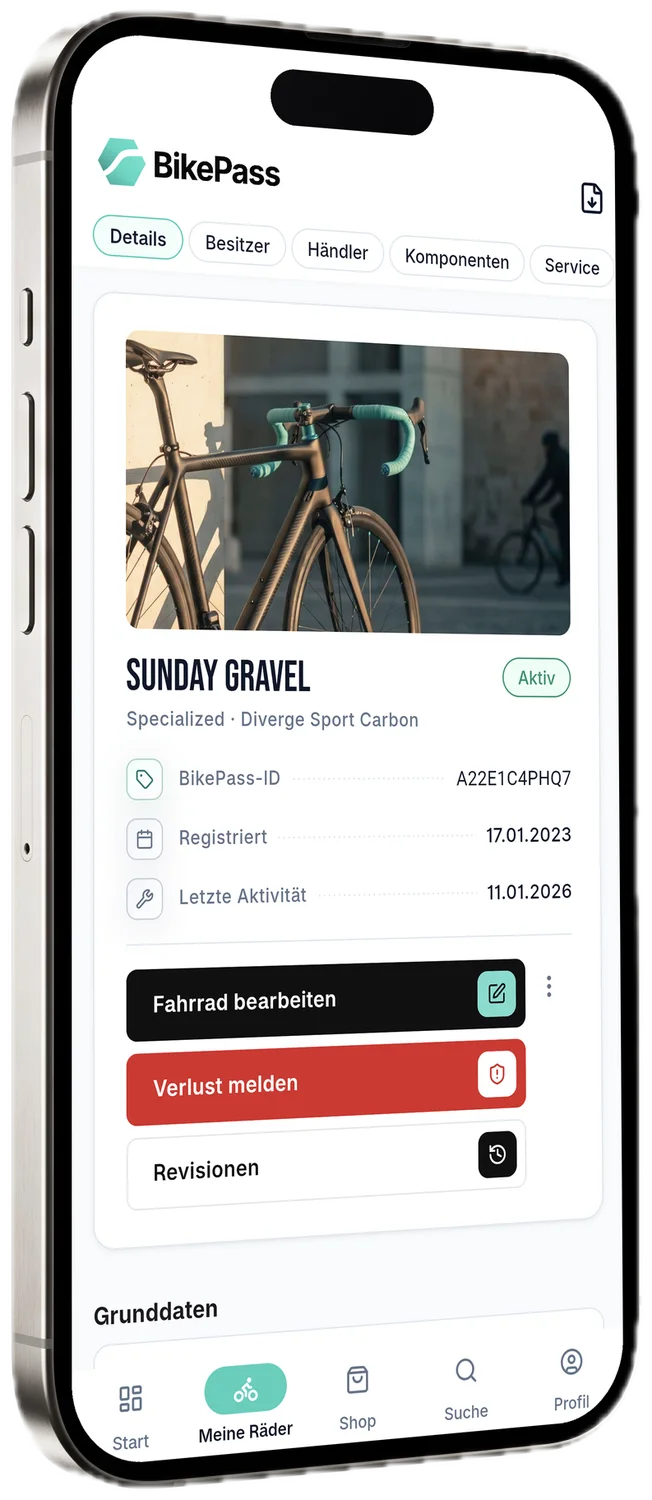
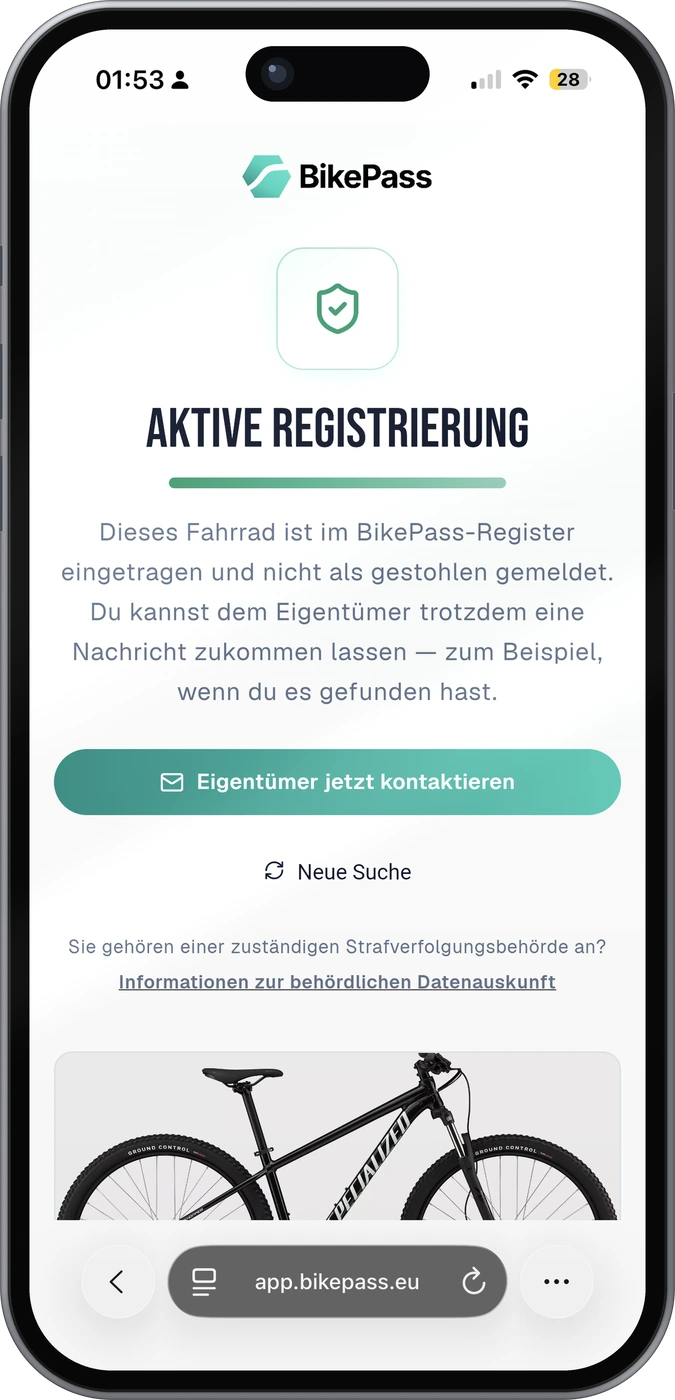
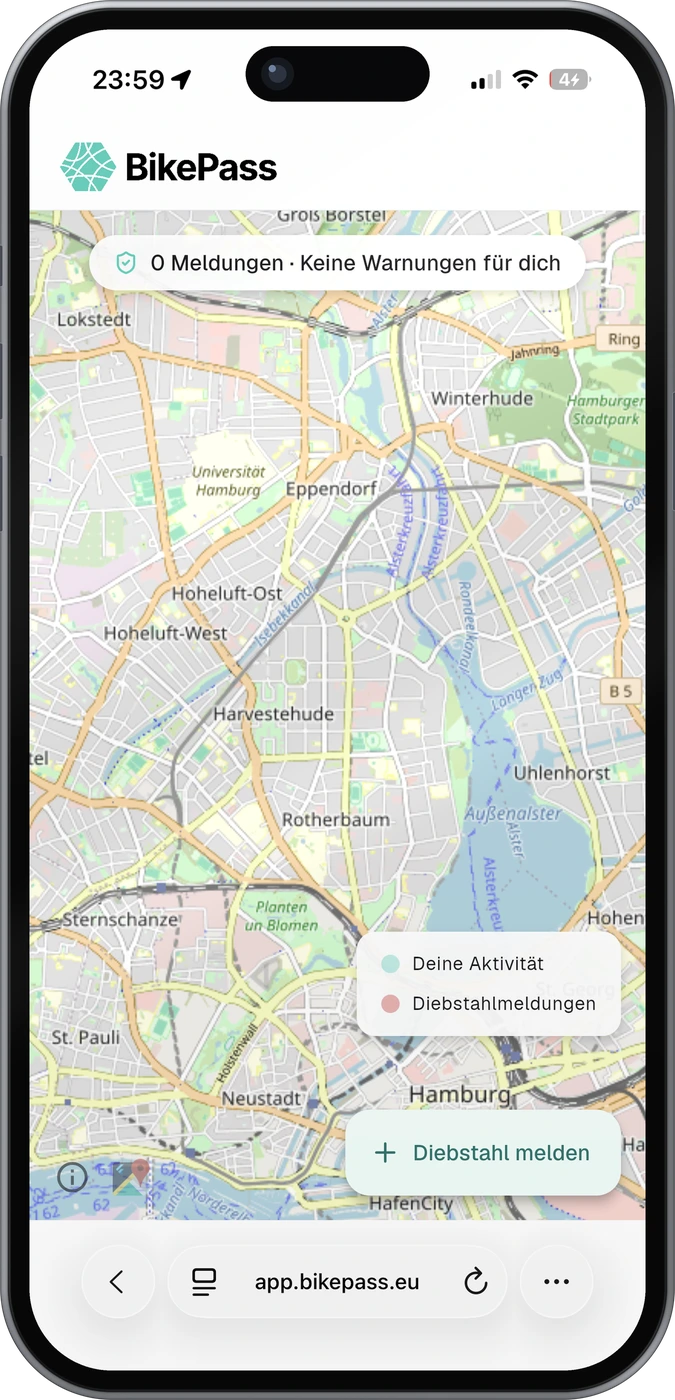
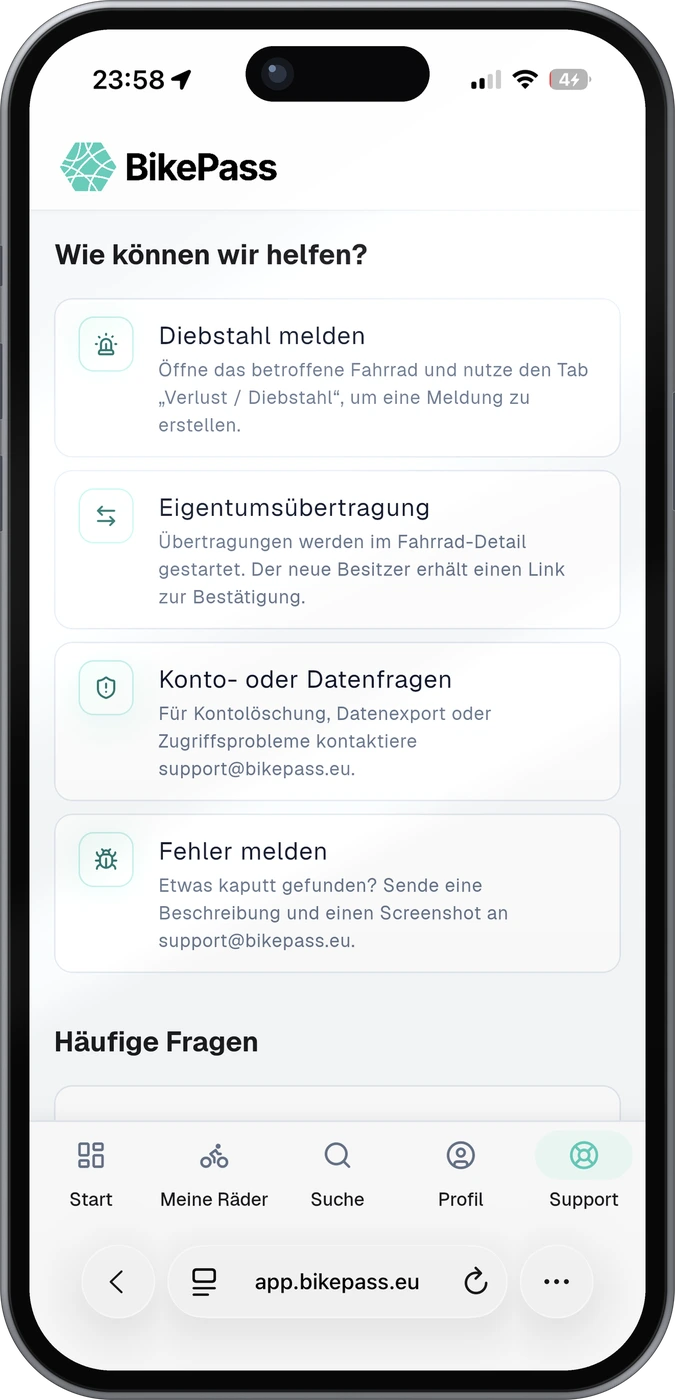
Through your digital bike passport, and right after filing the police report. The thinking behind it is simple: a bike that is demonstrably reported as stolen is harder to sell. In the BikePass web app you report the theft in a few clicks. After that the ID is visible to the authorities, finders can contact you anonymously, and anyone who checks the frame number or the code before buying used sees the stolen status straight away.
This is the point where registration proves a value it never had before. You can read what else a digital bike passport can do on the page about the bike passport app.
Also report the theft to your city’s lost property office and, if your bike is security-marked, to the body that issued the marking. Reporting twice is better than forgetting once here.
05What do you have to report to your insurer, and how quickly?
Report the loss without delay, meaning without culpable hesitation, and submit the crime reference number, purchase receipt and frame number afterwards. Many policies set short deadlines; if you wait for weeks, you risk your claim, even when everything else is in order. A phone call on the same day, followed by a written report, is the safe route.
The insurers' figures show that the effort pays off: in 2025 around 115,000 insured bikes were compensated, with total payouts of about EUR 150 million and an average of EUR 1,270 per bike (source: the German Insurance Association (GDV), 2025).
Whether your home contents insurance covers you or you need separate bicycle insurance depends on your policy. Three levers are common, and you should know them: a night-time clause, which limits cover at night if the bike was not in a locked room; a lock requirement, meaning the condition that the bike was secured to a fixed object; and a compensation limit, which ties the amount to the value of your household contents. The details vary from provider to provider, so there is no way around reading your policy.
Which policy is responsible in the first place is covered in the guide “Bike stolen, which insurance pays?”; when home contents insurance pays and when it does not is explained in the guide “Home contents insurance and bike theft”.
06Where do you keep searching yourself?
Where stolen bikes are sold: on used markets, online and offline. Many bikes resurface weeks later, often a few towns away, because selling at the scene is too risky. So do not search only in your own city.
- Online classifieds and marketplaces: search by make and model, set a wide radius, create saved searches.
- Local flea markets and used bike shops: above all at weekends, often without any listing.
- Lost property office and auctions of found bikes: many councils auction bikes that nobody has collected.
- Local groups on social networks: a photo plus the frame number surprisingly often brings in a tip-off.
How to turn this into a systematic search, with saved searches and a fixed route, is shown in the guide “Finding a stolen bike again”. If your e-bike has gone, a few extra points apply, which you will find in the guide “E-bike stolen”.
If you spot your bike: do not take it back yourself and do not confront the seller. Secure the listing link with a screenshot and call the police, with your crime reference number and proof of ownership. Anyone who takes their bike back on their own initiative ends up in a bad position.
07What protects your next bike better?
A combination of lock, parking spot and provability, because none of these measures covers everything on its own. Once you have sorted this out, you will not have to start from scratch next time. The table shows what each measure really achieves and where it stays blind:
| Measure | What it does | What it does not do | When it counts |
|---|---|---|---|
| A good lock | It costs time and tools, and time is what thieves have least of. | It stops nobody who lifts the bike up and loads it away. | Always. Rule of thumb: budget around 10 % of the bike's value. |
| A deliberate parking spot | Busy, visible places and fixed locking points noticeably reduce the risk. | It is no use if the bike hangs only by its front wheel. | Every day, every time you park. |
| Registration | Bundles the frame number, photos and receipts and makes the bike attributable. | It does not prevent a theft. | After the theft, for the police report, the insurer and a find. |
| Visible security marking | Signals to every buyer that the bike has a documented owner. | It does not help if nobody checks the code. | On resale and during police checks. |
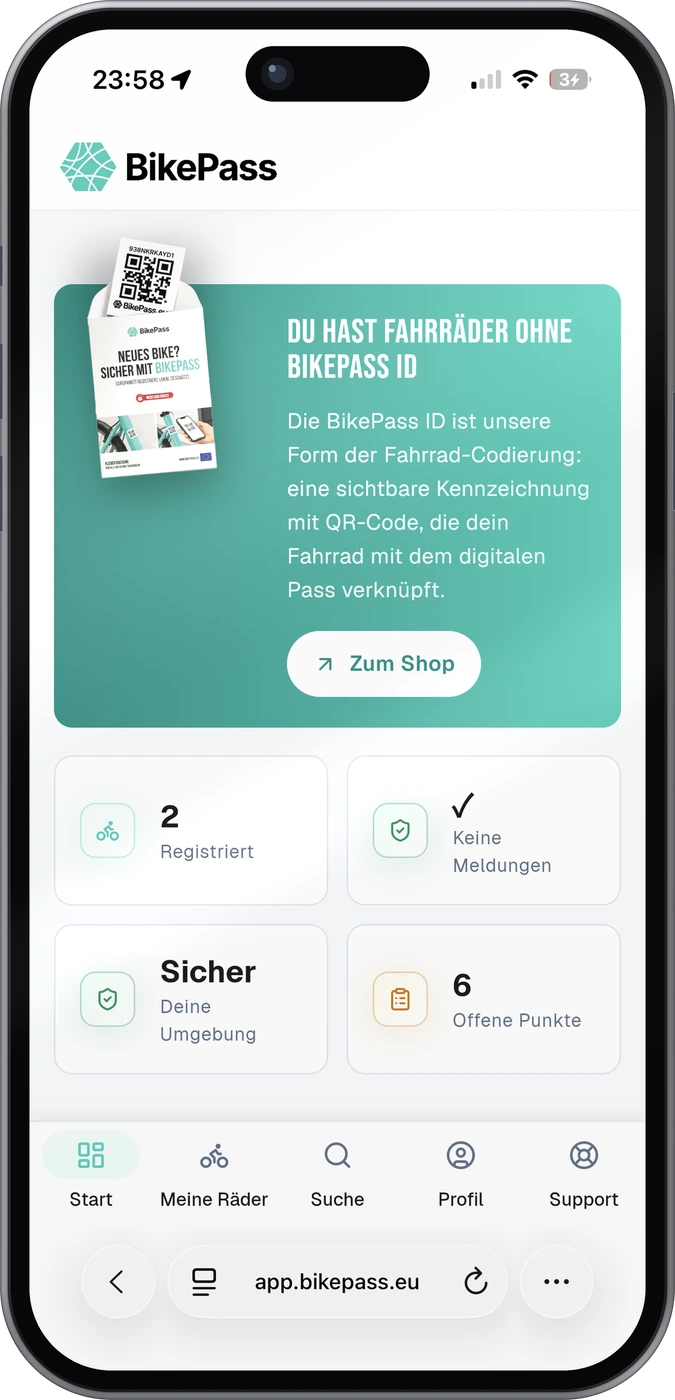
The most common locking mistakes are collected in the guide “Locking your bike properly”. And how security marking works is explained on the page about bike security marking. With BikePass you register your bike free of charge and EU-wide, in under 3 minutes and for as many bikes as you like. If you also want a visible marking, you fit the marking set with its tamper-proof sticker and QR code yourself at home, with no appointment and no tools.
Where does immediate action reach its limits?
Time for the uncomfortable part. These seven steps improve a lot, but they do not conjure up a stolen bike.
The clear-up rate is thin. Around 11 % of reported bike thefts were solved in 2025 (source: the German police crime statistics (PKS) 2025). Filing a police report is still right, but it is not a search request with good odds; it is the basis for everything that follows.
Without proof, a found bike stays put. Bikes are found in cellars, in bushes, during checks. If nobody can say who they belong to, they end up at the lost property office and eventually at auction. That is why the frame number and receipts are the real core of this list.
Insurance does not replace your bike. It replaces an amount, depending on your policy the replacement value or the current value, often with an excess and an upper limit. Your broken-in saddle and the tyres you only just changed are not reflected in that.
Some things quietly lapse. Insurance deadlines, keeping receipts, saved searches that nobody checks any more. Set yourself a reminder so the search does not fall asleep after three days.
What you can influence is your starting position. Everything else is decided elsewhere.
And the cut lock from the beginning? It is still lying there at the end. The difference is whether what follows is an empty folder or a record with the frame number, photos and receipts that shows an officer in thirty seconds who this bike belongs to. That is exactly the part you still have in your hands today.
The immediate-action checklist to tick off
- Walked the parking spot and the surrounding area, noted the location and last sighting
- Gathered the frame number, purchase receipt and photos
- Filed a police report, online or in person, and noted the crime reference number
- Reported the bike as stolen in the bike passport, informed the lost property office
- Notified the insurer without delay, submitted the documents afterwards
- Set up saved searches on classifieds, checked the lost property office and local groups
- For the next bike: a lock matched to the bike's value, a good parking spot, registration, security marking
We write about bike theft, security marking and digital theft protection – practical, without scaremongering and with real steps you can take.
See all guides