
In short
Almost every rejection after a bike theft comes down to one of seven reasons: night-time clause, unsuitable lock or a bike that was not locked to anything, no police report, missing evidence, exceeded value limit, gross negligence, missed deadline. Six of them are decided before your bike is even gone.
The bike rack at the station is empty. Where your bike stood last night, a cut cable lock lies in the gravel. Three weeks later the letter from the insurer arrives, and it contains one sentence that costs more than the theft itself.
Around 214,000 bike thefts were reported in Germany in 2025, and about one in nine cases was solved (source: the German police crime statistics, Polizeiliche Kriminalstatistik 2025). For most victims, the insurer is therefore the only place left to cushion the loss. That makes a rejection hit all the harder. And it is almost never decided by the theft itself, but by small details that were settled long before.
Obliegenheiten, the duties of care in your insurance contract, set out how you secure your bike, how quickly you report a theft and what evidence you provide. They are not obligations your insurer could sue you over, but conditions for payment: break them and you get less or nothing, depending on how serious the breach is. Almost every rejection after a bike theft goes back either to a breached duty of care or to a limit written into the contract. You can read both in advance. That is the good news.
Why does the insurer reject a claim after a bike theft?
Insurers usually reject a bike theft claim for one of seven reasons: the night-time clause, an unsuitable lock or a bike not locked to anything, no police report, no proof of ownership or value, the policy's value limit exceeded, a gross breach of care, and missed reporting deadlines. Payment is the norm, though: in 2025, 115,000 insured bikes were compensated, at an average of 1,270 € per bike (source: GDV, the German Insurance Association, 2025). Rejection is the exception, but one that has almost always prepared itself.
The overview below shows what the claims handler pins each trap on, and what protects you. Read it once with your own daily routine in mind: where do you leave your bike at night, what documents do you have, how do you lock it?
| Trap | What the insurer pins it on | What saves you | When you need to act |
|---|---|---|---|
| Night-time clause | The time of the offence in the police report falls in the night window and the bike was outside. | Bike kept in the flat, cellar or garage overnight. | Every night, starting today. |
| Lock | Lock type, condition or the way it was secured does not match the terms. | A lock that meets the contract terms, bike locked to a fixed object. | When you buy the lock, then every time you park. |
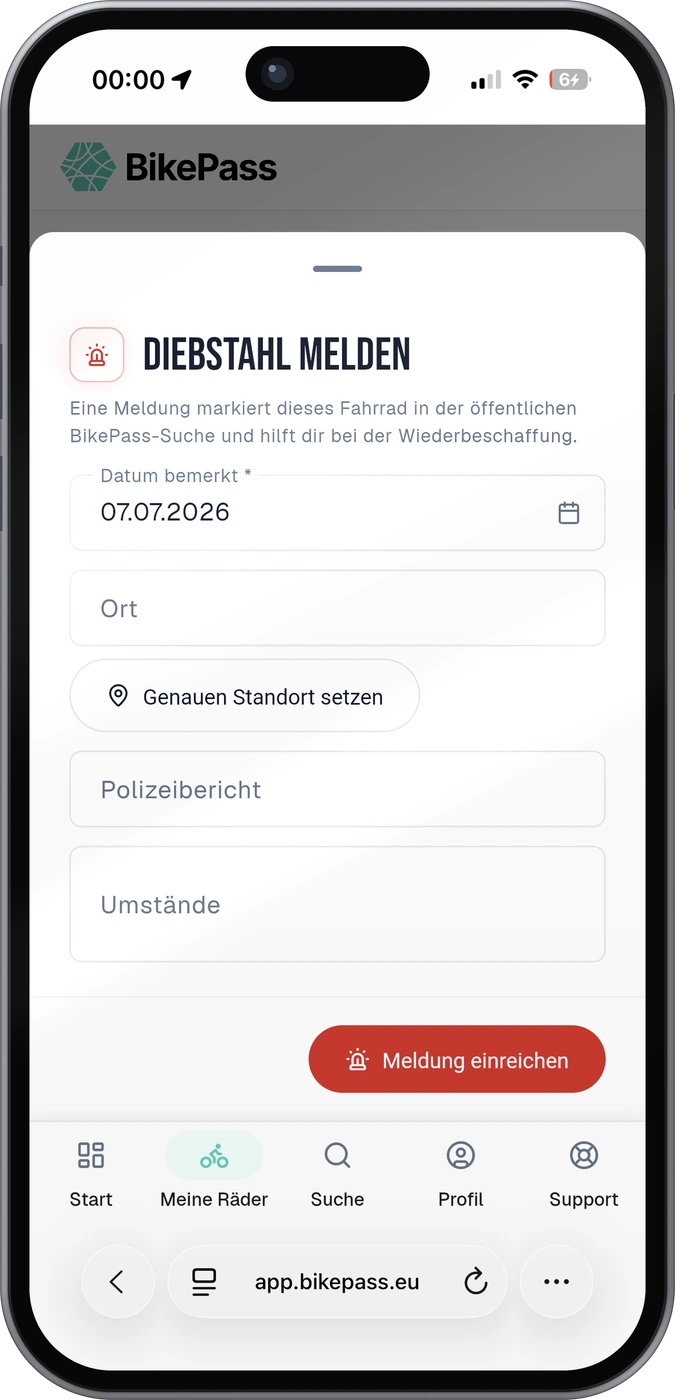
| No police report | No case reference, no time of offence, no frame number filed with the police. | Report immediately, with frame number and case reference. | On the day of the theft. |
| Missing evidence | Ownership and value cannot be proven. | Frame number, receipt and photos, stored securely. | While the bike is still there. |
| Value limit | The bike's value exceeds the policy's bicycle limit. | Work out the limit, top up the clause or take out a separate policy. | When you buy the bike, at the latest when reviewing the contract. |
| Gross negligence | Bike left unlocked, key in the lock, security obviously inadequate. | Always lock up, even for “just a minute”. | At every stop. |
| Deadlines | The report to the police or the insurer came late. | Do both on the same day, submit evidence afterwards. | Immediately after the theft. |
Six of the seven rows play out before anyone touches your lock. Only one is decided afterwards.
01When does the night-time clause apply?
The night-time clause applies when your bike was outside at night and was not demonstrably in use. Many home contents policies, especially older ones, limit theft protection during the night hours: the usual window is between 22:00 and 06:00, and the exact time is in your terms. If you leave your bike at the kerbside overnight, you often get nothing within that window, whatever lock you used.
The catch lies in the time of the offence. A theft is usually only noticed in the morning, and you then give the police a period rather than a point in time. If that period reaches into the night window, the insurer looks closely right there.
How to avoid it: search your policy terms for the word “Nachtzeit” (night-time) and check the stated hours. If the clause applies to you, the bike belongs in the flat, the cellar or the garage at night. Our guide “Home contents insurance and bike theft” explains how the bicycle clause is structured overall.
02Which lock does your policy actually require?
Most policies require the bike to have been secured with its own lock, and some also require a particular lock type or minimum quality. If the bike was only locked but not locked to something, exactly the point the insurer checks is missing. A cut cable lock on the ground is not proof of a break-in at that moment, but an argument against you.
The difference between locking the bike and locking it to something sounds like hair-splitting, and in a dispute it is the whole case. Locked means: the bike cannot be ridden away. Locked to something means: the bike cannot be carried away.
How to avoid it: read the lock clause in your terms before you buy your next lock. As a rule of thumb, spend around 10 % of the bike's value on the lock. And always lock the bike to a fixed object, not just to itself. If a lock is forced in the process, this usually counts as a particularly serious case of theft (Section 243 of the German Criminal Code, StGB), which supports your position. Our guide “How to lock your bike properly” shows the technique.
03What happens without a police report?
No insurer will settle a bike theft without a police report. The case reference is the evidence that the loss happened at all, and it is a condition in practically every policy. The fact that the police solve only around 11 % of reported cases (source: the German police crime statistics, Polizeiliche Kriminalstatistik 2025) makes no difference: what is required is the report, not the result.
This is exactly where many victims give up. The bike is gone, the chance of getting it back feels small, and a trip to the police station seems pointless. That ends the insurance claim on the same day.
How to avoid it: report the theft immediately, online or at the station, and give the frame number. Ask for the case reference and include it with your claim. Our guide “Reporting a bike theft” describes the process step by step.
04What happens if the frame number and receipt are missing?
Without proof of ownership and proof of value, the payout is reduced or refused, because the insurer can check neither who owned the bike nor what it was worth. The frame number, the receipt and photos are the three pieces of evidence the claim form asks for. After a theft they are hard to obtain: the till receipt has faded, the frame number was only on the bike, and photos usually exist only by chance in a holiday album.
Each piece of evidence does something different. If you know that, you collect more precisely rather than just more:
| Evidence | What it proves | What it does not prove | When to get it |
|---|---|---|---|
| Frame number | The bike’s identity, matching it up if it is found. | Neither ownership nor value. | Photograph it right after buying. |
| Receipt | Ownership, purchase date and the value at the time of purchase. | Not the current condition or accessories. | At purchase, save it digitally straight away. |
| Photos | Condition, specification, add-on parts, recognisable features. | Not ownership, anyone can take photos. | While the bike is still there. |
| Security marking or registration | A clear link between bike and owner. | It does not prevent a theft. | Before you park it for the first time. |
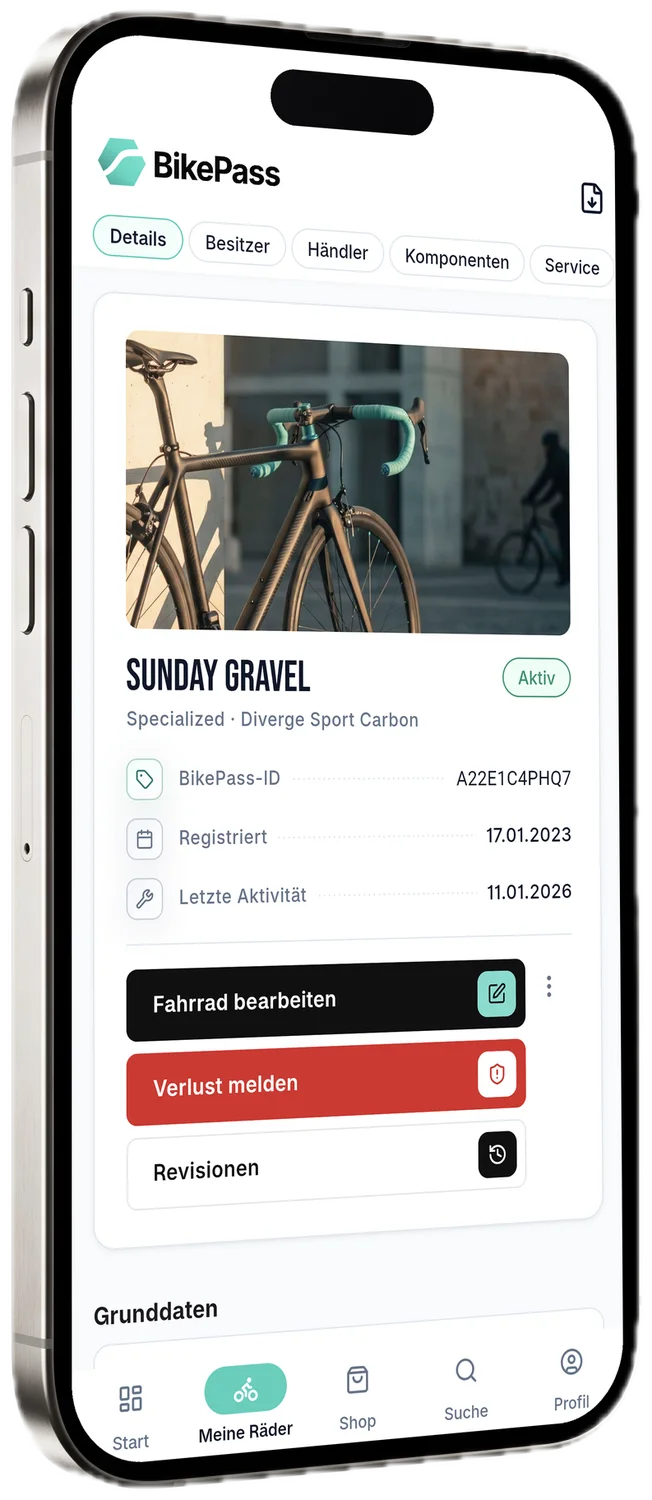
How to avoid it: Secure all four points while the bike is still in your hallway. Where to find the number on the frame is shown in “Find and check your frame number”. With BikePass you store your frame number, receipts and photos free of charge, bundled as digital proof of ownership, and share it directly with the police and your insurer if the worst happens.
Tip: Photograph your bike from both sides, plus the cockpit and the frame number, ideally on the day you buy it. Ten minutes of effort that cut short every discussion about evidence when you make a claim.
05How far does your policy’s value limit go?
The bicycle clause in home contents insurance is almost always capped, usually at a share of the sum insured. If your bike is worth more than that, you only get part of it replaced, even if you have met every contract term. That share varies considerably between providers and contract generations, so the only thing that helps is a look at your own terms.
This trap closes quietly. It never shows up as a refusal, but as an amount on the settlement that is less than a replacement bike costs. It hits e-bikes and cargo bikes particularly often, because their purchase price long ago overtook the old contents sum while the contract carried on unchanged.
How to avoid it: Work out the limit from your sum insured and compare it with the current replacement value of your bike. If it is not enough, there are two routes: increase the bicycle clause or take out standalone bicycle insurance. Which cost factors matter is set out in our guide “Bicycle insurance: costs”, and which policy is responsible in the first place is explained in “Bike stolen: which insurance pays?”.
06When does your insurer accuse you of gross negligence?
Gross negligence means you ignored a level of care that is obvious to everyone. With bikes it is always the same situations. The bike stood unlocked outside the bakery, the key was left in the frame lock, the battery lock on the e-bike was open, or the lock was so flimsy that it was more decoration than security. The insurer may then reduce the payout, and in serious cases refuse it entirely.
What is assessed is not your bad luck but your behaviour compared with an averagely careful cyclist. So the dispute is rarely about the thief and almost always about the two minutes for which you wanted to leave the bike standing.
How to avoid it: Lock your bike and secure it to something fixed at every stop, even for “just a minute” and even in your own yard. Additional measures such as security marking or registration are no substitute, but they show that you protect your bike seriously. You will find an overview of the measures on our page about theft prevention for bikes.
07Which deadlines must you meet after a theft?
Almost all policies require you to report the theft without delay, both to the police and to the insurer. “Without delay” is a legal term and means without culpable hesitation, not “sometime this week”. If you wait, you risk the delay being treated as a breach of your duties, which reduces the payout.
A typical mistake: gather all the documents first, then report it. The right way round is exactly the opposite. Report first, submit evidence afterwards.
How to avoid it: File the police report and the insurance claim on the same day, note the time and the person you spoke to, and follow up in writing so you can prove it. The exact deadline is in your contract terms. What else counts in the first few hours is covered in “Bike stolen: what to do?”.
Where does even the best preparation stop helping?
Even a perfectly prepared claim can turn out smaller than you expect. Three points that insurance websites rarely mention.
Current value. Many tariffs do not replace the new price but the value of the bike on the day of the theft. Whether new-for-old or current value applies is stated in your terms and varies by provider, so check it before your next bike purchase.
The excess. Where one is agreed, it comes off the amount. With an inexpensive everyday bike, little may be left.
The burden of proof. The insurer has to prove you breached a duty, but you have to prove that the bike was yours at all and what it was worth. That is exactly where most cases fail, not because of the contract but because of a drawer with no receipt in it.
And one limit remains even with a perfect file: money does not replace a bike. A registered and security-marked bike can be returned to you by the police; one that is only insured is paid out. In the end, the difference is your bike.
The letter from the start does not have to end that way. In almost every case its content is decided months earlier: by a clause you read once, by a lock that goes around a fixed object, and by a frame number that is not only on the bike.
Your checklist against refusal
- Have you checked your contract for a night-time clause and the time it states?
- Does the lock meet the contract requirements, and is the bike always secured to something fixed, not just locked?
- Have you filed a police report including the case reference number?
- Are your frame number, receipt and photos stored digitally and shareable?
- Have you compared your policy’s value limit with your bike’s replacement value?
- Have you never left the bike unlocked and never left the key in it?
- Did you report the theft to the police and your insurer on the same day?
We write about bike theft, security marking and digital theft protection – practical, without scaremongering and with real steps you can take.
See all guides