
In short
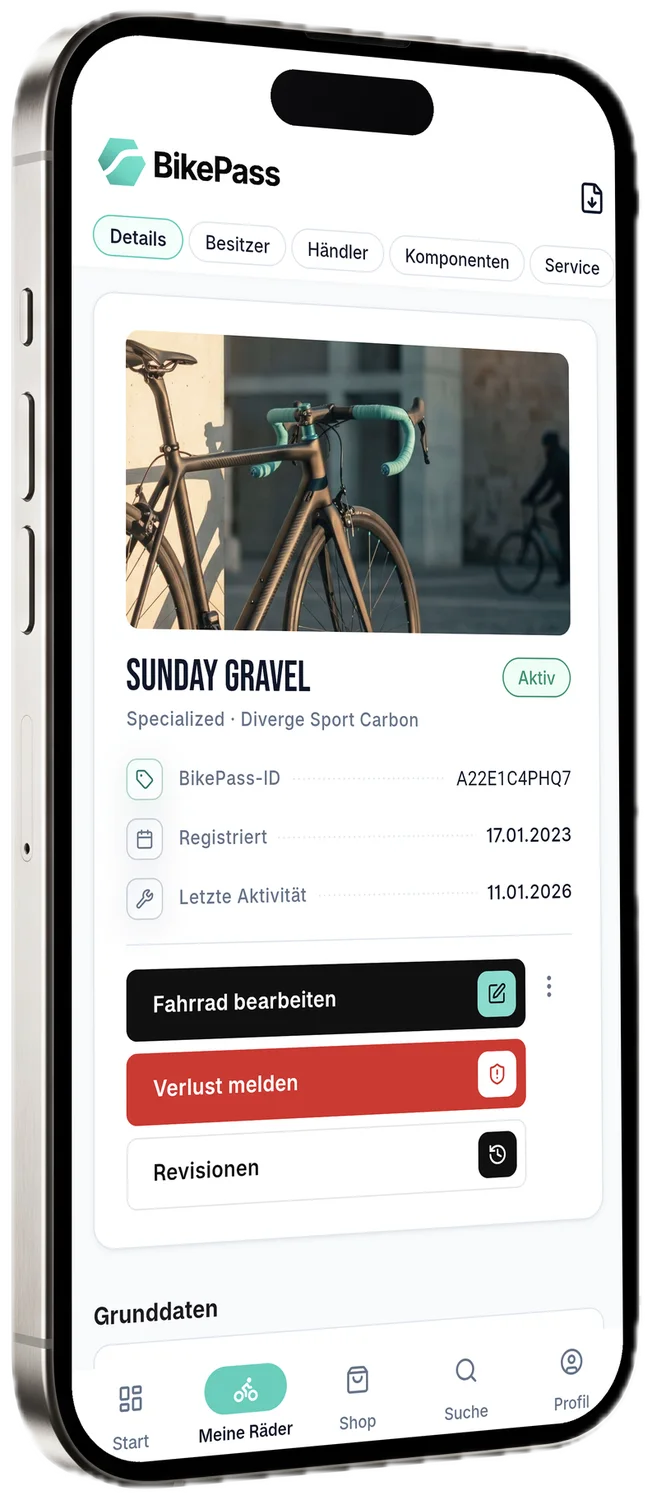
There is no nationwide police register in which you can enter your bike as a precaution. Some police forces register bikes regionally, the police bike passport app has been discontinued, and otherwise your frame number only enters the system when you file a report. It is best to register your bike online first, for example free of charge with BikePass, and additionally with the police where they offer it. You export the bike passport from BikePass as a PDF and take it with you to the registration.
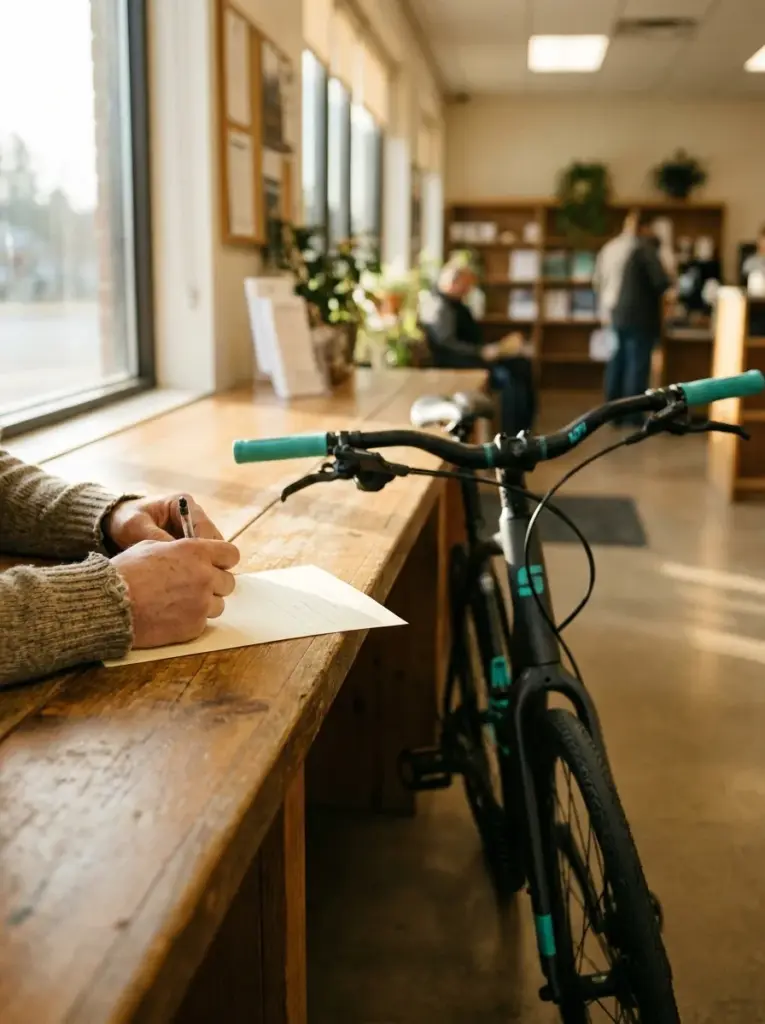
A Saturday morning, a police station, you are standing at the counter asking whether you can have your new bike registered here. The officer thinks for a moment, pulls a leaflet from the rack and says: “There is a bike passport in here, you are best off filling it in at home.” You go home with a piece of paper and the feeling that this was somehow not the answer.
But it was, at least in most places in Germany. The question of whether you can register your bike with the police has no nationwide answer, only a regional one. In some federal states the police offer registration, in many others they do not. What is the same everywhere is the moment when the police really need your frame number.
So that we are talking about the same thing, a quick word on the term. A police bike registration is a regional service offered by individual police forces that records your bike’s data in a database, assigns a number and makes it visible on the frame with a sticker. It is neither a police report nor security marking. A report registers a bike as stolen, security marking engraves or sticks a code onto the frame, registration creates a record as a precaution. It is not compulsory, because unlike with cars there is no registration requirement for bicycles.
Can you have your bike registered with the police?
Yes, but only where the local police offer it, and that is far from everywhere. In its leaflet “Räder richtig sichern”, the German police crime prevention service (Polizeiliche Kriminalprävention) writes that the police offer bike registration “in some federal states”, in part also online. There is no central office for the whole of Germany.
Where the service exists, your bike’s data goes into a database and receives a number, which is attached to the bike as a sticker. If the police find the bike after a theft, it can quickly be matched to you.
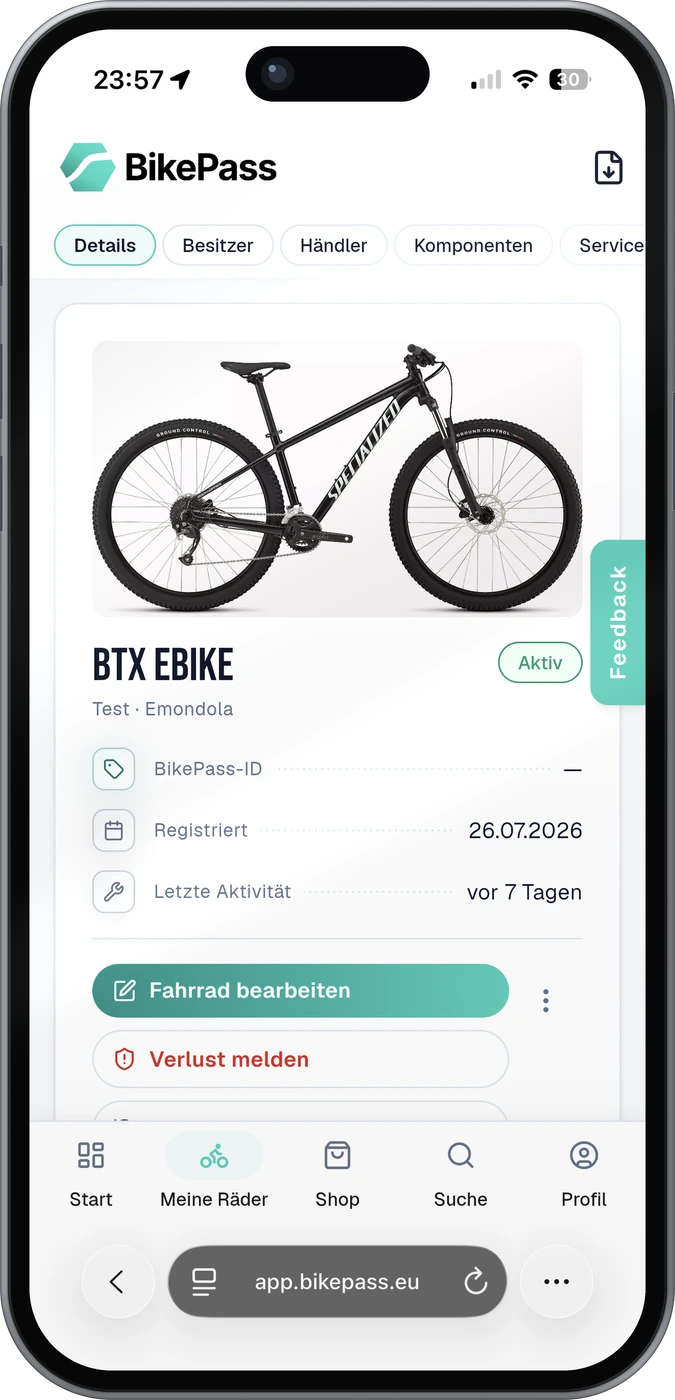
As a rule you need to bring an identity card or passport, proof of ownership, the bicycle itself and the bike data, for example the completed bike passport. If you have set your bike up with BikePass, you export the bike passport as a PDF with one tap, including photo, frame number, security marking, purchase date and, for an e-bike, the details of the motor and battery. From that you transfer the details into the police form, without having to hunt for numbers on the bike. You can find out whether the service exists in your area from the (criminal) police advice centre near you.
So the honest answer is that it depends on where you live. Our recommendation does not. Register your bike online first and, where possible, with the police as well. Why the two complement each other is explained further below.
What happened to the police bike passport app?
The police bike passport app no longer exists. According to polizei-beratung.de it has been discontinued for iPhone and Android, is no longer available, and an update is currently not planned.
What remains is paper. The police bike passport is included as a tear-out page in the free leaflet “Räder richtig sichern”. It is available at the (criminal) police advice centres or as a download. In it you note the frame number, security marking, name and address, plus a photo of the bike.
One sentence in the leaflet is often overlooked. The bike passport is not sufficient as proof of ownership, for that you need the purchase receipt. The passport helps with describing, the receipt with proving. The two belong together.
This is exactly where the app left a gap. The passport is in a folder, the receipt in a drawer and the photos on your phone. Our guide “Filling in your bike passport” shows you how to complete the passport in full. If you want everything in one place, use a digital bike passport app that stores the frame number, photos and receipts together.
What do the police store about your bike, and when?
Without a police report and without regional registration, the police generally store nothing at all about your bike. That only changes when you give them data.
The most important of these moments is the theft report. The police then record the frame number and circulate the bike as wanted. If it turns up later, it is matched using the number. Without a number there is nothing to search for.
The table shows which situation leaves what with the police. Pay attention to the right-hand column, because that is where it is decided whether a found bike makes its way back to you.
| Situation | What the police record | What they do not record |
|---|---|---|
| You have done nothing | Nothing. Your bike is unknown to the police. | Neither frame number nor owner. A found bike stays anonymous. |
| Regional registration | Bike and owner data in a database, number on the frame as a sticker. | Only applies within the area of the registering authority. No nationwide matching guaranteed. |
| Security marking at an event | A code on the frame that points to your encrypted home address. | No record in a police register. The code is on the bike, not in a file. |
| Theft report | Frame number, description and file reference, the bike is circulated as wanted. | A bike whose frame number you cannot provide. It lacks the search feature. |
The order is the point. The police do not register as a precaution, they search afterwards, and they search for what you give them when you file the report. Whatever you did not note down beforehand is then missing.
Tip: Not every number on the frame is a frame number. On bikes from mail-order and department store retail in particular, you sometimes find order or article numbers that are not assigned individually and, according to the police, are unsuitable for property tracing.
Where do the police offer regional bike registration?
There is no complete list of police authorities that register bikes, and the schemes change. Two examples show how different they can be.
Bremen. The Bremen police register bikes free of charge. Details of the bike and the owner go into a database, and the bike gets a sticker with an individual number that is hard to remove. You can fill in the registration form in advance; the Bremen police list dates and locations on their website. You need to bring ID, proof of ownership and the bike.
Kreis Gütersloh. The district police authority in Gütersloh offers its own bike registration form, with mandatory fields for make, model, frame number and colour. You hand it in at a police station or fill it in online and send it by email. Other police authorities in Nordrhein-Westfalen also work with such forms for bike marking.
You can only find out how things stand in your city locally. Search for “Fahrradregistrierung” together with the name of your police authority, or ask at the (criminal) police advice centre. There is no nationwide portal.
Why register online and with the police?
Because the two registers close different gaps. Registering with the police records your bike where people look first after a bike is found. But it only applies within that authority’s area, it costs you an appointment, and it stores neither photos nor receipts that you can call up yourself at any time.
An online register like BikePass works everywhere in Germany and beyond, with no appointment. You have the frame number, photos and purchase receipt on your phone at all times, and anyone who checks the BikePass ID or the frame number sees immediately whether the bike is reported stolen. By contrast, there is no police register that dealers or used-bike buyers could look into.
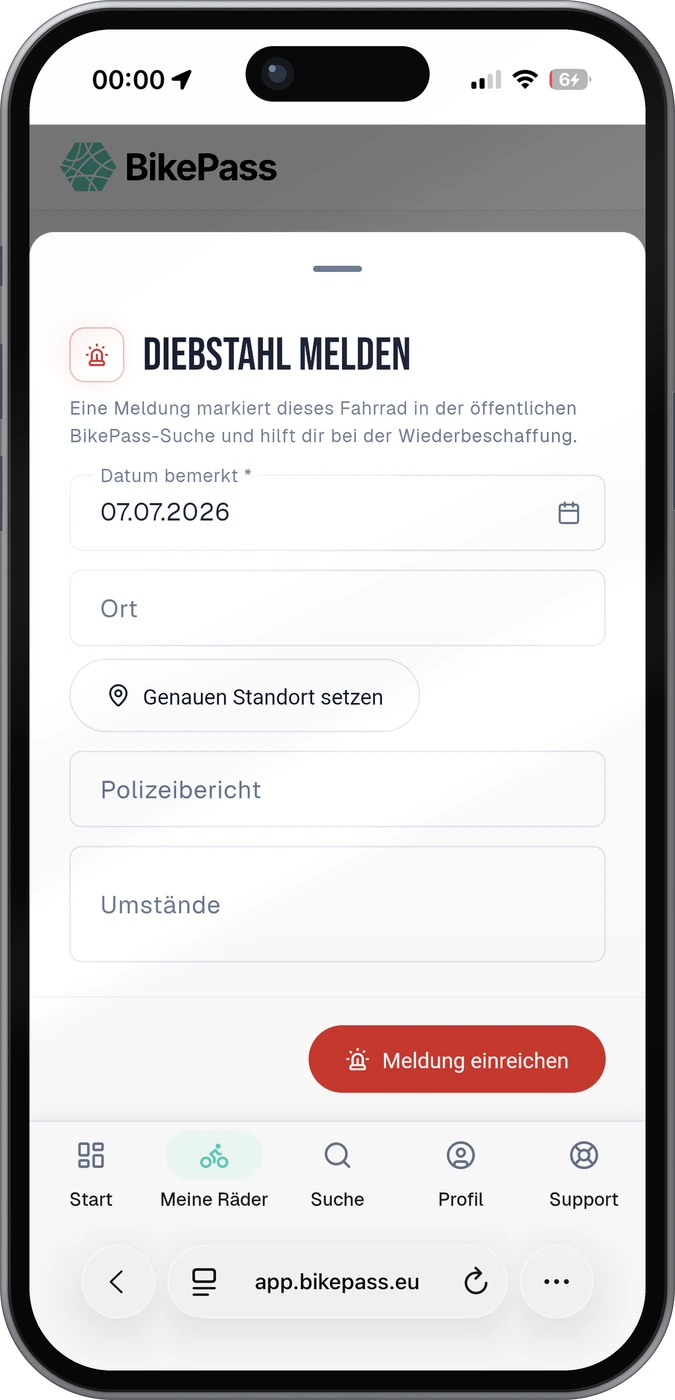
The order is simple. First you add your bike to BikePass, which takes a few minutes. If your police force offers registration, you export the bike passport as a PDF and take it to the appointment along with your ID, purchase receipt and the bike. You then add the registration number you receive there to BikePass. That way all your numbers sit in one place.
Security marking with the police or registering: what is the difference?
Security marking means attaching a code permanently to the frame; registering means storing your bike’s details in a database. Each solves a different problem. According to the police, marking events are run by the ADFC, insurers, clubs and in some cases the police themselves. Our guide “Getting your bike security-marked” explains how that works in detail.
What matters most in the comparison is where your data sits when you need it. The table puts the options side by side.
| Option | What it can do | What it cannot do | When it makes sense |
|---|---|---|---|
| Police registration (regional) | Records bike and owner with the police, sticker on the frame. | Only available in some regions, usually with an appointment in person. | In addition to online registration, if your police force offers it. You bring the details as a PDF from BikePass. |
| Marking at an event | Visible code on the frame, deters thieves and leads to your address. | Stores no photos or receipts. After a move, the code no longer matches your address. | As a permanent marking, combined with a record of ownership. |
| Paper bike passport from the police | Records frame number, marking and photo free of charge. | Sits at home, cannot be shared and is not proof of ownership on its own. | As a second copy, together with the purchase receipt. |
| Digital bike register | Brings together frame number, photos and receipts, shareable with police and insurer. | Replaces neither a police report nor a lock. | Always, as the basis for every other option and everywhere there is no police scheme. |
No single row covers everything. The strongest combination is a visible code on the bike, a complete record in an online register and, where offered, registration with the police. Our guide “Register your bike” compares the types of register available outside the police.
What else counts with an e-bike?
You register an e-bike with the police in exactly the same way as a normal bike, that is wherever a regional scheme exists, plus online. There is no separate police registration for pedelecs. Fast S-pedelecs do need an insurance plate, but that is an insurance matter, not a theft register.
The difference lies in the data. An e-bike carries further serial numbers, for example on the battery and the motor. The battery in particular is in demand. The police advise taking it with you when you park, or securing it separately, because the built-in battery locks are not enough as theft protection. So note down these numbers too, before anything happens. Our page on e-bike theft protection shows how lock, marking and proof work together on an e-bike.
More value, more numbers. More reason to take precautions.
How do you register your bike yourself in a few minutes?
Whether your police force registers bikes or not, the first step is your own record in a digital register such as BikePass. It is free, takes under 3 minutes and works as a web app on any device, and as an app on the iPhone. It takes five steps.
Copy down the frame number. It usually sits under the bottom bracket, on the seat tube or on the head tube. Photograph it at the same time.
Take photos. The whole bike from both sides, plus stickers, scratches and modifications.
Upload receipts. Purchase receipt or invoice, and for an e-bike the documents for the battery and motor too.
Add any existing marking. If your bike has already been security-marked at a police or ADFC event, record that code as well.
Export a PDF for the police. If your police force offers registration, export the bike passport as a PDF and take it with you. Afterwards, add the number you receive there to BikePass.
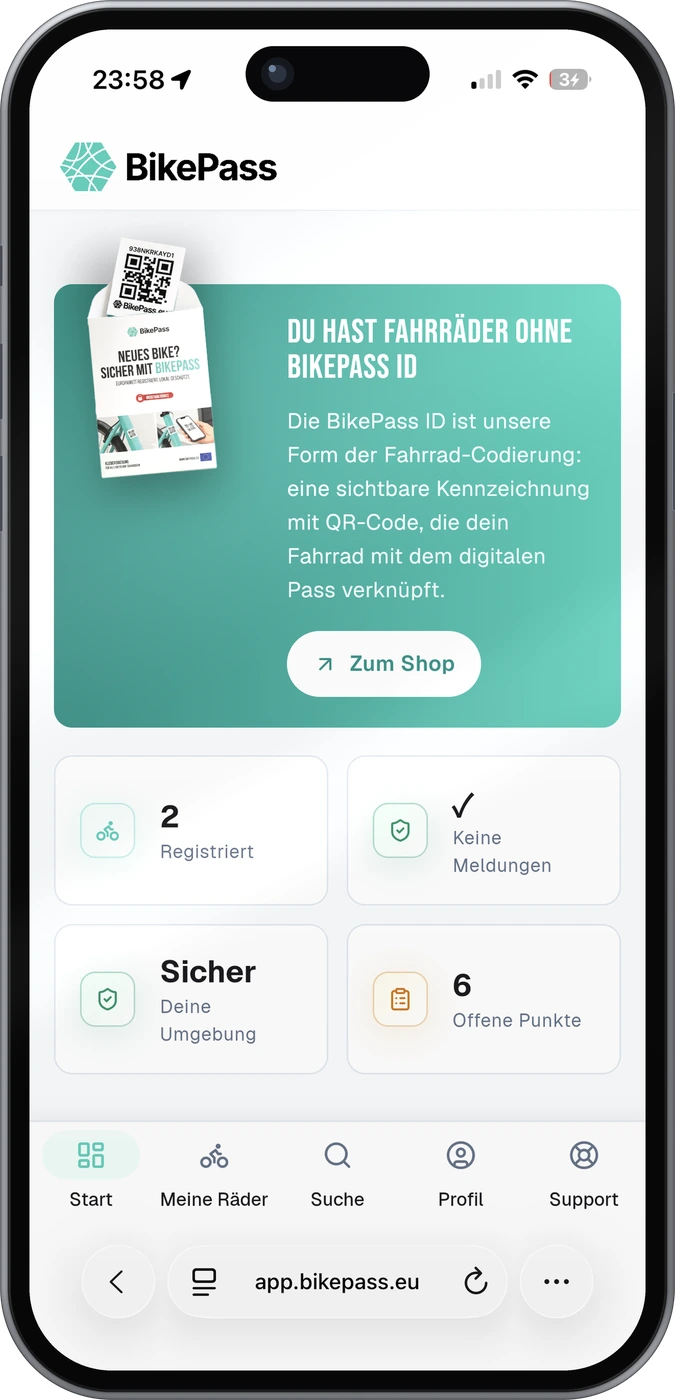
Done. The data is stored in Europe in line with the GDPR, for as many bikes as you like, and can be shared with the police or your insurer if the worst happens. For a visible marking there is the BikePass ID with an individual QR code. You stick it on the frame yourself, with no appointment and no tools, and pay once instead of by subscription.
Where does registration not help?
No registration prevents a theft, whether with the police or privately. Time for three uncomfortable truths.
It does not replace the police report. Even a registered bike is only searched for once you report the theft. Without a report there is no search and no case number for the insurer.
It only works if someone checks. A data record only helps once the bike is found and matched. The clearance rate for bicycle theft was 9.8 % in 2025, so fewer than one in ten cases is solved (source: the German police crime statistics, Polizeiliche Kriminalstatistik 2025). Most stolen bikes never turn up again.
A regional register ends at the border. What one authority holds in its database is not automatically visible to every other station. But your bike can end up anywhere.
Registration is preparation, not protection. The protection comes from the lock.
What does registration give you once the bike is gone?
When it matters, registration saves you exactly the minutes you would otherwise spend hunting for the frame number and the receipt. In 2025, around 214,000 bicycle thefts were reported in Germany, a good 12 % fewer than the year before (source: the German police crime statistics, Polizeiliche Kriminalstatistik 2025). Every report is only as good as its data.
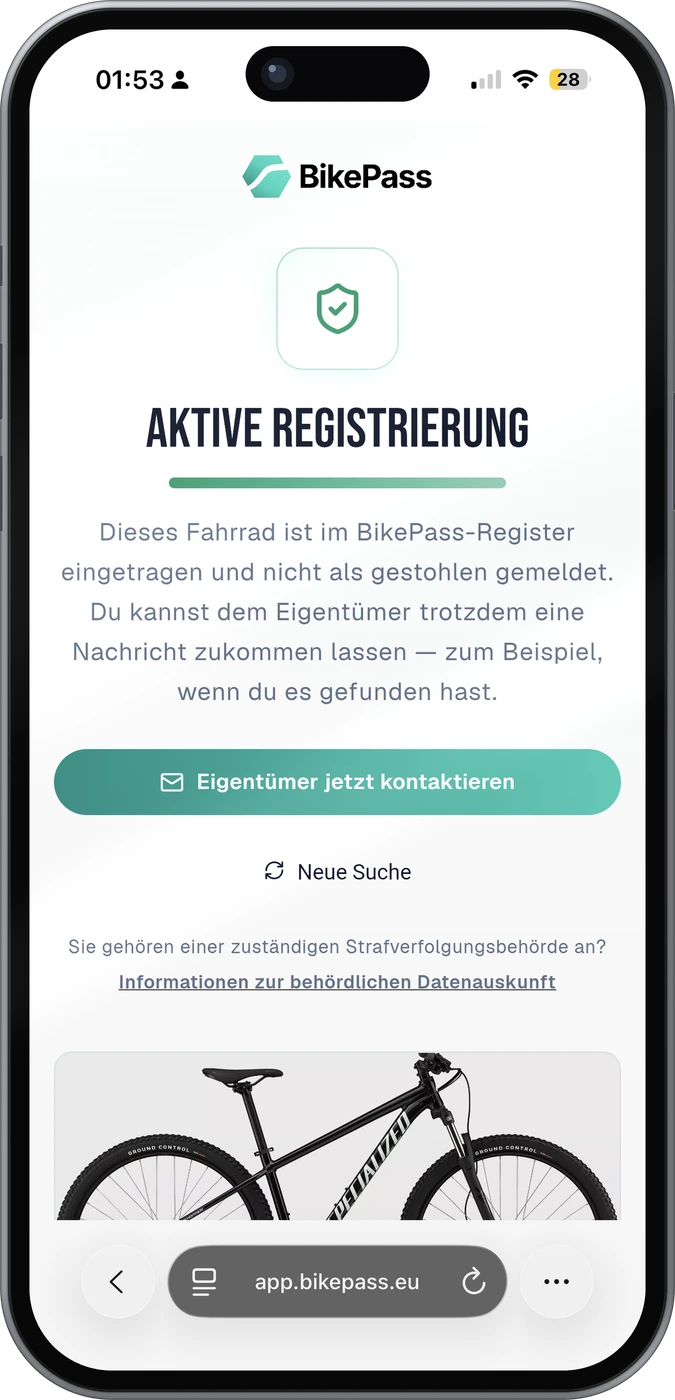
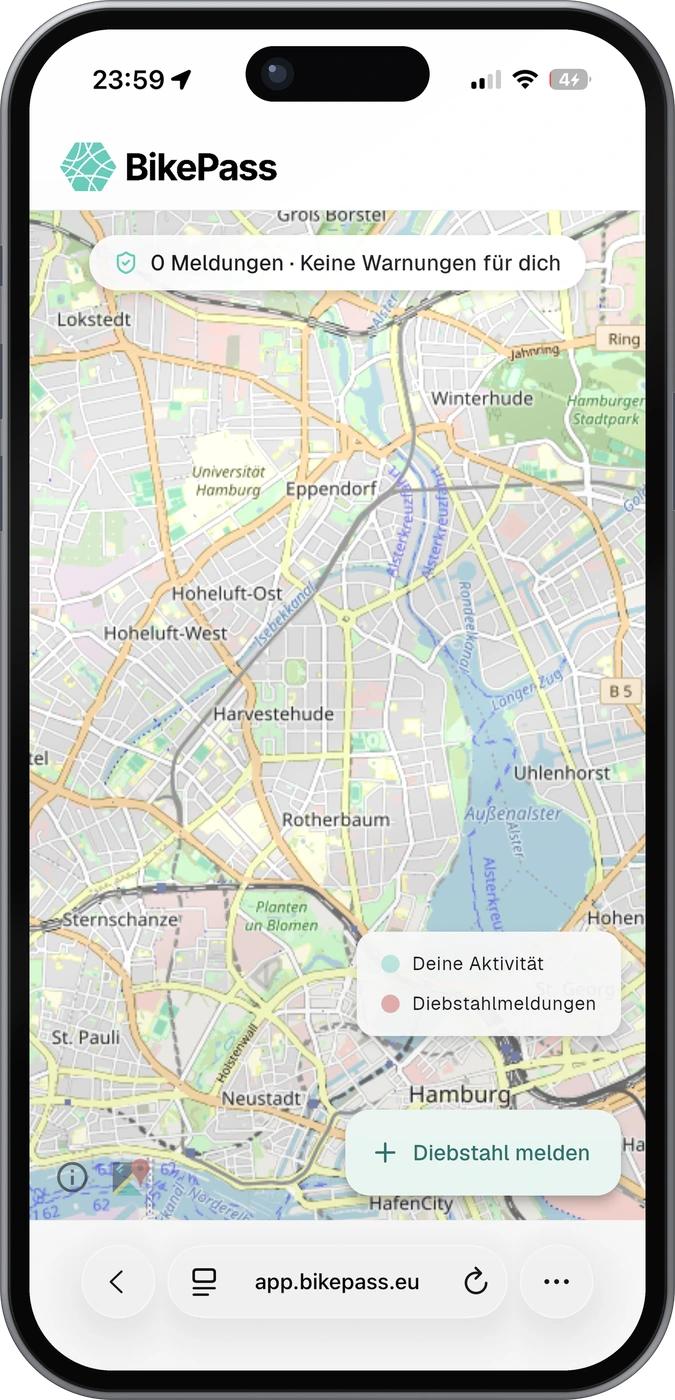
With a complete data record, the report is done quickly, online or at the station. Our guide “Reporting a bicycle theft” shows how it works step by step. At the same time, you report the theft in BikePass. Anyone who then checks the BikePass ID or the frame number, whether a dealer, the police or an honest buyer, sees the status “stolen”. Anyone who finds your bike can contact you through BikePass without your data being disclosed.
And if the bike is found, the proof decides. Receipt, photos and frame number turn “this could be mine” into “this is mine”.
And that counter from the beginning? The next time you stand there, it might be because your bike is gone. A blank leaflet will not be enough then. You hold out your phone to the officer, with the frame number, photos and receipt at a glance. The leaflet was the invitation. The rest you do yourself.
Your checklist: registering your bike with and without the police
- Bike registered online, for example free with BikePass?
- Asked your local police whether they offer bike registration, and picked up the bike passport as a PDF?
- Found the real frame number, not an article or order number?
- Taken photos of the whole bike and of any distinctive features?
- Receipt secured, because the bike passport alone is not enough as proof of ownership?
- For an e-bike: serial numbers of the battery and motor noted?
- Security marking considered and, if you have one, added to the register?
- All data digital and in one place, ready for the police report and the insurer?
We write about bike theft, security marking and digital theft protection – practical, without scaremongering and with real steps you can take.
See all guides