

In short
A bike register links your bike's frame number to your name, which makes your ownership provable. Police security marking, a paper bike passport and a digital register each do something different. Digital registration is free and takes under 3 minutes.
In almost every larger city there is a hall full of bikes that belong to nobody. Seized during a check, found in a park, passed on from the lost property office. Some of these bikes are still being looked for, but nobody knows it.
The reason is rarely a lack of interest on the part of the police. In 2025 around 214,000 bicycle thefts were reported, and the clear-up rate was about 11 % (source: the German police crime statistics, Polizeiliche Kriminalstatistik 2025). What is missing in many of these cases is mundane: a stored link between the frame number and a name. Without it, a recovered bike remains an anonymous piece of metal.
So that we are talking about the same thing: a bike register is a directory that links a bike's frame number to its owner's details, stores that link permanently and makes it verifiable for the police, insurers or buyers if the worst happens. It is not a lock and not a tracker: a register does not stop a thief and does not show you where your bike is right now. It answers a single question, and it answers it reliably: who owns this bike? That is exactly where most cases fall apart.
Why should you register your bike?
Registration makes you the provable owner of your bike, and that proof decides in four situations whether you get your bike back or not. As long as nothing happens, the effort feels like busywork. As soon as something happens, it is the difference between “bike gone” and “bike back”.
- Filing a police report. Without a frame number, no station will take a usable theft report. The guide “Reporting a bicycle theft” shows everything you will be asked.
- Notifying your insurer. Insurers require evidence that the bike was yours before they pay out. Frame number, photos and receipt in one place save you searching at the worst possible moment.
- Return of a found bike. If your bike turns up during a check or at the lost property office, only the stored number decides whether anyone can call you.
- A sale with a clean handover. If you pass your bike on later, you transfer the proof of ownership with it and document from when you are no longer responsible.
The real effort is not in registering. It is in doing it beforehand. After the theft you can no longer read off a frame number, take photos or document the condition.
What types of bike register are there?
Three routes are common in Germany, and they differ less in price than in reach. When comparing them, pay attention above all to who can actually access the entry if the worst happens, because a register that only exists in a folder in your city will not help you two house moves later.
| Type of register | What it can do | What it cannot do | When it makes sense |
|---|---|---|---|
| Police or club security marking | Applies a visible marking to the frame and records you on site during the event. Deters thieves visually alone. | Mostly only takes place on fixed dates and is often recorded regionally. A house move or a sale to another city breaks the link. | When a club, the police or a specialist dealer near you offers an event. |
| Paper bike passport | Collects frame number, make, colour and distinguishing features in one place, with no account and no technology. | It is at home precisely when you need it, and it cannot be shared or queried by the police. If you lose it, everything is gone. | As quick initial cover, as long as nothing digital exists. |
| Digital bike register | Stores frame number, photos and receipts online, can be accessed from any device and shared with the police or your insurer. | It does not prevent theft and does not replace a lock. Without a correctly entered frame number, even the best entry is useless. | As the basis for every bike, regardless of where you live and of event dates. |
The three routes do not exclude each other, they stack. The sensible order is from the bottom up: first set up the digital register, because it works everywhere, then add a visible security marking when the chance arises. The guide “Getting your bike security-marked” explains how such an appointment works.
With the paper passport an honest look is worthwhile: it is better than nothing, but it only solves half the problem. The guide “Filling in a bike passport” explains which fields belong in it at all.
Which details do you need for registration?
Four details carry the entire registration, and each of them answers a different question if the worst happens. The table shows what each field is needed for and what you will be missing if you leave it blank.
| Detail | What it is needed for | What is missing without it |
|---|---|---|
| Frame number | The unique identifier of the bike. It links the frame and the person. | Without it no link is possible, and the rest of the data hangs in mid-air. |
| Make, model, colour | Makes your bike findable in wanted lists and found reports. | “Black men's bike” fits thousands of bikes in every collection point. |
| Photos | Evidence of condition and distinguishing features, such as scratches, stickers or add-on parts. | In a dispute over condition or value you have no evidence at all. |
| Purchase receipt | Shows when you bought the bike and for how much. | Your insurer will then estimate the value by its own yardstick, not yours. |
The frame number is the linchpin, and it is the most common stumbling block. It usually sits under the bottom bracket, sometimes on the seat tube or the dropout, often stamped in and covered by dirt. The guide “Finding & checking your bike frame number” explains where to find it and how not to make a mistake when typing it out.
Tip: Already mislaid the receipt? Register anyway. The frame number and photos alone are already solid proof, and you can add the receipt at any time if it turns up again.
How does digital registration work?
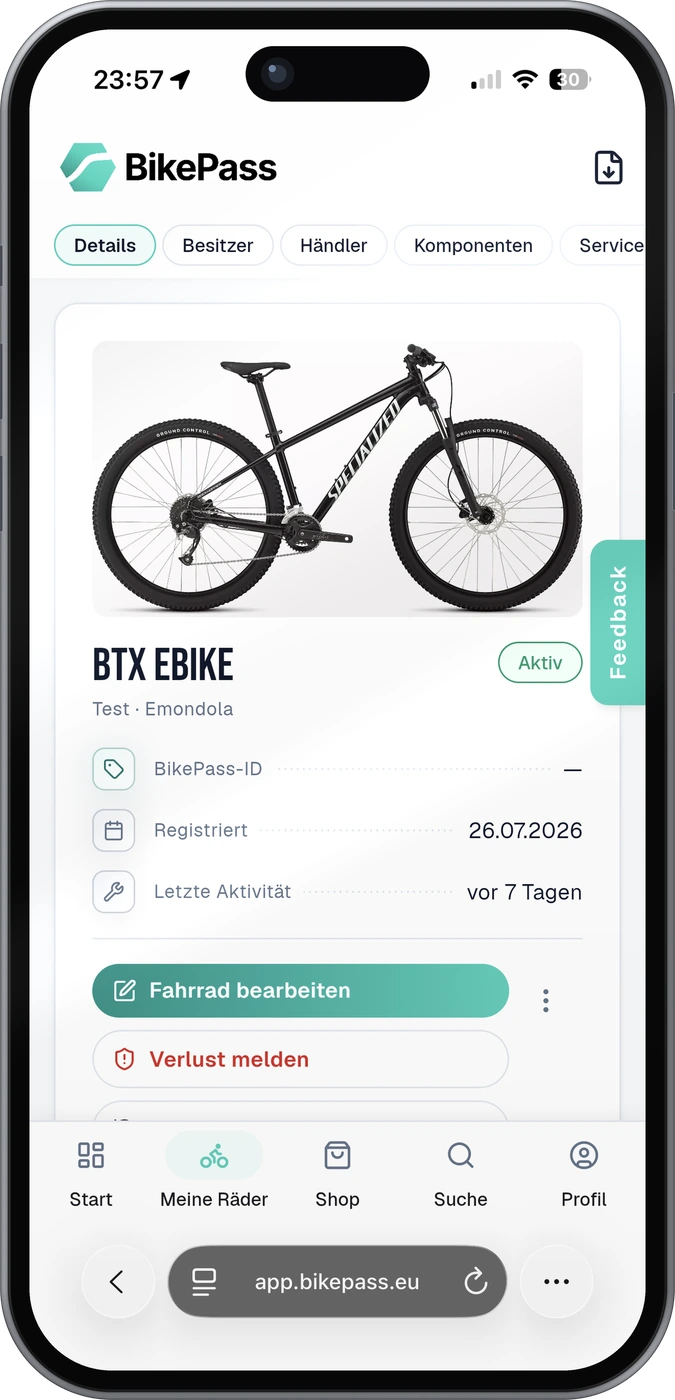
Digital registration consists of three steps: enter the frame number, upload photos, attach the receipt. After that everything is in one place that you can share from your phone if the worst happens, instead of rummaging through drawers.
The most important step is the first one. Take your bike, tip it on its side, wipe the bottom bracket clean and photograph the stamped number before you type it out. A photo of the number beats any transcript, because you can still tell a six from an eight later.
Then you photograph the bike itself: once complete from the side, once from the front, plus every detail that sets your bike apart from others. The scratched mudguard stay is more valuable here than the prettiest promotional photo.
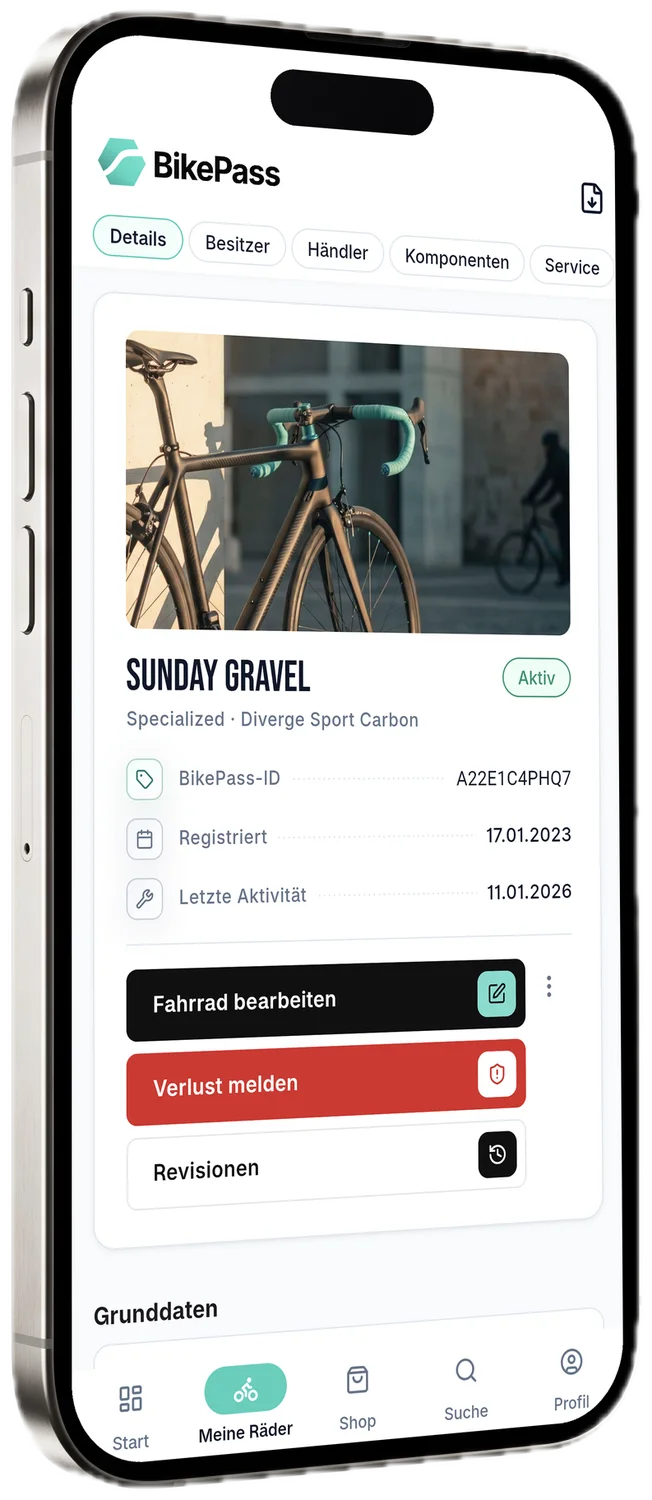
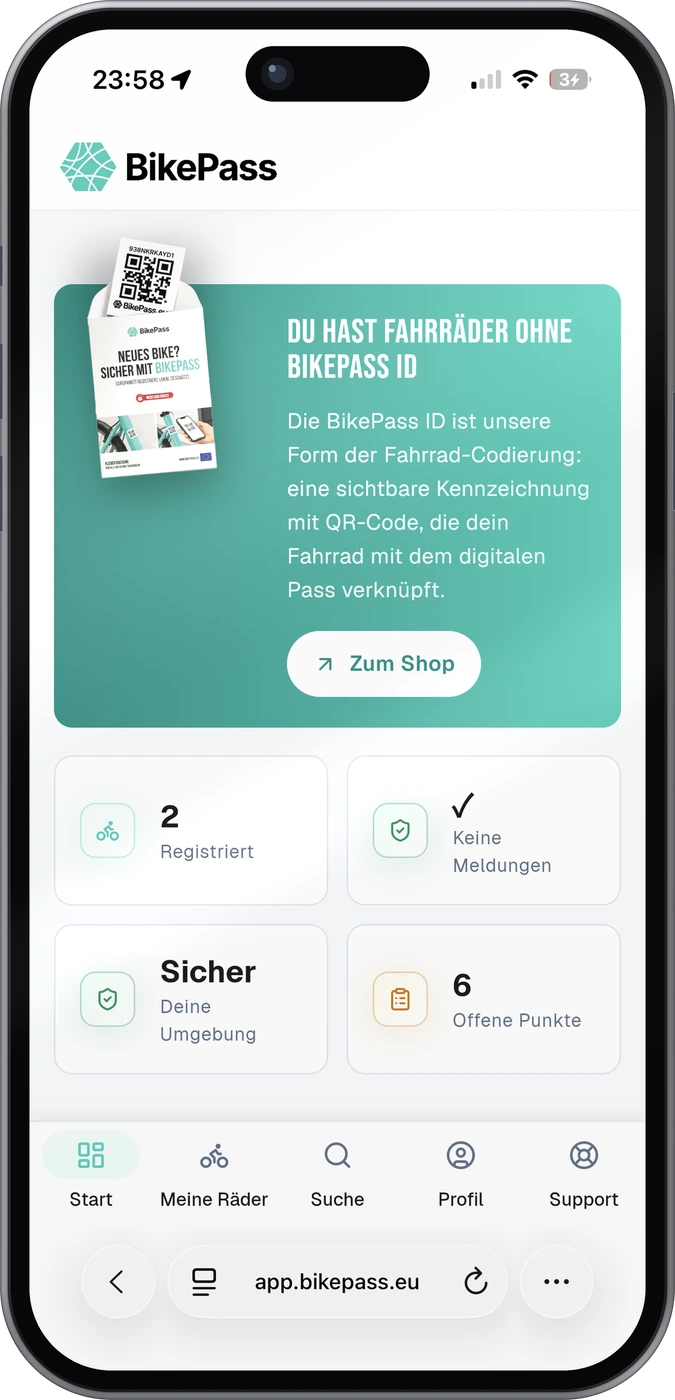
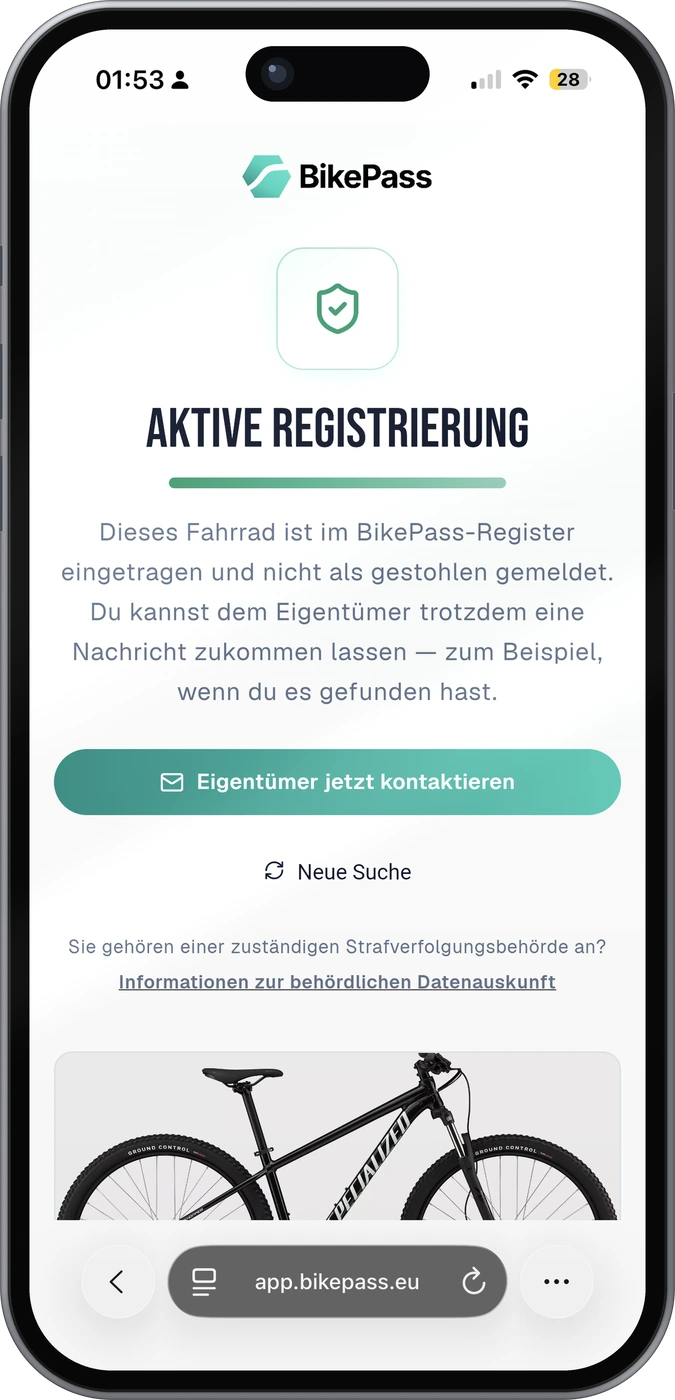
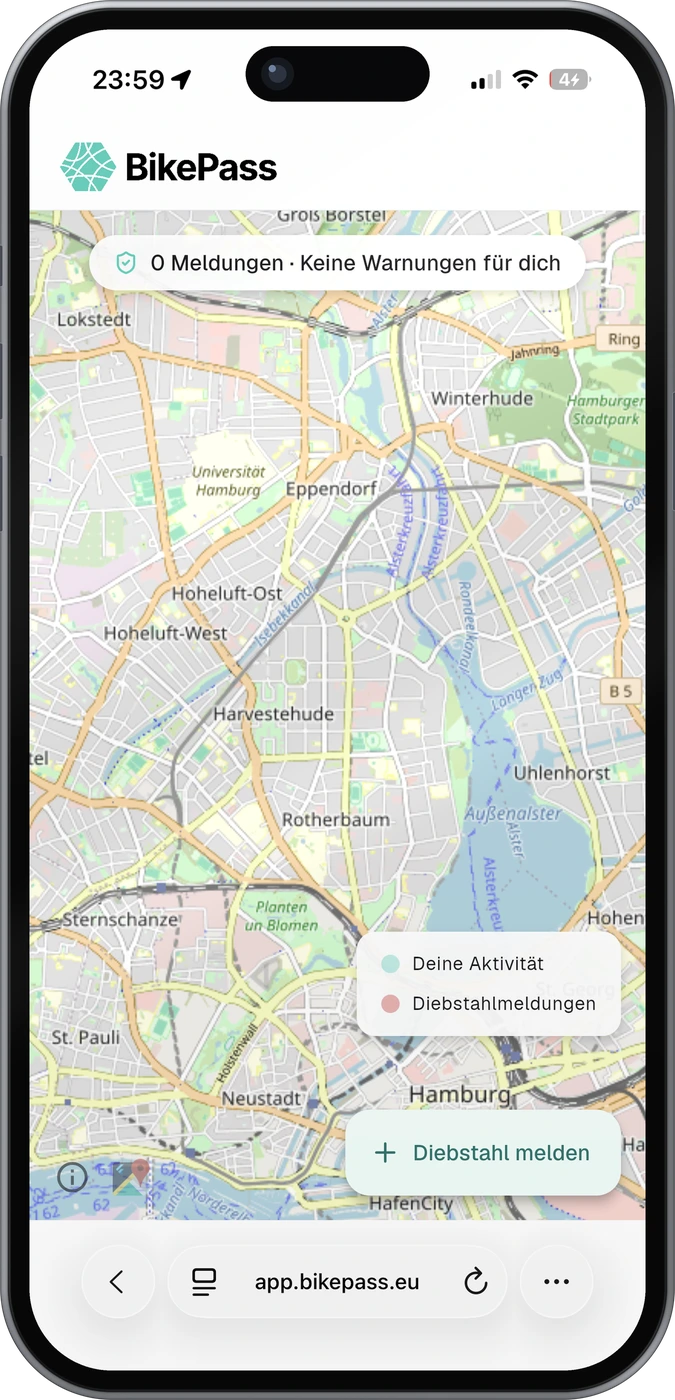
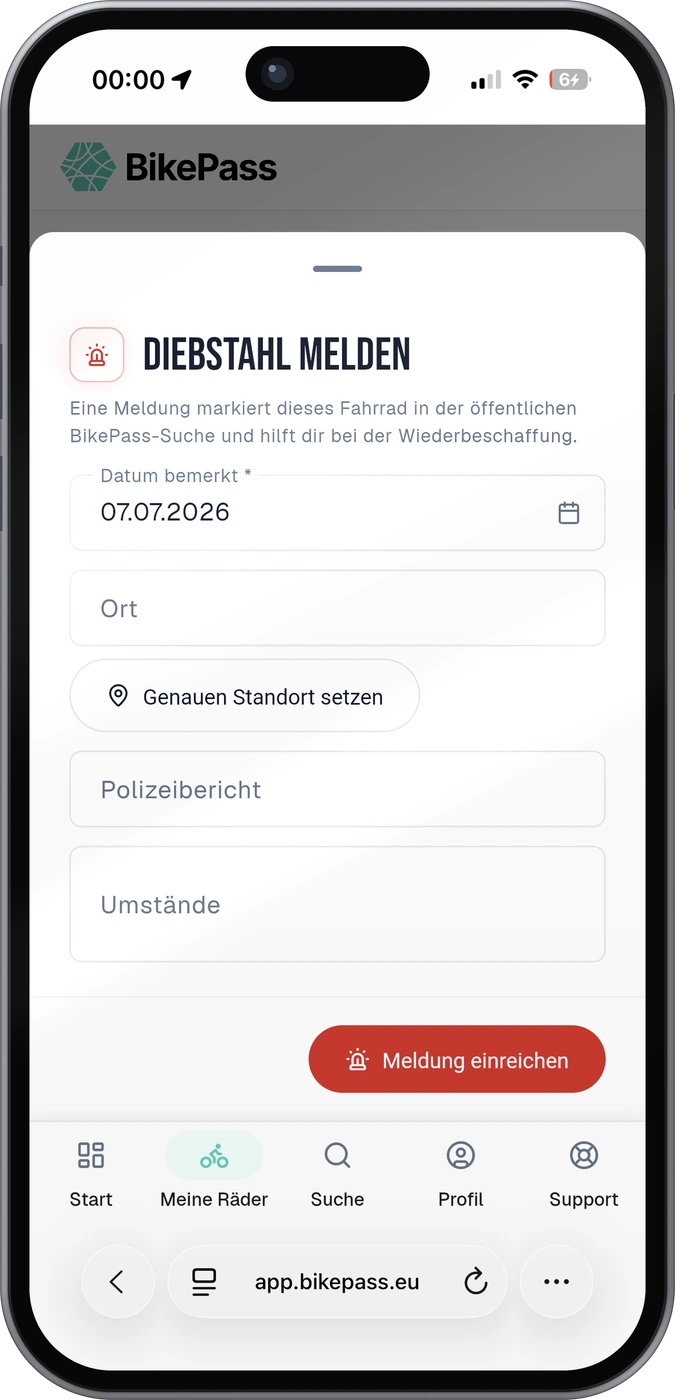
At BikePass this process runs free of charge through the web app on any device, EU-wide and GDPR-compliant with hosting in Europe. You need no installation and no appointment, you can add as many bikes as you like, including your family's, and you can add details at any time. If you later report a theft in the web app, the ID becomes visible to the authorities and finders can contact you anonymously.
Registration or security marking: what is the difference?
Registration works invisibly in the background, security marking works visibly on the frame. Registering means your data sits in a directory that someone can query. Security-marking means there is a marking stuck or stamped on the bike that signals, even before a theft, that this bike can be traced to an owner.
The two work at different points. Security marking acts as prevention, because a marked bike is harder to resell. Registration works afterwards, when it comes to proof and return. If you only do one of the two, start with registration, because it costs nothing and needs no appointment.
At BikePass the visible layer is a tamper-proof sticker with a QR code that you apply yourself at home, without tools and without an appointment, bought once rather than on subscription. It is UV- and weather-resistant and cannot be removed without leaving traces. You can simply record existing security markings or serial numbers, for example from the ADFC, in your registration. You will find more on this on the page about security marking.
Where does registration not help?
Registration prevents not a single theft. That is the uncomfortable truth that is rarely stated this clearly on provider pages, and it has three concrete consequences.
It replaces no lock. If you register your bike and then lean it unlocked against a lamp post, you have only documented better what is about to disappear. The basis remains a lock that matches the value of the bike, rule of thumb: around 10 % of the purchase price.
No tracking. A register knows who owns the bike, not where it is. If you want to search for your bike actively in an emergency, you need other means; the guide “Finding a stolen bike” shows which ones.
A wrong number is useless. One transposed digit in the frame number makes the whole entry worthless, because it matches no real bike. So check once too often rather than once too little.
And then there is the case nobody likes to hear: even with a perfect entry, a large share of stolen bikes never turns up again. Registration improves your chances with every bike that is found. It does not turn bad luck into a guarantee.
What happens to the registration when you sell?
When you sell, the registration moves with the bike to the new owner instead of sitting orphaned in your account. That sounds like a formality, but it is the point where paper solutions regularly fail: a handwritten sales contract without a reference to the number proves little if someone turns up with the same bike months later.
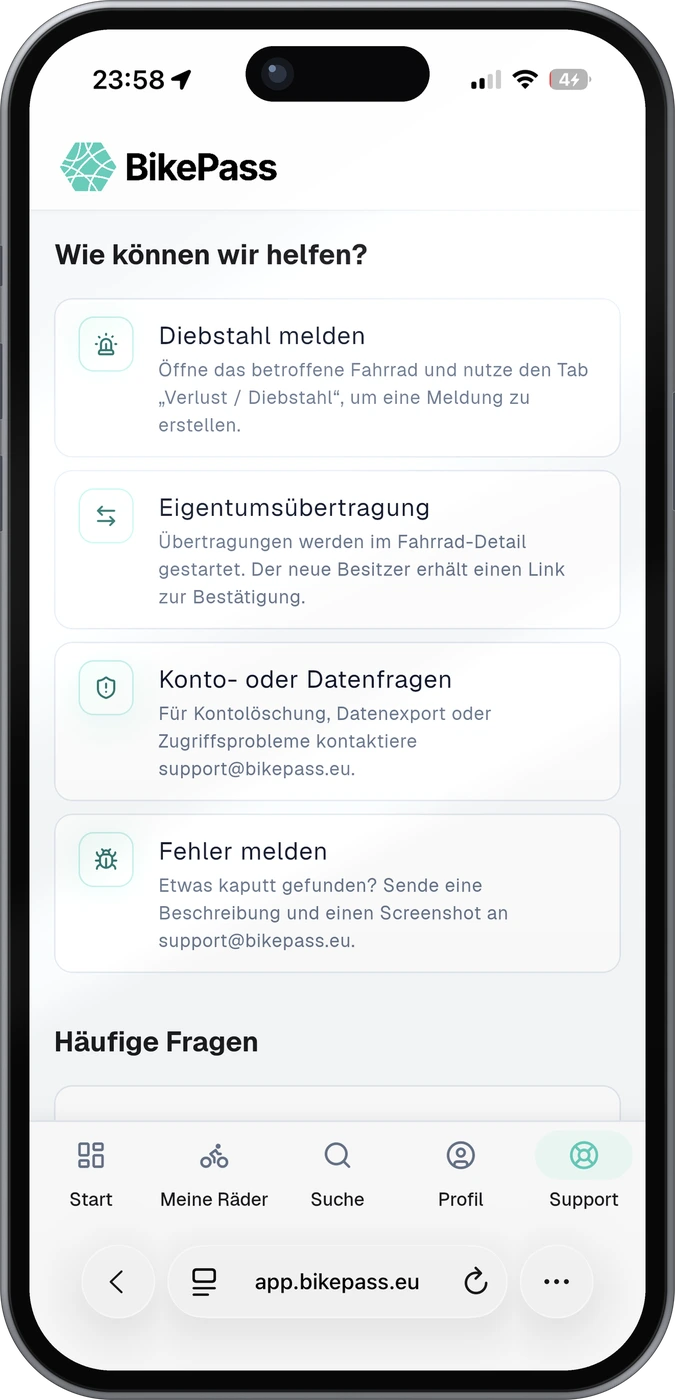
A clean handover means naming the frame number in the contract, recording the handover date and transferring the digital entry to the buyer. At BikePass this transfer of ownership takes a few clicks. After that it is documented from when you are no longer responsible.
The same applies the other way round when you buy a used bike: ask to see the frame number before the purchase and check it against the bike. A seller who will not give you the number is reason enough to walk away.
How does registration fit into your theft protection?
Theft protection consists of three layers, and registration is the last of them. The lock holds the bike in place. The visible marking makes it unattractive to fences. The register entry makes sure that a bike that turns up ends up back with you.
The first two layers work before the theft, the third afterwards. That is exactly why it is so often forgotten: it only pays off in a moment nobody plans for. And in that moment you can no longer catch up on it.
On BikePass you register your bike for free, store the frame number, photos and receipts as digital proof of ownership, and can share that proof with the police or your insurer if the worst happens. If you also want visible deterrence, add the security marking set.
That leaves the warehouse from the beginning. It does not get emptier because more bikes are found, but because more bikes have a number with a name behind it. Your bike needs three minutes and a clean spot at the bottom bracket for that.
Your registration checklist
- Frame number found, photographed and checked character by character?
- Make, model, frame size and colour noted?
- Photos taken: overall view, front and at least one unmistakable detail?
- Purchase receipt or invoice stored digitally, if available?
- Bike entered in a digital register that can be queried EU-wide?
- Visible security marking added or an existing marking recorded as well?
- Other bikes in the household entered too?
We write about bike theft, security marking and digital theft protection – practical, without scaremongering and with real steps you can take.
See all guides