In short
You do not find a stolen bike through luck, but through matching: a police report with the frame number, a theft report in the register, saved search alerts on classifieds portals, the lost property office and the flea market. If you spot your bike, do not take it back yourself. Call the police and present your proof of ownership.
The stand is still there, a piece of cut lock cable lies next to it, your bike is gone. In those first few minutes you are not thinking about databases, but about who did it and how long it took them. Two hours later you are sitting at home wondering where you even look for a bicycle.
The sober starting point: in 2025 around 214,000 bicycle thefts were reported in Germany, and the clear-up rate was around 11 % (source: the German police crime statistics, Polizeiliche Kriminalstatistik 2025). That figure describes the average. And the average has neither a frame number nor photos to hand, does not search systematically and often does not report the theft at all. The first-aid order of steps for the first few hours is set out in our guide “Bike stolen – what to do?”.
First the key term, because it determines everything that follows: a bicycle register is a database that links a bike to a person via its frame number, stores photos and receipts alongside it, and makes the theft status visible to finders, buyers and authorities. It is not the police wanted database, but a second, openly searchable layer beside it: the police database is created by your report and is checked during police checks, while a register depends on people looking things up themselves. Neither actively searches for your bike. They make sure that a bike which turns up can be matched to you. That is the whole trick.
What are your chances of finding a stolen bike again?
The chance depends less on luck than on whether your bike is identifiable. Across Germany, around one in nine reported bicycle thefts was solved in 2025 (source: the German police crime statistics, Polizeiliche Kriminalstatistik 2025) – a rate that includes every case, including those without a frame number, without photos and without a police report.
Bikes turn up again more often than the clear-up rate suggests. They stand parked in the next street, end up at the lost property office, are seized during a police check or are listed on a marketplace. The bottleneck is rarely the bike turning up. The bottleneck is matching it to you.
And that is decided beforehand, not afterwards. Anyone with the frame number, the receipt and a few usable photos to hand can immediately prove that the bike is theirs at every hit. Anyone without all that sees a bike that looks like theirs and can do nothing.
Identifiability beats luck.
Why is the police report the first step towards getting your bike back?
Without a police report, your theft does not exist for the authorities. Only with it does your bike enter the police wanted database via the frame number, and only then does a police check, a purchase or a seized load flag anything up at all. Our guide “Reporting a bicycle theft” explains how the report works and what details you need.
The key element is the frame number. It is the only detail that distinguishes your bike from millions of similar ones – thousands share the same make, colour and frame size. The guide “Find & check the frame number” shows where the number sits and how to read it off cleanly.
Note down the case reference number and keep it with the photos. You will need it for every later lead, every call to the lost property office and for the insurer.
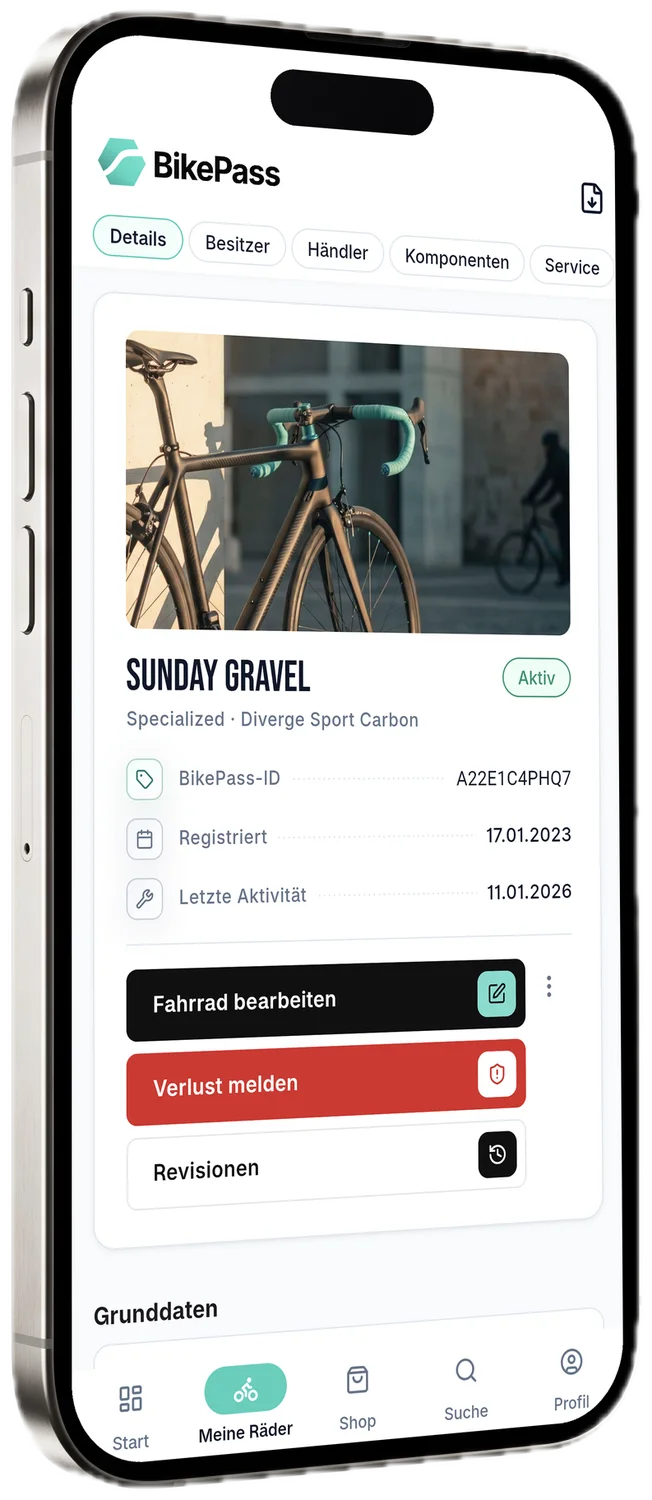
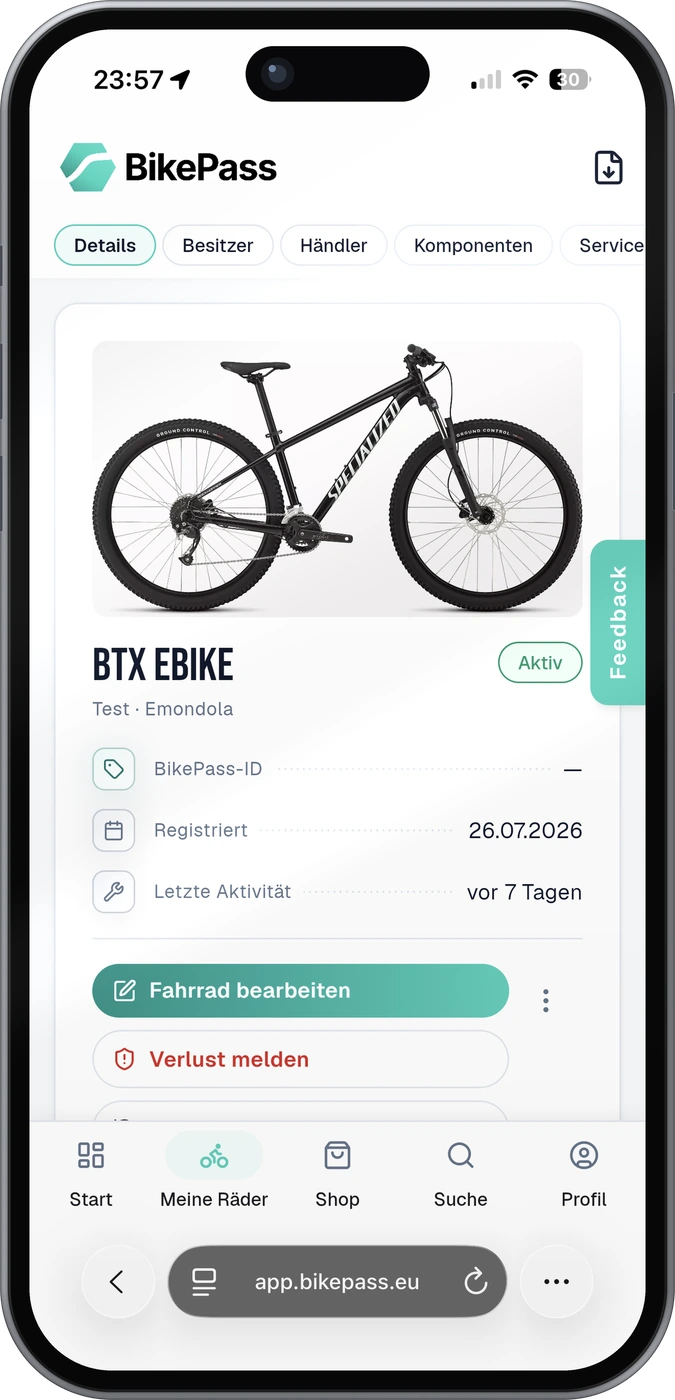
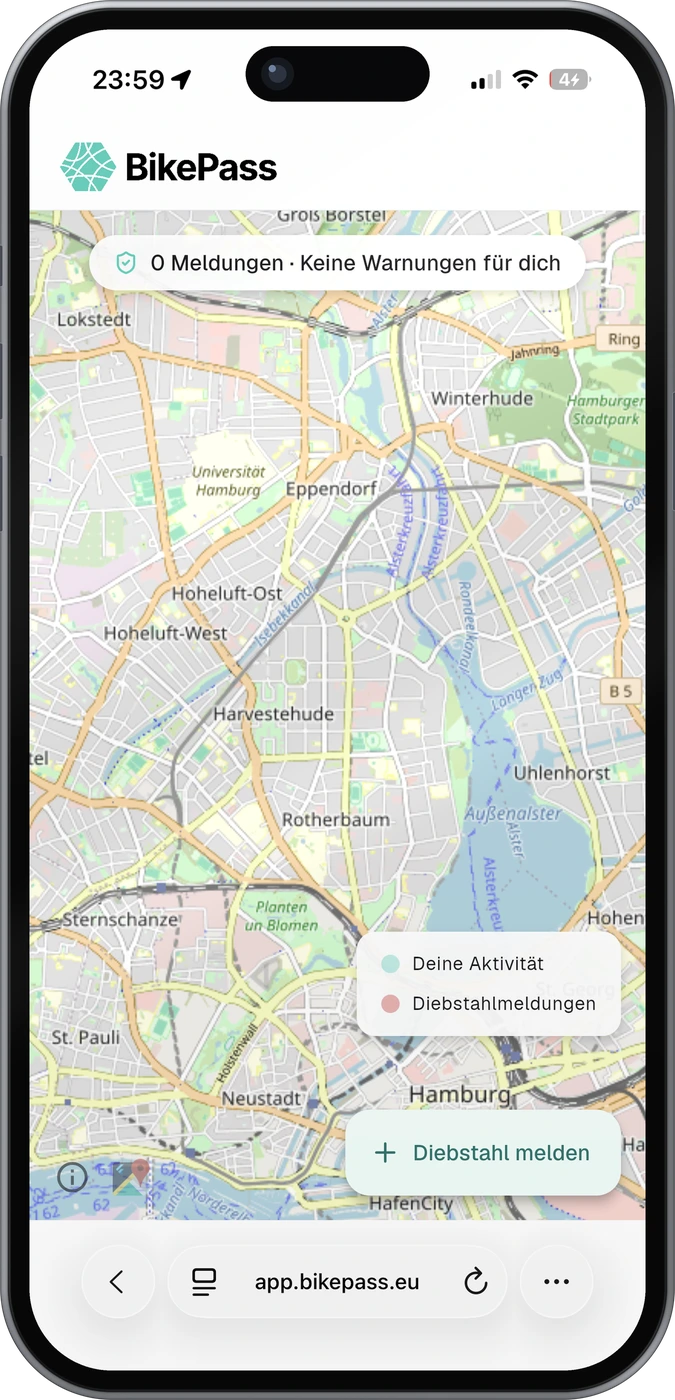
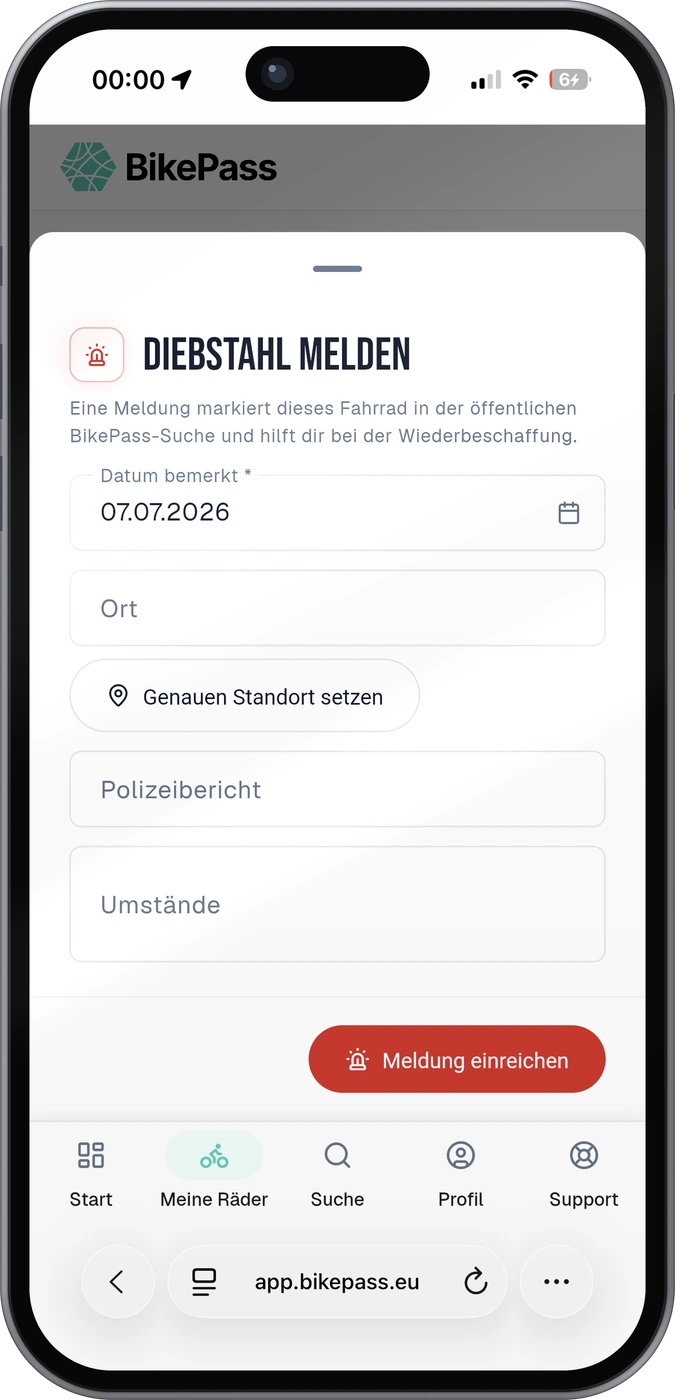
Tip: In the BikePass web app you also report your bike as stolen. The ID becomes visible to authorities, finders can contact you anonymously, and your digital proof of ownership is ready for the police and your insurer.
Is there a database for stolen bikes?
Yes, but not a single, publicly searchable list where you type in your frame number and get your bike back. Your bike can sit in three different records, which follow different rules and can do different things. Confuse them and you wait for a response that never comes.
The table shows what each record is good for, where it stays blind and what you have to do yourself:
| Record | What it can do | What it cannot do | What you have to do |
|---|---|---|---|
| Police wanted database | Identify your bike as stolen via the frame number during police checks, purchases and seizures. | Not publicly searchable. You get no list of hits and no self-disclosure. | File a police report, give the frame number correctly, note the case reference number. |
| Registers such as BikePass | Prove ownership, make the theft status openly visible, put finders and buyers in anonymous contact with you. | Does not replace a police report and does not actively search for your bike. | Register the bike in advance and, if the worst happens, report the theft in the web app. |
| The city’s lost property record | Store found and abandoned bikes, often with an online search by characteristics. | Matches nothing without proof and does not store bikes indefinitely. | Ask yourself, and repeatedly, bringing the frame number and photos. |
Read the third column twice. None of the three records searches for you, and none hands over your bike without proof. They are gateways, not search engines. Your job is to knock at every gateway and bring the proof with you.
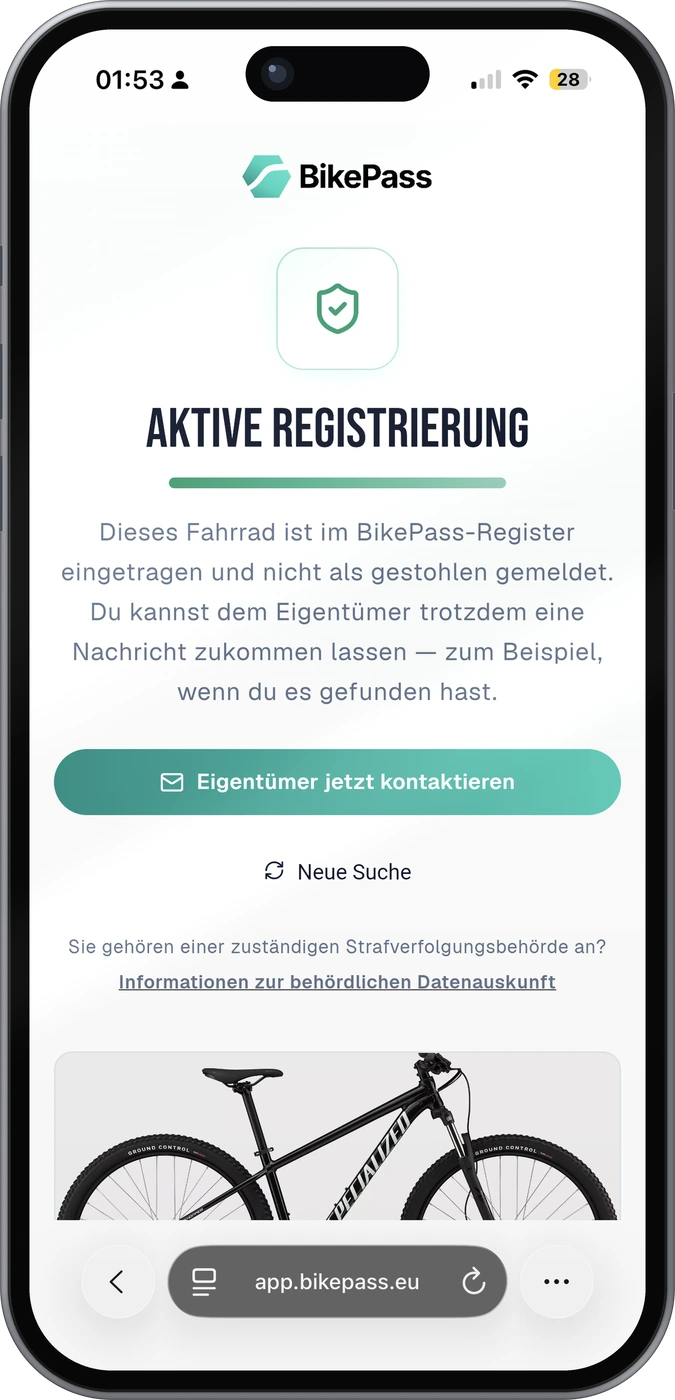
Incidentally, the theft status can also be checked the other way round: anyone buying a used bike can use the Bikefinder search and scan the BikePass ID to see whether a bike is reported stolen. That is exactly what makes a registered bike unattractive to handlers of stolen goods.
How do you search classifieds and marketplaces systematically?
Many stolen bikes reappear online within a few days, often slightly altered, in the neighbouring town, strikingly cheap. Aimless scrolling achieves little; a fixed pattern achieves a lot.
Save search alerts instead of searching every day. Set up search alerts for the make and model on the big classifieds portals, plus common typos, English and German colour names, and a wider radius. Thieves rarely sell where they steal.
Search by characteristics, not by model name. The model name is the first thing to disappear from a listing. Scratches, stickers, a retrofitted pannier rack, an unusual saddle: such details often stay on the bike and show up in the photos.
The first two weeks are the important ones. Check daily during that time, then every two days is enough. Fresh listings are your best chance, because a bike rarely sits around for long.
If you suspect something, do not escalate. Do not message the seller as an avenger. Take screenshots of the listing, the price, the photos and the seller profile, note the listing URL with the date, and pass everything on to the police with your case reference number.
A screenshot is evidence; a deleted listing is nothing.
Where do stolen bikes turn up offline?
A large share of bikes never leaves the internet, because they never arrive there. Three places are worth the effort, and they only cost you time.
Your city's lost property office first. Bikes left standing somewhere end up exactly there, and many lost property offices run an online search. Ask not once, but every few weeks, because a bike can be handed in months after the theft.
Then flea markets and used bike dealers, especially in the first few weeks. Someone offering a bike there without any paperwork is not necessarily selling stolen goods, but the combination of price, haste and no information on the frame number is a pattern.
And then your own neighbourhood. Bikes are often ridden only a few streets and then left standing as soon as a quick sale stops being worth it. Back yards, station racks, cellar entrances: walk the route once on foot instead of riding it. You see more that way.
What does tracking by GPS tracker or AirTag achieve?
Tracking gives you a head start, but only if you fitted something beforehand – retrofitting after the theft is no longer an option. If a GPS tracker or a Bluetooth tag such as an AirTag sits in the frame, document the location with screenshots including timestamps and inform the police immediately.
The difference between the two technologies matters in this situation. A GPS tracker reports a position under its own power, but needs electricity and reception for that. A Bluetooth tag has no tracking of its own; it only reports in when someone else's smartphone comes within range – in a garage on the edge of town it stays silent.
With e-bikes it is also worth checking the drive manufacturer's app, because some systems come with locking or tracking functions. The scope differs by manufacturer and model year; a look at your drive's manual settles it faster than any search engine.
What applies to every tracking route: the position leads you to the bike. That does not mean you may retrieve it yourself.
You have spotted your bike – what now?
Do not take it back on your own authority. That is the most important sentence in this guide, and in that moment it feels completely wrong. As long as the question of ownership is unresolved, you may well be the one who looks like the suspected thief, and a find turns into a dispute with an uncertain outcome.
Call the police instead – 110 if the situation is unfolding right now, otherwise the local station – and quote your case reference number. Stay within sight without putting yourself in danger, and document the place, time and condition of the bike with photos.
Then comes the moment all that preparation was for: you present your proof of ownership. Frame number, receipt, photos, ideally all bundled together and shareable in your digital BikePass. If the frame number matches your proof, the question is settled in minutes.
Without proof, even a recovered bike stays with the police for the time being.
Where does the search hit its limits?
Time for the uncomfortable side: even a thorough search does not find some bikes again, and there are four reasons for that which few people write about.
Stripped bikes. A bike broken down for parts reappears as a wheelset, a drivetrain and a seatpost, not as a bike. The frame number then only helps with the frame itself.
The route abroad. Bikes are collected in vans and sold far away. Neither your local lost property office nor your search alerts in the surrounding area help then.
The ground-off number. If the frame number has been removed, there is no way to match the bike. That is exactly why an additional marking makes sense, for example security marking or a tamper-proof sticker with a QR code that cannot be removed without leaving traces.
Staying power. After a few weeks without a hit, most people stop searching. But bikes are still handed in or advertised months later. A search alert you simply leave running costs you nothing and carries on while you are long since riding another bike.
How do you make your bike findable before it is gone?
Everything that supports the search later is created beforehand on a quiet afternoon. The only question is which building block really changes something for you – the overview below sorts them by what they achieve if the worst happens and where they stop.
| Building block | What it does for recovery | What it cannot do | When it makes sense |
|---|---|---|---|
| Frame number noted down | Makes the police report, the wanted database and any match possible in the first place. | Does not help if the number on the bike has been ground off. | Always. Nothing else works without it. |
| Photos & receipt | Prove condition, fitted parts and ownership to the police, lost property office and insurer. | Do not replace a unique number, because models look alike. | For every bike worth more than a spare part. |
| Registration in a bike register | Bundles the proof, makes the theft status visible and lets finders make contact anonymously. | Does not actively search and does not replace the police report. | Always, because it is free and done in under 3 minutes. |
| Visible marking | Deters resale and allows a match without the frame number. | Does not prevent the theft itself. | For bikes parked outside day to day. |
| Tracker or Bluetooth tag | Provides a trail in the first hours after the theft. | Needs power or other devices within range and proves no ownership. | For high-value bikes and e-bikes. |
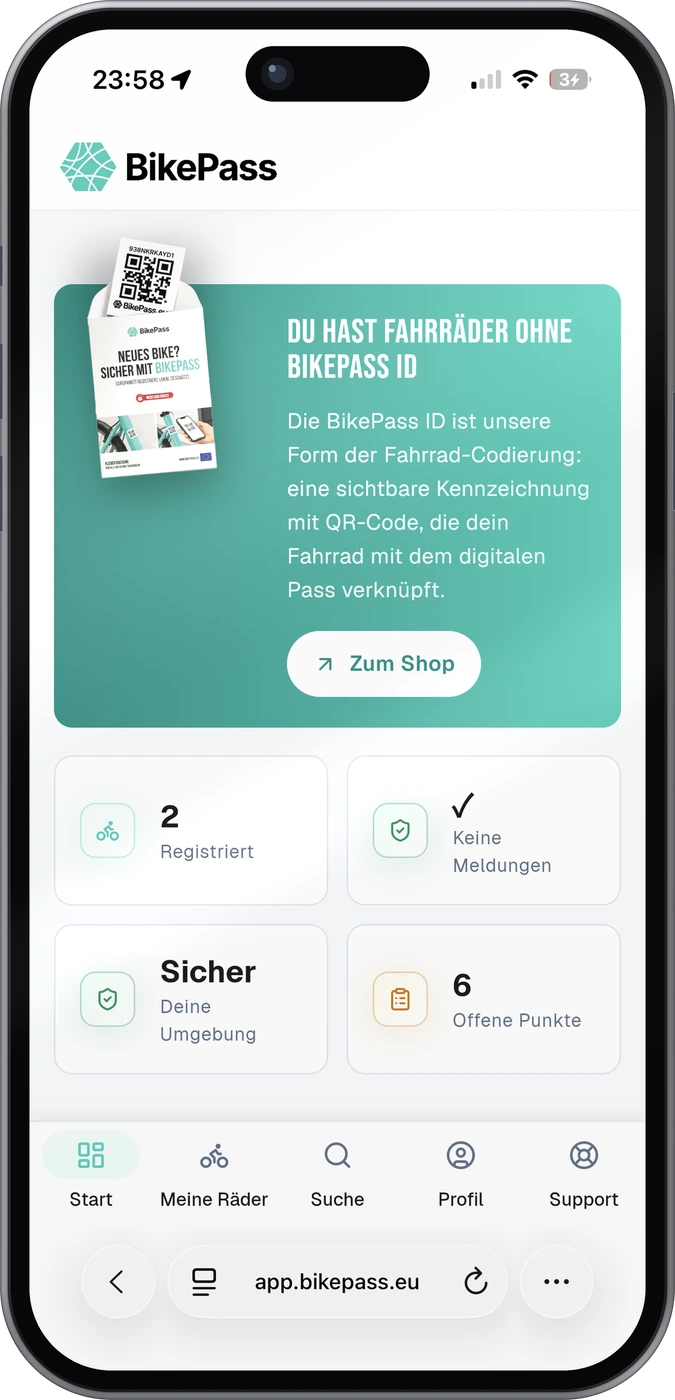
The first three rows are the core, the rest is built on top. Our guide “Register your bike” shows you how to set up the proof properly. With BikePass you store your frame number, photos and receipts free of charge and EU-wide, for any number of bikes, on any device in the browser. If you also want a visible marking, you fit the security marking set with sticker and QR code yourself at home, with no appointment and no tools.
And the stand from the beginning, with only the lock cable left hanging on it? It stays just as empty whether you prepared or not. The difference only shows two weeks later, when a lost property office calls or an advert appears: then you either have a frame number and proof – or a photo of a bike that might be yours.
Your recovery checklist
- Police report filed with the frame number, case reference number noted
- Bike reported as stolen in the register, status publicly visible
- Search alerts set up on classifieds portals, with typos and a wider radius
- Watching for features rather than the model name: scratches, stickers, fitted parts
- Lost property office contacted and a follow-up date set, flea markets kept in view
- Tracker location documented with a timestamp, if available
- If found: police called, proof of ownership ready, nothing retrieved yourself
We write about bike theft, security marking and digital theft protection – practical, without scaremongering and with real steps you can take.
See all guides