In short
A GPS tracker works out its position via satellite and sends it to an app over the mobile network. What matters is battery life, reception and a fitting spot that nobody can reach without tools. Even so, only the police may recover your bike, and for that you need proof of ownership.
A blue dot on the map, seven in the morning, three streets away. Not a film moment, but a circle wobbling around a backyard and jumping on every few minutes. You sit there with your phone in your hand and have no idea what to do with it.
The wish to track has a sober reason: in 2025, around 214,000 bicycle thefts were reported in Germany, and roughly one in nine cases was solved (source: the German police crime statistics, Polizeiliche Kriminalstatistik 2025). If you want to see your bike again, you need leads. A tracker delivers exactly one of them: a location. How the cases spread across the cities is shown in our guide to bicycle theft statistics for Germany.
So we are talking about the same thing: a GPS tracker for your bike is a battery-powered locating device that calculates its position from satellite signals, transmits it to a server over the mobile network and plots it on a map in an app. Not a direction finder you carry through the city with an aerial, but a small mobile subscriber on your frame: it needs power, reception and a SIM connection, otherwise it stays silent. The location alone does not get you far, because a dot on a map belongs to nobody. Only a police report, tracking and proof of ownership together make a case the police can work with. Locating is not recovering.
How does tracking work with a GPS tracker for your bike?
A GPS tracker receives the signals of several navigation satellites, calculates its own position from them and then sends those coordinates over the mobile network to a server, which you access via an app. So two radio paths, not one. This is where most misunderstandings begin.
The first path, satellite positioning, works anywhere under open sky and costs nothing. The second path, transmission, needs a network and therefore a SIM card in the device. If either path fails, you see nothing: under a metal roof the tracker finds no satellites, in a dead spot it finds no network.
Here is what that looks like day to day: the tracker sleeps most of the time and reports in only on a fixed rhythm or when its motion sensor triggers. That rhythm is exactly the adjusting screw. Anyone wanting positions every minute has an empty battery within days. Anyone happy with one sign of life a day gets very far, but in an emergency may only see where the bike stood yesterday.
That is why almost every usable device has a motion alarm: only when the bike moves without permission does the tracker wake up and switch to a tight transmission interval. That saves power and still gives you a trail instead of a single dot. The alarm wakes the tracking.
What is the difference between GPS trackers, Bluetooth tags and mobile trackers?
GPS trackers, Bluetooth tags and pure mobile trackers answer the same question in three very different ways, and if you mix them up, you buy past your own needs. The table shows what each technology depends on for tracking and what it cannot deliver when it matters. Read the “What it cannot do” column above all, because that is where the buying decision sits.
| Technology | How it finds your bike | What it can do | What it cannot do | When it makes sense |
|---|---|---|---|---|
| GPS tracker with SIM | Satellite position, reported to the app over the mobile network. | Report a location at street level, even when there is nobody around for miles. | Report anything without a network or with a flat battery. Nor prevent any movement. | High-value bikes, e-bikes, cargo bikes, rural areas. |
| Bluetooth network tag | Transmits over a short distance; other people’s smartphones pass the find on anonymously. | Run for years without charging and be surprisingly accurate in busy areas. | Report anything while no suitable third-party device passes by. And trigger a motion alarm. | City, plenty of passers-by, small budget, second bike. |
| Mobile tracker without GPS | Estimates the position from the mobile cells within range. | Give a sign of life even where there is no satellite reception. | Deliver an address. The accuracy is often only good enough for a neighbourhood. | As a fallback in cellars and underground car parks, not as your only system. |
| Factory-fitted tracking on an e-bike | Uses the bike’s drive electronics and battery, controlled through the manufacturer’s app. | Run along without retrofitting and sit deep in the bike, where nobody looks. | Move over to your second bike. The feature set depends on the drive system. | If your e-bike offers it: activate it before you retrofit anything. |
A Bluetooth tag such as an AirTag is therefore not a worse GPS tracker, but something different: it has no channel of its own to the outside world and lives off other devices being nearby. How to fit such a tag sensibly on your bike is covered in our guide to hiding an AirTag on your bike. With e-bikes it pays to check the drive system first, because tracking and locking functions are often already built in; more on this on our page about e-bike theft protection.
Where do you fit the tracker on your bike?
The best fitting spot is the one where a thief does not suspect the tracker and cannot remove it without tools. Both together, not one of the two. A device someone can pull off in passing is an expensive rear light.
The overview below ranks the usual fitting spots by camouflage and effort. Watch the last column: every spot has a catch, and that decides whether the tracker is still on the bike when it counts.
| Fitting spot | How well hidden | Effort to fit | The catch |
|---|---|---|---|
| Rear light with tracker | Inconspicuous, because a rear light belongs on a bike. | Screw it on, done. | The first place experienced thieves look. Removable without tools. |
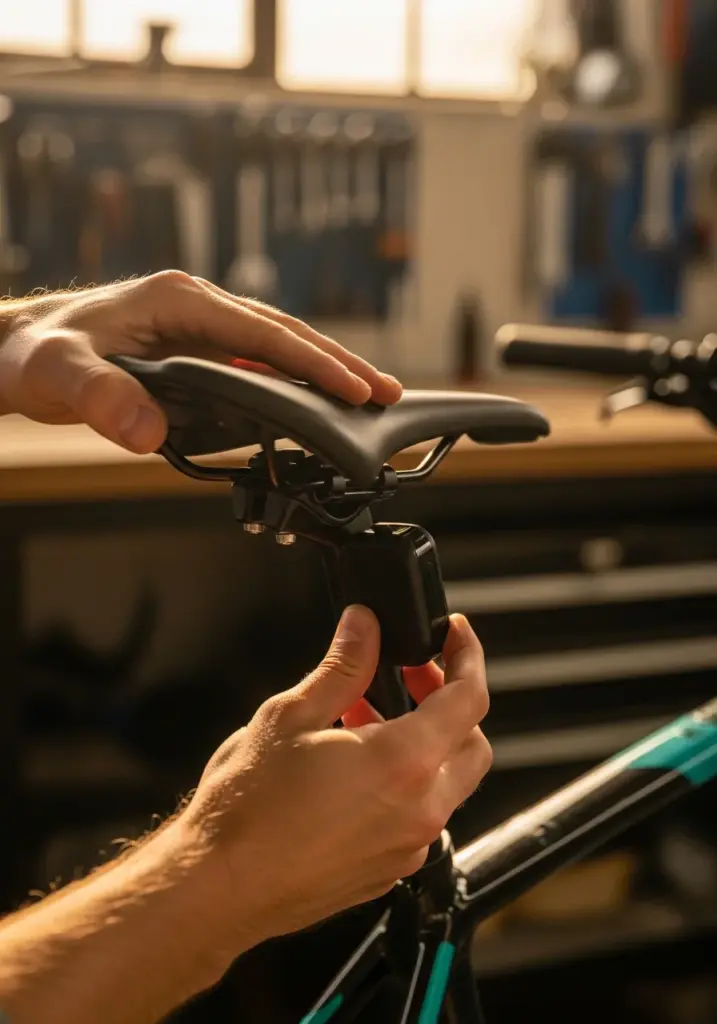
| Seatpost or seat tube | Invisible from the outside. | Take the saddle out, insert the module, reset the height. | With suspension seatposts or a battery in the tube there is often no room. |
| Head tube or steerer | Very good, nobody expects electronics there. | Loosen the stem, refit cables and bearings properly. | Not a place to improvise. If in doubt, take it to the workshop. |
| Bottle cage mount | Middling, a second little box stands out. | Two screws. | Accessible from outside, so quickly off again. |
| E-bike: motor and battery area | Good, there is technology there anyway. | Depending on the bike, a specialist workshop, sometimes hard-wired. | Work on the drive system can affect the warranty. Clarify beforehand. |
One more thing that is often overlooked: metal interferes with reception. A tracker sitting deep in an aluminium frame or right under the motor housing has a harder time with satellites and the network than one in the plastic housing of a rear light. That is the price of better camouflage. Good hiding places are poor aerial positions.
Tip: Note down exactly where the tracker sits, how it is fixed and when you last charged it. Sounds trivial. After a few months nobody else knows, and neither will you.
How do you spot a tracker that works in everyday use?
A tracker is fit for everyday use when it still transmits after half a winter in the rain, without you having had to think about it. Best-in-test lists help little here, because models and firmware change constantly. Criteria last longer than rankings.
Battery and charging route. Do not just ask about the runtime, ask about the transmission interval it applies to. And about how it charges: some models run off the hub dynamo or the e-bike battery and charge as you ride, others you have to remove. A tracker that means dismantling half the bike rarely gets charged.
Running costs. The SIM connection costs money, either as a subscription or built into the purchase price. Both models exist. Amounts and billing vary by provider, so the only thing that helps is reading the small print before you order.
Motion alarm you can adjust. An alarm that goes off with every gust of wind gets swiped away after the tenth notification. That is the real danger: not the false alarm, but getting used to it.
Weatherproofing and temperature. The bike stands outside, in frost and at thirty degrees in the sun. Cold reduces every battery runtime, and moisture reaches places you would not suspect.
The app and what it stores. Check whether you can export the history of a ride or at least save it as a screenshot. That history is exactly what you will need later at the police station.
What do you do when the tracker goes off?
If the app reports movement you did not cause, document first and then call the police. In that order, and without setting off yourself. The temptation is strong, and it is still wrong.
Documenting means: screenshots of the location with the time, plus the movement trail of the last few hours if the app shows it. With some providers, such data disappears from the history after a short time.
Then report the theft and pass on the located position. Do not go there yourself. What sounds like a simple collection is, in case of doubt, a confrontation with a stranger on someone else's property, and legally you are in a worse position than you think. Our guide “Finding a stolen bike” explains how to proceed with a located position without putting yourself at risk. With an e-bike there are a few extra points, which our article “E-bike stolen: what to do?” covers.
And the point where many people get stuck: the police can only hand a bike back if it is clear who owns it. Frame number, photos and purchase receipt decide whether a located bike becomes your bike again. Without proof, the dot on the map stays a dot on the map.
What is legally allowed when tracking?
Tracking your own bike is allowed. Using a tracker to observe people is not, so fitting one to another person's bike or secretly tracking a bike you have lent out is off limits. The difference is not the device, but whose movements you record with it.
In practice that means: if someone else in your household rides your bike regularly, tell them a tracker is fitted. That is not a formality, it is the whole difference between theft protection and surveillance.
The second legal point concerns getting the bike back. Even if your bike is clearly standing in someone else's yard, collecting it yourself can end as trespass, and a theft victim quickly becomes the subject of a second report. Breaking your lock, incidentally, is generally an especially serious case of theft (Section 243 StGB), so not something the police simply file away. Hand over the location and let the officers do their work.
Where does a GPS tracker not help?
Time for the uncomfortable truth: a GPS tracker prevents not a single theft. It documents it. You should know four gaps before you rely on one.
The battery. An empty battery turns the tracker into a piece of plastic in the frame. And it usually runs empty when you have not thought about it for months, which is exactly when a bike gets stolen.
Reception. Underground car park, cellar compartment, metal container: where neither satellites nor mobile networks reach, the device stays silent. Those are precisely the places where stolen bikes are stored in the meantime.
The search for it. With high-value bikes, professional thieves expect trackers and check the known spots. A rear light is quickly unscrewed, a module in the head tube is not. Effort decides, not the technology.
The dot without paperwork. Even a perfectly located position does you little good if you cannot prove your ownership. No tracker in the world proves that this bike belongs to you. The frame number does that.
So a tracker is neither a lock nor insurance nor proof. It is a sensor. What a coherent overall package looks like is set out on our page on theft prevention for bicycles, and what an alarm and an immobiliser add is covered in the guide to alarms and immobilisers.
How do tracker, lock and registration work together?
The three building blocks act at three different moments, which is why none replaces another. The lock works before, the tracker during, the registration afterwards.
Before: a good, tested lock is the only measure that makes the theft itself harder. As a rule of thumb, budget around 10 % of the bike's value for the lock. Everything electronic comes on top, never instead.
During: the tracker turns a vanished bike into a trail. It supplies time, place and direction, exactly the details that make a police report more than a form.
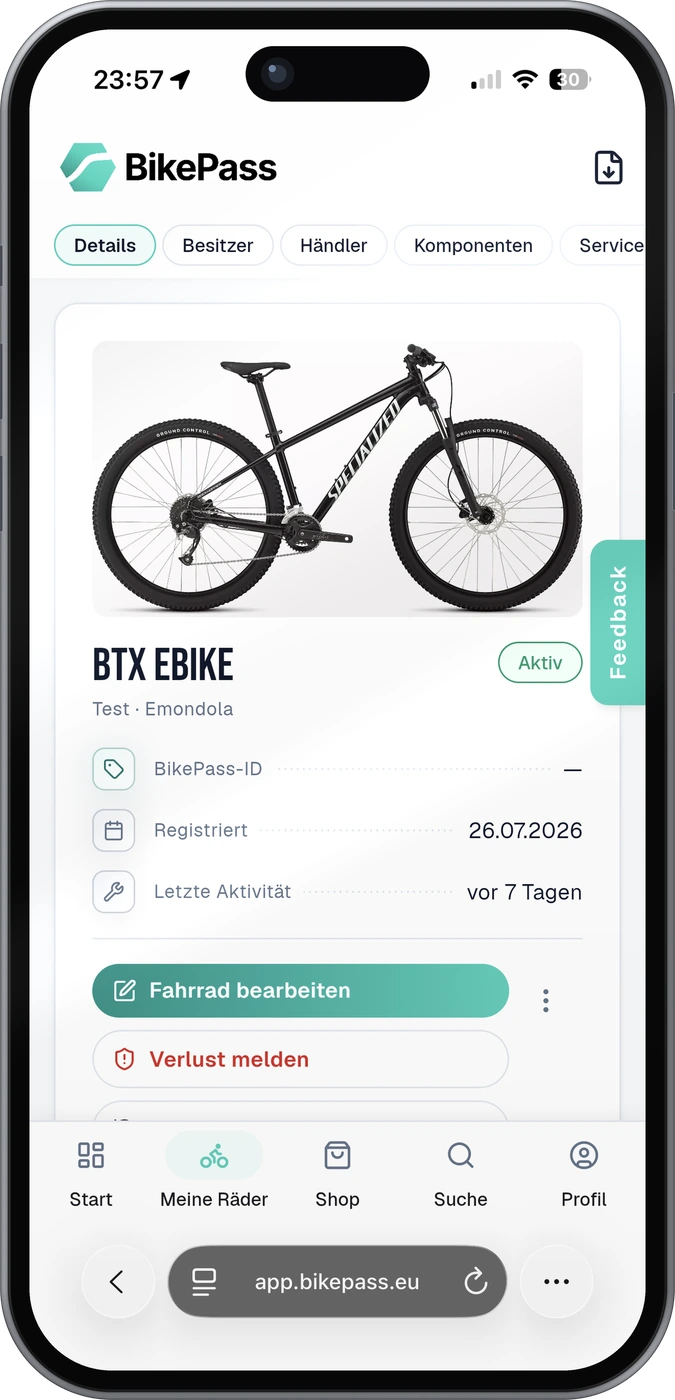
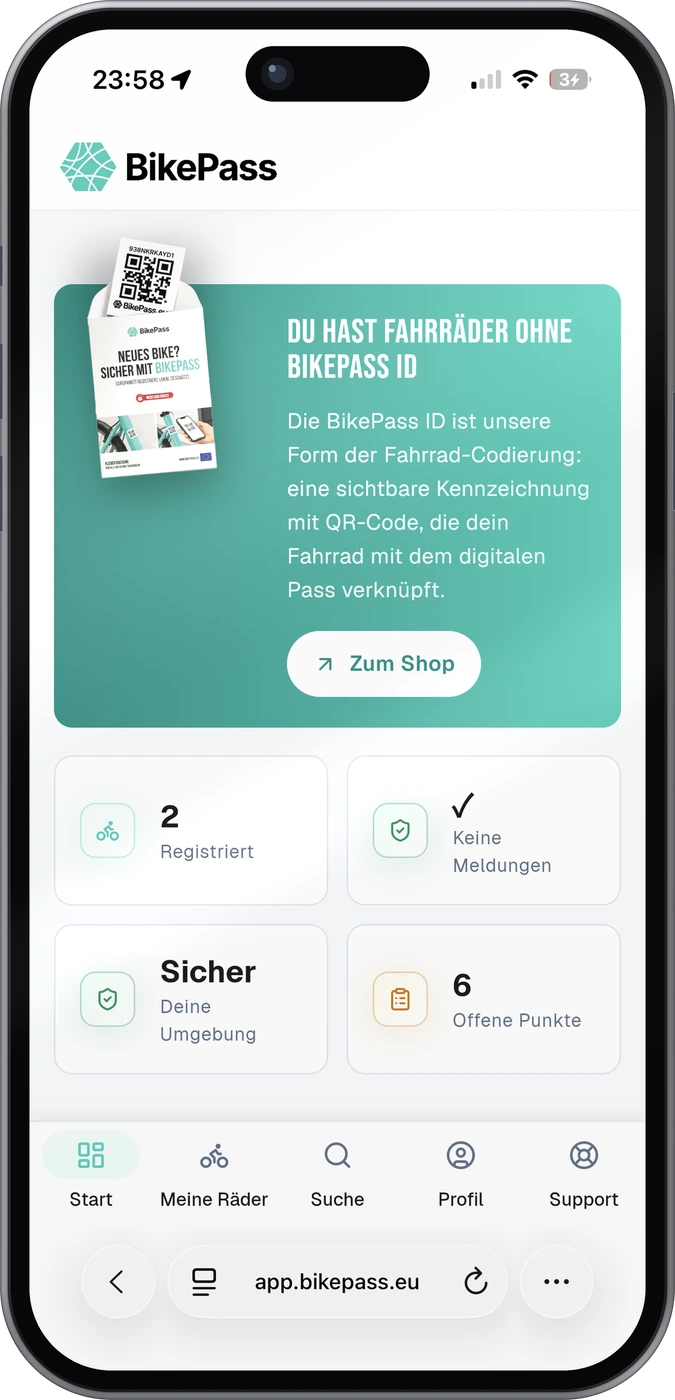
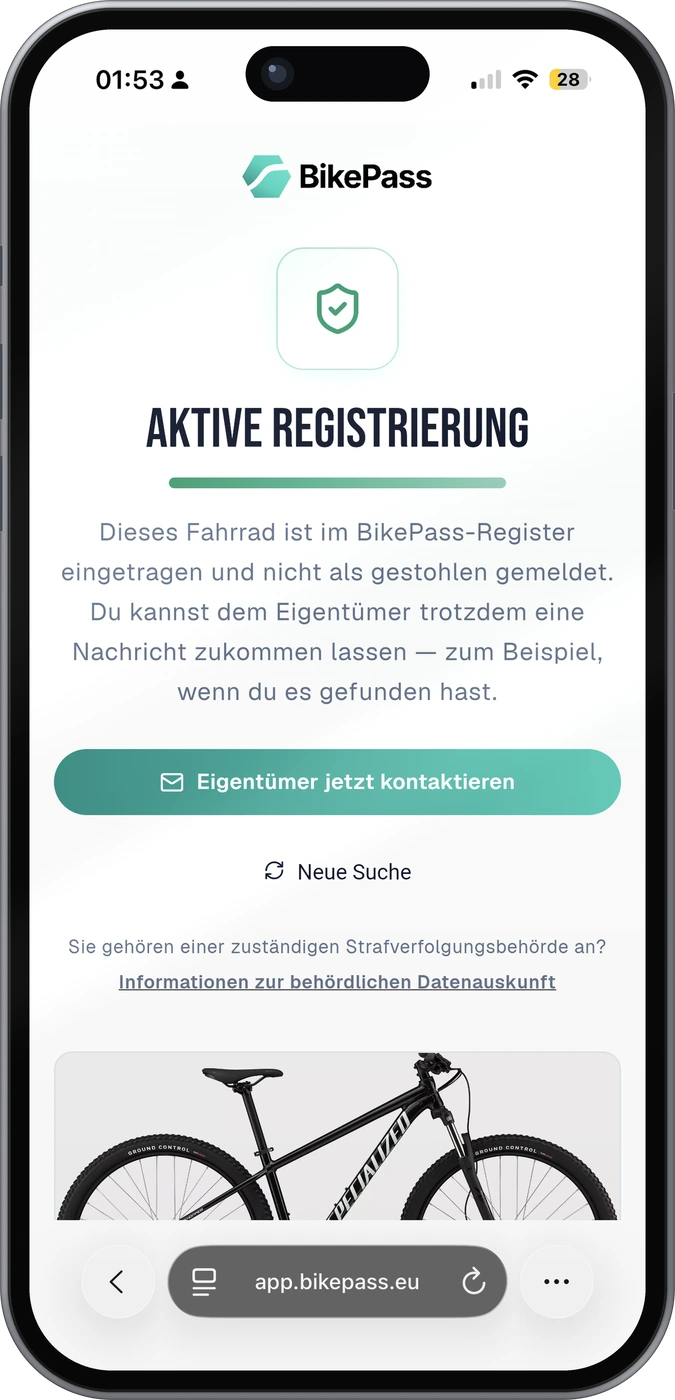
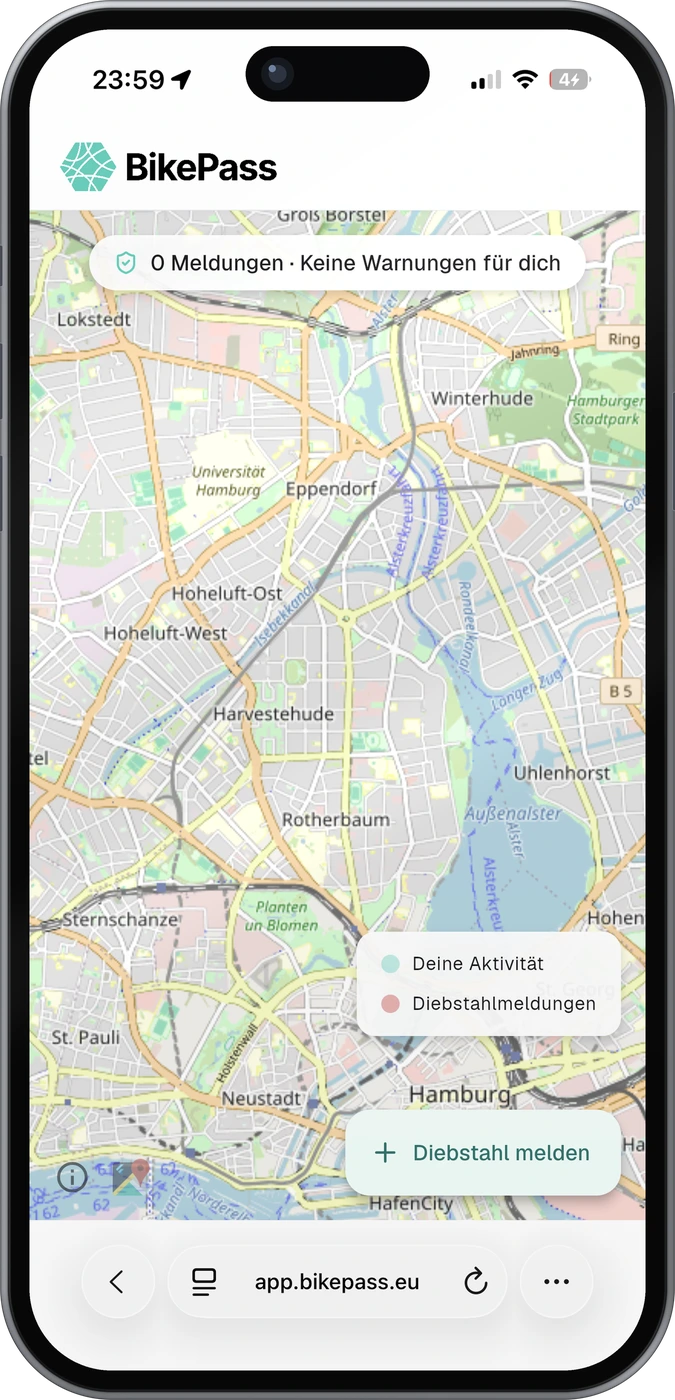
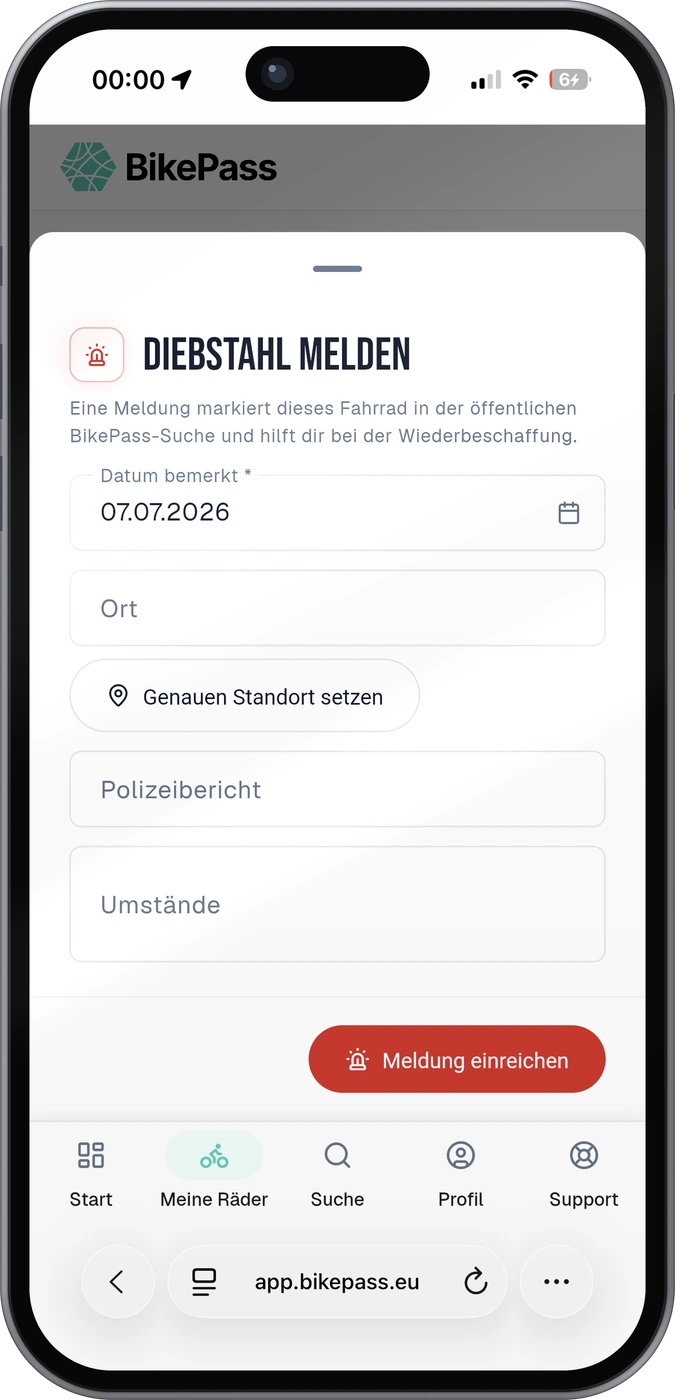
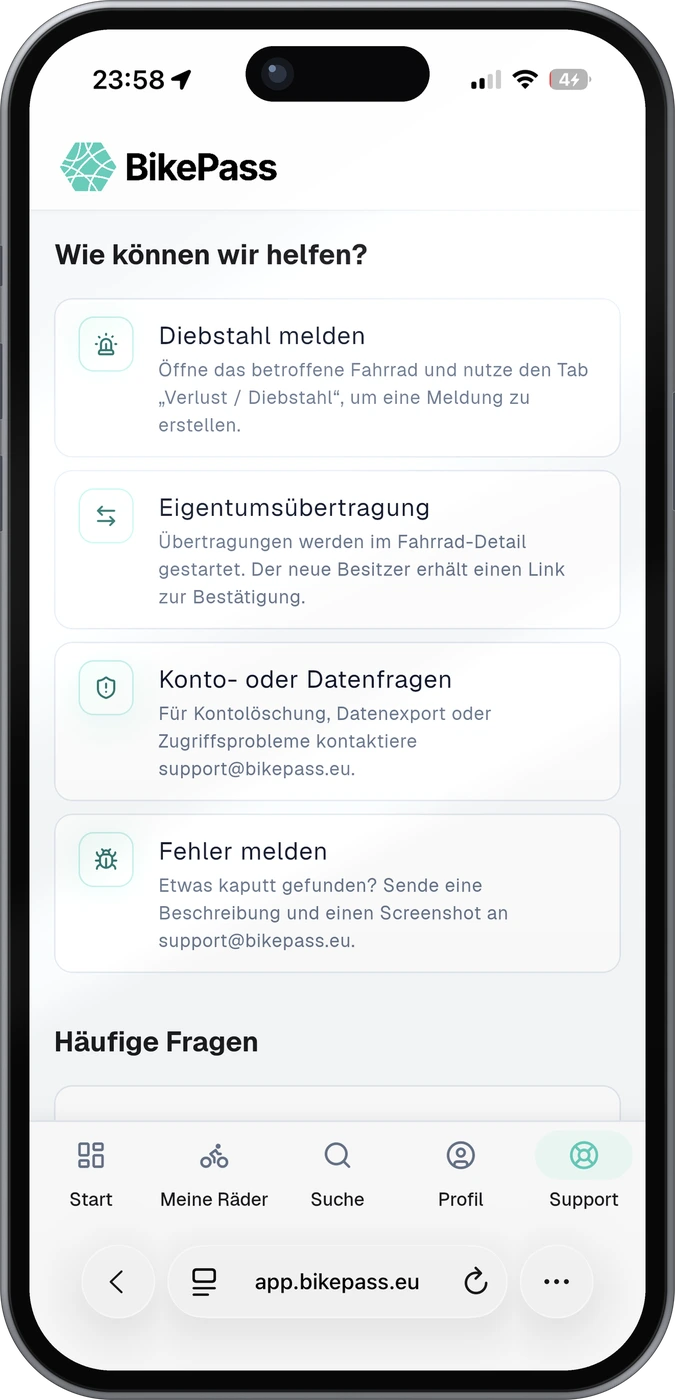
Afterwards: the link to you. With BikePass you store your frame number, photos and purchase receipts free of charge as digital proof of ownership, which you share with the police or your insurer if the worst happens. You report a theft directly in the web app, after which the BikePass ID is visible to authorities and finders can get in touch anonymously. If you like, you can add a tamper-proof security marking set with a sticker and QR code, which you fit yourself at home, with no appointment and no tools. Our guide “Register your bike” shows how registration works in practice.
That gives you the full picture: the lock holds, the tracker shows, the proof proves. If one link falls away, the next one still helps.
And the blue dot from the beginning, at seven in the morning? It is worth exactly as much as what you can put beside it: a police report, a frame number, a few photos of the bike. With those things the dot becomes an address and the bike becomes yours again. Without them it stays a circle wobbling around a back yard.
Your tracker checklist
- Chosen the technology deliberately: GPS tracker with SIM, Bluetooth tag or built-in tracking on the e-bike?
- Checked the battery life at the actual reporting interval and worked out a realistic way to charge it?
- Clarified ongoing SIM or subscription costs before buying?
- Chosen a mounting spot that cannot be reached without tools, and tested reception there?
- Activated the motion alarm and set the sensitivity so that it does not trigger constantly?
- Do others in your household who ride the bike know that a tracker is fitted?
- Using a lock, frame number, photos and receipts alongside the tracker?
We write about bike theft, security marking and digital theft protection – practical, without scaremongering and with real steps you can take.
See all guides