In short
The same steps apply to an e-bike as to a bicycle, plus three special features: tracking via the manufacturer's system or a tracker, the police report with frame, battery and motor numbers, and a higher value that decides the insurance question. What you do in the first few hours determines what remains possible afterwards.
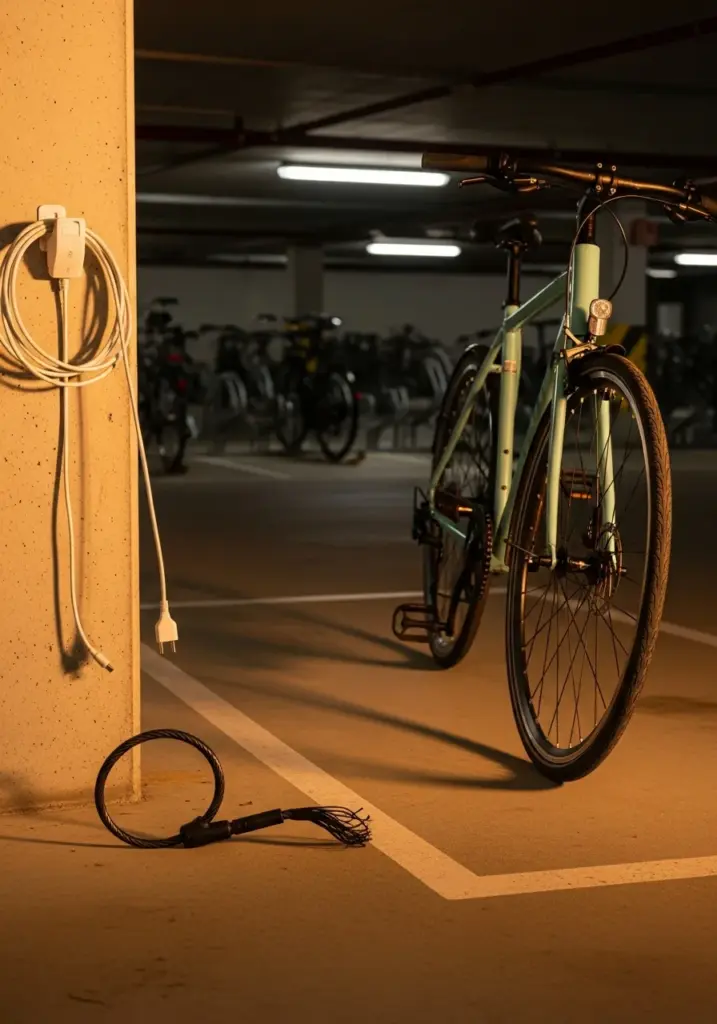
The bike rack outside the station is full, but at your spot a cut lock lies on the paving. Next to it, nothing. With an e-bike this moment is more expensive than with any other bike, and the reflex to reach for your phone straight away is, for once, the right one.
In 2025, victims across Germany reported around 214,000 bicycle thefts, a fall of 13 % on the previous year. Only about one case in nine was solved; the clearance rate stood at around 11 % (source: the German police crime statistics, Polizeiliche Kriminalstatistik 2025). Our guide to bicycle theft statistics for Germany shows how these cases are spread across the cities.
A quick word on terms, so we mean the same thing: an e-bike theft is the theft of a pedelec including its drive unit, where not only the frame disappears but, with battery and motor, two components that can be resold separately. This is not simply a more expensive bicycle theft, but a case with its own logic: three identifying numbers instead of one, a possible tracking trail, and an insurance question that rarely arises so sharply with an everyday bike. With an e-bike, the value does not sit in the frame alone. It is spread out.
Can you track a stolen e-bike?
An e-bike can only be tracked if a tracking system was fitted and activated beforehand. Nothing works retrospectively. So first open the app for your drive system and check whether a tracking or locking function is available for your model. If it shows a location, take a screenshot with the time immediately.
The same goes for a separate tracker: document the location and the time before you do anything else. Also note how long the position has been unchanged. That detail helps the police judge whether a quick trip there makes any sense at all.
The four ways an e-bike can be found at all differ more than the advertising suggests. What matters is not how precisely a system tracks, but whether it is still transmitting when it counts:
| Tracking method | What it can do | What it cannot do | When it makes sense |
|---|---|---|---|
| Manufacturer's drive system | Lock the motor via the app and, depending on the system, show recent positions. | Without power or without the function activated it stays completely silent. | Always activate it if your drive offers it. It costs nothing. |
| Permanently fitted GPS tracker | Report the position even over long distances, as long as the battery and mobile network hold up. | Prevent the theft. It only reports what has already happened. | For high-value e-bikes and cargo bikes that are often parked outside. |
| Bluetooth finder in the frame | Provide a rough trail in a busy area, if other devices are within range. | Report anything at all in an empty warehouse or a cellar. | As a cheap addition, never as your only protection. |
| Registration & security marking | Link a recovered bike clearly to you, even months later. | Show live where your e-bike currently is. | Always. It is the only route that still works after the theft. |
Read the “What it cannot do” column from top to bottom and the pattern is unmistakable: not one method covers everything. Tracking tells you where your bike is. It tells nobody who owns it. You will find more on the technology and its limits in our guides to GPS trackers for bikes and AirTags on your bike.
Should you go to the displayed location yourself?
No. Do not go to the location yourself, however tempting the flashing dot on the map may be. You do not know who is there, whether your bike is even still there, or whether only the tracker has been passed on.
Here is the catch: even if all goes well and you get your e-bike back, you may have no evidence that it is yours. Without the frame number, photos and a receipt, it ends up as your word against someone else's. Instead, pass the location on in your police report or by phone and let the police take over. That takes longer. But it holds up.
Which numbers belong in the police report for an e-bike?
All of your e-bike's unique identifiers belong in the report, not just the frame number. Battery and motor are often sold separately, because without the frame they are hard to recognise. With the serial number noted down, they stay identifiable anyway.
Where to find each number and what it counts for when it matters:
| Identifier | Where to find it | What it counts for | What it does not do |
|---|---|---|---|
| Frame number | Usually stamped on the bottom bracket shell, less often on the rear stays or head tube. | Linking the complete bike to you during a check, a search and with the insurer. | Nothing, if the battery and motor turn up separately. |
| Battery number | Printed or laser-etched on the battery casing, often next to the charging port. | Proof for the most expensive single part, which is traded separately. | It does not prevent the resale, it only makes it traceable. |
| Motor number | On the housing of the mid-mounted motor, often readable from below. | Linking the drive unit to you, even if the frame was long since resprayed. | It only helps if you noted it down beforehand. |
| Security marking or register ID | On the sticker on the frame and in your digital bike passport. | Quick identification without hunting for stamped numbers. | It does not replace filing a police report. |
A note on the legal side: if a lock was broken open, this generally counts as an aggravated case of theft under § 243 StGB. So mention any traces on the lock or at the parking spot in your report. Our guide “Reporting a bicycle theft” explains how a police report works and what belongs in it. Where exactly the frame number sits is shown in “Find and check your frame number”.
What does a motor lock such as Bosch eBike Lock achieve?
A manufacturer's motor lock makes the e-bike less attractive to thieves, because the assistance stays off. Bosch eBike Lock is the best-known example, and other drive manufacturers now offer similar functions. We deliberately avoid the details of individual systems, because the range of functions and their availability depend on the drive, model year and update status. If in doubt, ask the manufacturer of your drive unit.
The principle is similar everywhere: with the motor locked, the bike can still be pushed and pedalled, but the drive stays dead. For an opportunist thief, that is a strong argument to move on.
What a motor lock cannot do: prevent the bike being carried off. A locked motor stops nobody from lifting the bike into a van and stripping it for parts elsewhere at leisure. That is exactly why a good lock remains the basis, and the motor lock is the bonus on top.
Does insurance pay out after an e-bike theft?
Whether your insurer pays depends on the policy you hold and where the e-bike was standing. An e-bike generally counts as home contents, but outdoors the cover usually only applies with a bicycle clause. That clause is normally capped at a percentage of the sum insured, and with a high-quality drive system this limit is quickly too low.
A look at claim amounts shows how big the gap can be: in 2025, insurers paid out for around 115,000 insured bikes with roughly EUR 150 million, an average of EUR 1,270 per bike, a record figure (source: GDV, the German Insurance Association, 2025). If you ride an e-bike worth well above that average, know your policy before something happens.
| Cover | What it usually covers | What it often does not cover | What to check |
|---|---|---|---|
| Home contents without a bicycle clause | Theft from locked rooms, such as a locked cellar. | Theft from the street or from a bike rack. | Does the policy list “bicycle theft” as a separate point at all? |
| Home contents with a bicycle clause | Theft outdoors too, provided the bike was locked up. | Amounts above the compensation limit and often accessories. | Maximum sum, night-time clause, required type of lock. |
| Standalone bicycle insurance | Usually broader cover including theft of parts, depending on the provider. | Wear and tear and, in many tariffs, grossly negligent parking. | Excess, replacement value and deadlines for reporting. |
| Company bike via leasing | Often theft protection included in the leasing package. | Your leasing instalments. Depending on the contract, they continue. | Who reports the claim: you, your employer or the provider? |
The company bike row surprises many people. A leased e-bike is insured, but the monthly instalment is tied to the leasing contract, not to the bike. So check when you sign up what happens to the instalment in the event of theft. Our guides on home contents insurance and bicycle theft and on the question of which insurance pays for a stolen bike go into what clauses, limits and alternatives actually mean.
Tip: Report the theft to your insurer on the same day you notice it, and send the police confirmation afterwards. Many policy conditions require an immediate report, and “immediate” is not a period you should stretch.
What applies if only the battery or motor was stolen?
Theft of parts also belongs in a police report, even if the frame is still on the rack. The battery is attractive to thieves because it comes off without tools and sells inconspicuously without a frame. That is exactly why noting the battery number pays off.
With insurance, things get murky at this point. In many policies the battery, motor and display unit count as accessories or attached parts, and are then only covered to a limited extent, independently of the frame. Whether your policy treats the battery like part of the bike or like a bag on the pannier rack is stated solely in your terms and conditions. If in doubt, ask in writing.
And the practical part: take the battery with you when you park your e-bike, or lock it separately. A bike without a battery is far less interesting for a quick grab.
Where does technology no longer help with e-bike theft?
Time for the uncomfortable part. Once the bike is gone, the very features many people paid for fail, and for four entirely mundane reasons.
Power. A disconnected or removed battery shuts down every drive-linked system. No power, no tracking, no immobiliser.
Radio shadow. A tracker in an underground car park, a container or a warehouse simply does not report in. Thieves know that.
Time. Hours often pass between the last location point and your police report. In that time an e-bike changes location, sometimes also its appearance: new paint, different attached parts, swapped battery.
Proof. This is the harshest gap. Recovered bikes regularly end up in lost property offices and auctions because nobody can prove who owns them. A clearance rate of around 11 %, that is one figure. The other, invisible one: how many of those could never be returned to their owners. Our guide “Recovering a stolen bike” describes how to improve your chances.
What do you do in the first hours after the theft?
The basic steps for an e-bike are the same as for any other bike, just with three extra actions. In this order:
- Check and document tracking – open the drive system app, query the tracker, save a screenshot with the time.
- Record place and time – even approximate details are better than none.
- File a police report – with the frame, battery and motor numbers, photos and the saved location.
- Inform your insurer – on the same day, send the police confirmation afterwards.
- Involve your local network – neighbours, local groups on social networks, specialist dealers nearby.
The full instructions for the first hour are in our emergency guide “Bike stolen – what to do?”. Simply add tracking, the extra numbers and the insurance question from this article to those steps.
How do you protect your next e-bike better?
Prevention with an e-bike consists of three building blocks: a lock that matches the value, activated immobiliser and tracking functions, and proof of ownership that is still there when both of those have failed. As a rule of thumb for the lock, budget around 10 % of the bike's value, which with a high-quality drive system is quickly more than most people plan for.
The best time to set up proof of ownership is while you can still get to the bike undisturbed. Photograph the frame, battery and motor numbers, add the purchase receipt, plus a few photos from different angles, including the scratches and stickers by which you would recognise your bike if in doubt.
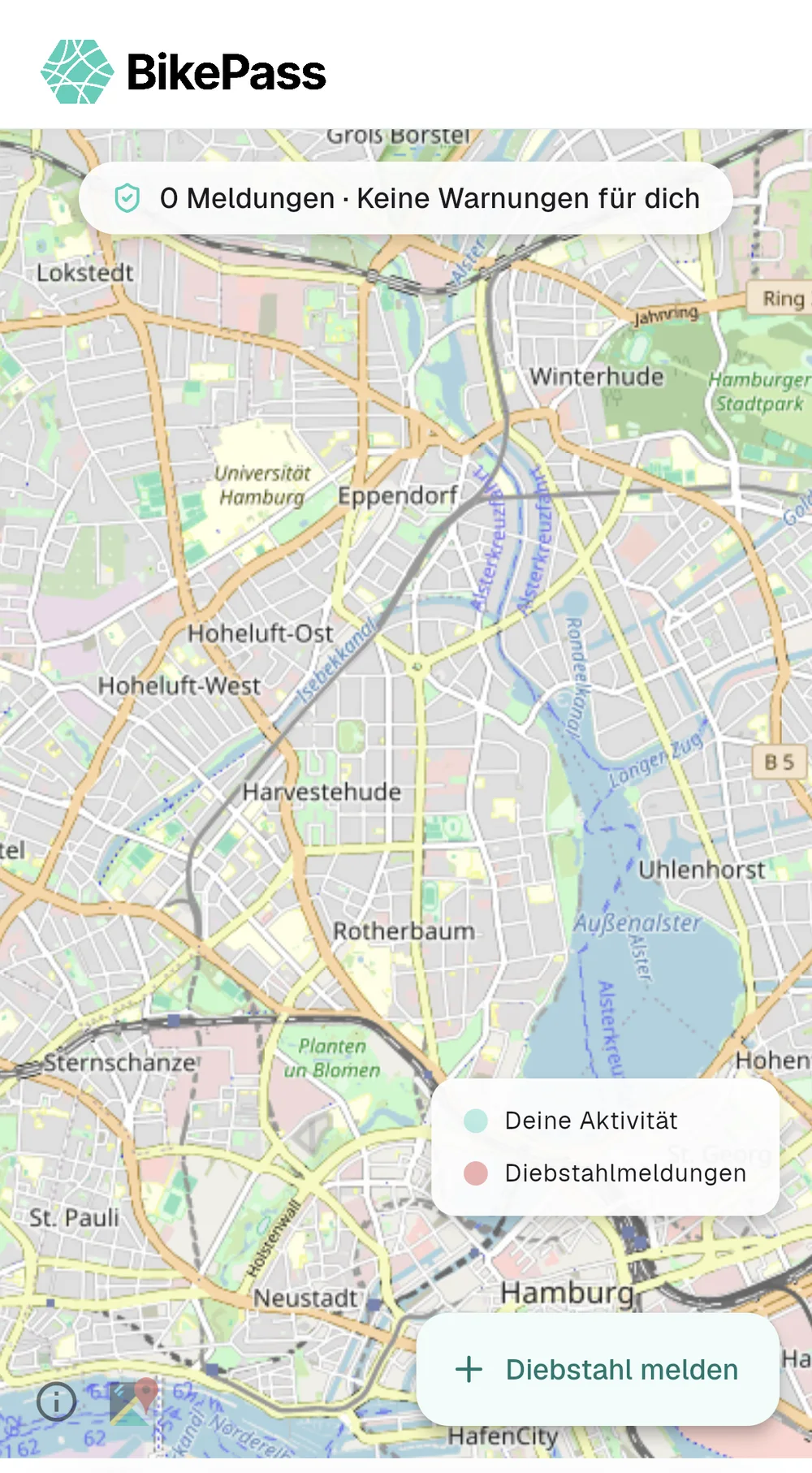
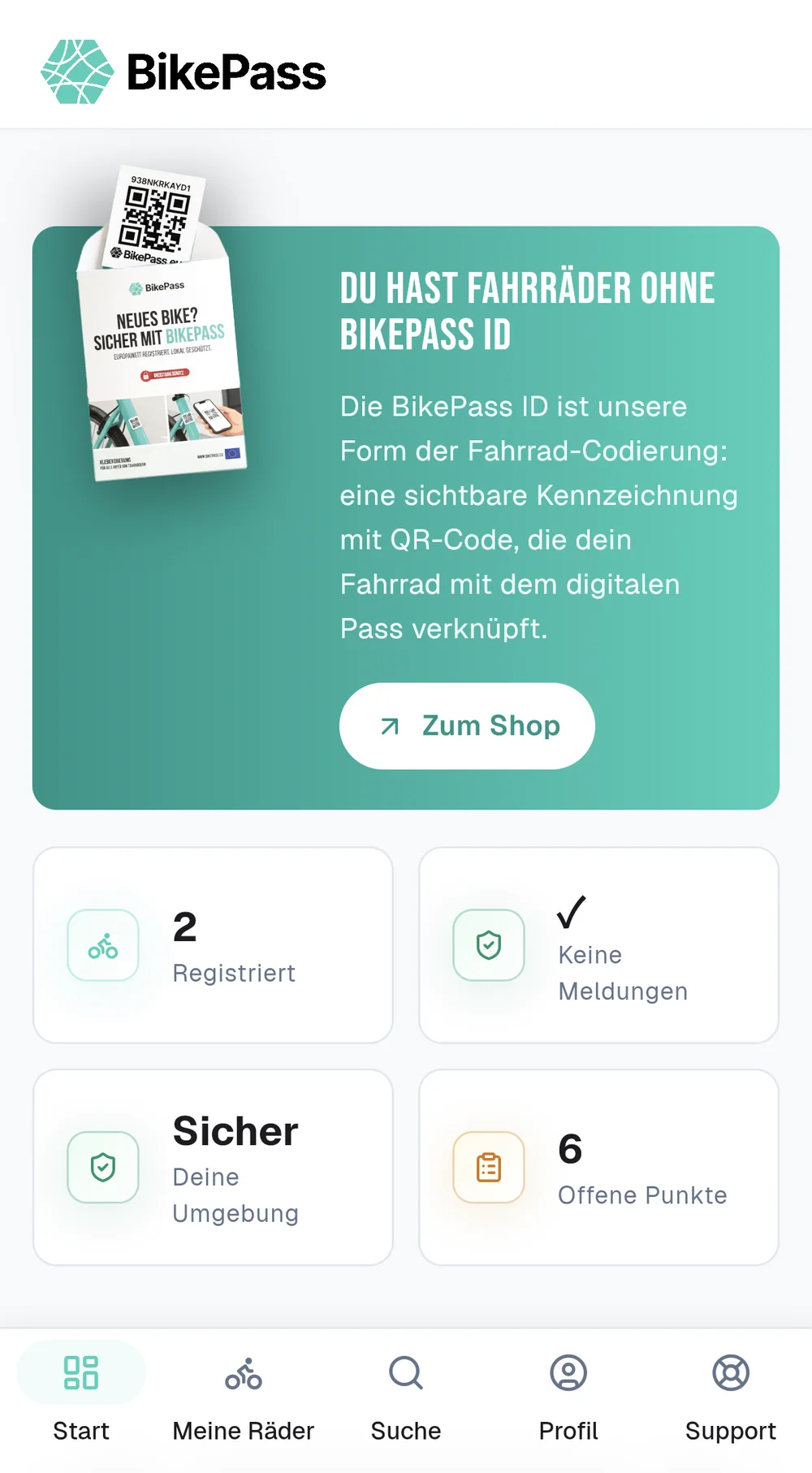
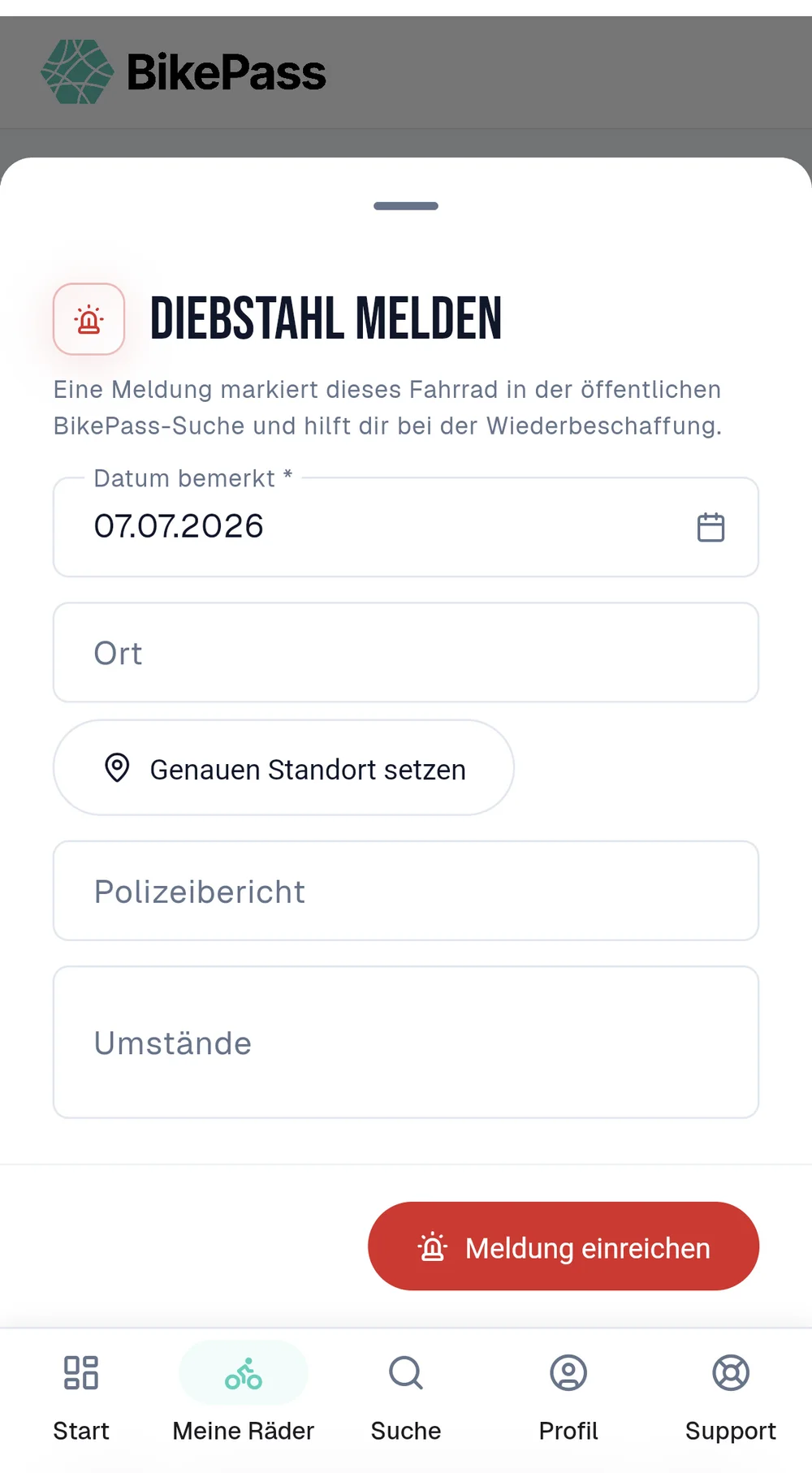
With BikePass you store exactly that free of charge as digital proof of ownership: frame, battery and motor numbers, photos and receipts bundled in one place, shareable with the police and your insurer. Registration takes under 3 minutes, works across the EU and covers any number of bikes. If you report a bike as stolen, the ID is visible to authorities, and finders can contact you anonymously. What else matters when protecting pedelecs is set out on our topic page on e-bike theft protection.
And the cut lock outside the station? It still lies there even if you did everything right. The difference is what you hold in your hand at that moment: an identification number, a photo, a receipt. That turns “my bike is gone” into a case someone can work on.
Your e-bike checklist
- Tracking checked via the manufacturer app or tracker and documented with the time?
- Location passed to the police instead of driving there yourself?
- Police report filed with the frame, battery and motor numbers?
- Insurer informed on the same day, police confirmation sent afterwards?
- Policy checked for a bicycle clause, compensation limit and accessories rules?
- Purchase receipt, photos and all numbers stored digitally, for this bike and the next one?