In short
When a bike is stolen, one of three parties pays: your home contents insurance with a bicycle clause, a specialist bicycle insurance policy, or nobody. From a locked cellar, home contents cover usually applies; outside at the station, only with an add-on module. Which option applies to you is set out in your contract, not in the marketing copy.
The bike rack outside the station is full, but your space is empty. A cut lock lies next to it. And before the shock has even worn off, the second question pushes to the front: who pays for this now?
Around 214,000 bike thefts were reported across Germany in 2025, and only about one in nine cases was solved (source: the German police crime statistics, Polizeiliche Kriminalstatistik 2025). Whether an evening like that hits you financially is not decided at the empty bike rack. It is decided months earlier, in a few lines of your contract.
The term that almost everything revolves around is the bicycle clause. The bicycle clause is an add-on module in your home contents insurance that also covers theft of your bike away from your home, ties this cover to conditions and caps the payout at a share of the sum insured. It is not a policy of its own, but an extension of your existing home contents contract. Without it, cover ends at the cellar door. And that is exactly where daily life starts for most bikes.
Which insurance pays when your bike is stolen?
In a bike theft, exactly three parties come into question: your home contents insurance, a specialist bicycle insurance policy, or your own bank account. There is no fourth option, and none of the three steps in automatically. Which one applies depends above all on where the bike was standing when it disappeared.
Insurers distinguish between two cases. In a burglary theft, someone overcomes a physical barrier, such as a locked cellar door. In a simple theft, the bike stands in a freely accessible spot on the street and is cracked open along with its lock. Home contents insurance is built for the first case; for the second, it needs help.
The overview below shows who is usually responsible in which parking situation. Check the row closest to your daily routine, because that is where your risk is decided:
| Where the bike was standing | Home contents without bicycle clause | Home contents with bicycle clause | Specialist bicycle insurance |
|---|---|---|---|
| Locked cellar or flat | usually pays, provided there was a break-in | usually pays | usually pays |
| Communal cellar with no lock on the door | often disputed, because there is no break-in | covered depending on the conditions | mostly covered, depending on the tariff |
| Station, city centre, commute | does not pay | pays up to the compensation limit | usually pays the replacement value |
| Outside at night, between 22:00 and 06:00 | does not pay | restricted depending on the night-time clause | mostly without a time window |
| Only parts gone: battery, wheel, saddle | does not pay | mostly not covered | often included, depending on the tariff |
All details are standard market patterns, not tariff specifics. What applies in your case is set out solely in your insurance conditions. The rest of this guide helps you read them.
When does home contents insurance pay – and when does it not?
Home contents insurance reliably pays for bike theft when the bike was stolen from a locked space: flat, cellar, locked garage. That is its core business, because your bike counts as household contents there, just like the sofa or the washing machine. Once it stands outside, it leaves this protected space.
For outside, you need the bicycle clause. And even with it, three brakes remain in the contract that many people only trip over when they make a claim.
The compensation limit. A cap at a small share of the sum insured is standard, often a low single-digit percentage. Work out that share in euros once before you rely on it. In many contracts the limit is well below what a modern e-bike costs.
The night-time clause. Older tariffs exclude thefts between 22:00 and 06:00 if the bike stood outside unused during that time. Anyone who comes home late in the evening and locks the bike outside the front door falls exactly into this window.
The policyholder duties. Almost all tariffs require a separate lock and a police report. Without a police report, no insurer settles, however good your contract may otherwise be.
We take apart how these clauses work in detail, and how to spot them in your conditions, sentence by sentence in the guide Home contents insurance and bike theft. And if your claim has already been refused, Insurer refuses to pay after a bike theft will help you further.
What does a specialist bicycle insurance policy cover?
A specialist bicycle insurance policy insures exactly one bike instead of your entire household and usually reimburses the replacement value after a theft, with no percentage cap. That makes it not a better home contents contract, but a different cut: narrower in its subject, broader in its scope of cover.
What many policies additionally cover is almost always missing from home contents contracts. Theft of parts is one, meaning the grab for the battery, wheel or saddle. So are crash and vandalism damage, repairs after an accident or breakdown assistance. Some tariffs also drop the night-time clause, which makes the decisive difference for commuters.
The catch: the scope varies widely between providers, and premiums depend on the bike’s value and the cover package. A look at the conditions is worth at least as much here as with your home contents contract. What drives the premium and when it starts to pay off is something we work through in the guide What does bicycle insurance cost.
Home contents or a bicycle policy: what can each do, and what not?
The most honest comparison is the one that also names the gaps. The table therefore sets each strength against its matching weakness, so you can see which option suits your parking situation:
| Option | What it can do | What it cannot do | When it makes sense |
|---|---|---|---|
| Home contents with bicycle clause | Covers your bike and the rest of your household in one contract, usually for a small surcharge, with no second policy. | Pays only up to the compensation limit, often with a night-time window and without theft of parts. | When the bike’s value is clearly below the limit and the bike mostly stands in the cellar. |
| Specialist bicycle insurance | Usually reimburses the replacement value and, depending on the tariff, covers theft of parts, vandalism and crash damage. | Costs a premium of its own, applies only to the registered bike and still excludes gross negligence. | For high-value bikes, e-bikes and daily use outdoors. |
| No cover | Saves every premium and every contract check. | Replaces nothing, not even parts, and leaves you to carry the full replacement value alone. | Only for an old bike whose loss would not really hurt. |
Two things stand out as you read. First, no option covers everything. Second, in both cases the third column is the reason people are surprised when they claim. The gaps are in the contract, just further back.
What does it cost you to have no insurance at all?
Without insurance you carry the full replacement value of your bike yourself, and that value is higher on average than most people assume. In 2025 insurers compensated around 115,000 bikes and paid out roughly 150 million euros for them, an average of EUR 1,270 per bike, a record figure (source: GDV, the German Insurance Association, 2025). Without a policy, exactly that amount lands on your bill.
That does not mean every bike needs a policy. For an old everyday bike you could replace cheaply, the risk is acceptable. But the decision should be a conscious one, not the result of never having opened your home contents policy.
The third option is usually not a decision at all. It is an oversight with an invoice attached.
Which cover suits your bike?
The choice comes down to a single calculation: the compensation limit of your home contents policy in euros against the new value of your bike. If the new value is higher, home contents cover no longer closes the gap. The table translates that into typical everyday situations:
| Your situation | Usually sufficient | Worth checking | Why |
|---|---|---|---|
| Old everyday bike, in the cellar at night | Home contents without add-on | Bicycle clause, if you occasionally park outside | The bike value stays below every common compensation limit. |
| Solid city bike, at the station every day | Home contents with a bicycle clause | Look for the night-time clause in the contract | Outdoors, home contents cover only applies with the clause, and the time window hits commuters first. |
| E-bike or cargo bike | rarely anything on its own | specialist bicycle insurance including theft of parts | New value and battery value regularly exceed the home contents limit. |
| Several bikes in the household | Home contents as the basis for the cheaper bikes | A separate policy for the most expensive bike only | The answer may differ per bike, but the limit still applies jointly. |
With e-bikes it is worth taking an extra look at the battery, because it can be unbolted and stolen on its own. Our overview of e-bike theft protection shows which building blocks belong together.
Tip: No policy replaces a good lock, and many contracts require one. As a rule of thumb, budget around 10 % of the bike value for the lock. There is more on our page about theft prevention for your bike.
Where does even the best policy stop helping you?
Even the best bicycle insurance replaces money, not your bike. These four limits rarely appear in the advertising copy.
Gross negligence. A bike leaning unlocked against a fence is practically never insured. A lock that only runs through the frame and not around a fixed object can also lead to a reduced payout.
The evidence. Insurers settle what you can prove. Without a frame number and a purchase receipt, your bike becomes an unspecified bicycle on the claim form, and unspecified bikes are compensated poorly.
The bike itself. The saddle that fits perfectly, the gears you have run in, the trailer that only fits this coupling: none of that comes back, even when the transfer arrives. And a stolen bike that turns up later often ends up in lost property rather than with you, without clear proof of ownership.
The time in between. Weeks usually pass between the police report and the payout, and you still have to get to work. That is why prevention remains the cheaper insurance: lock it properly, park it in plain sight, register your bike.
What do you need when you claim, whichever insurer pays?
Every settlement, whether home contents or a bicycle policy, requires practically the same three items of evidence: the police report with its reference number, the frame number of your bike and a purchase receipt or other proof of value. If one of them is missing, the process stalls, and in the worst case it stops altogether.
Our guide reporting a bike theft shows how to file the report correctly. Where the frame number hides on the frame is explained in finding and checking the frame number.
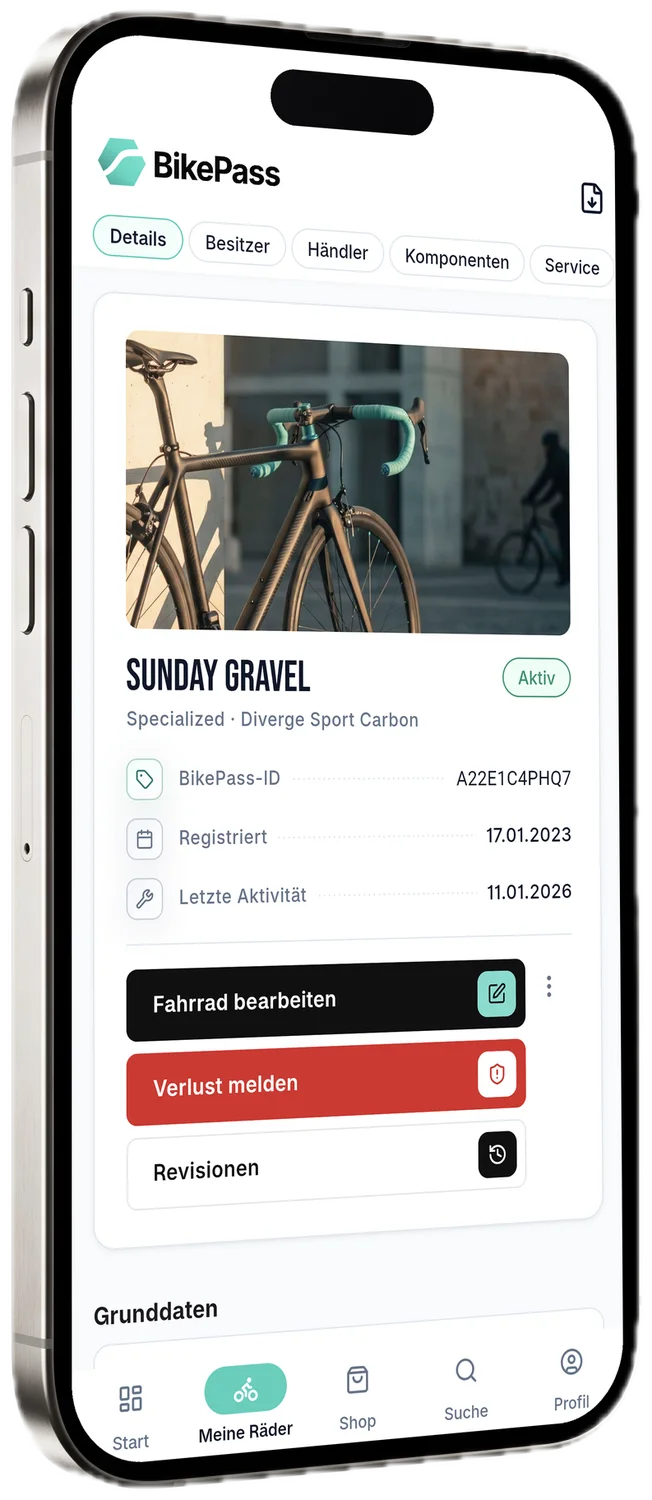
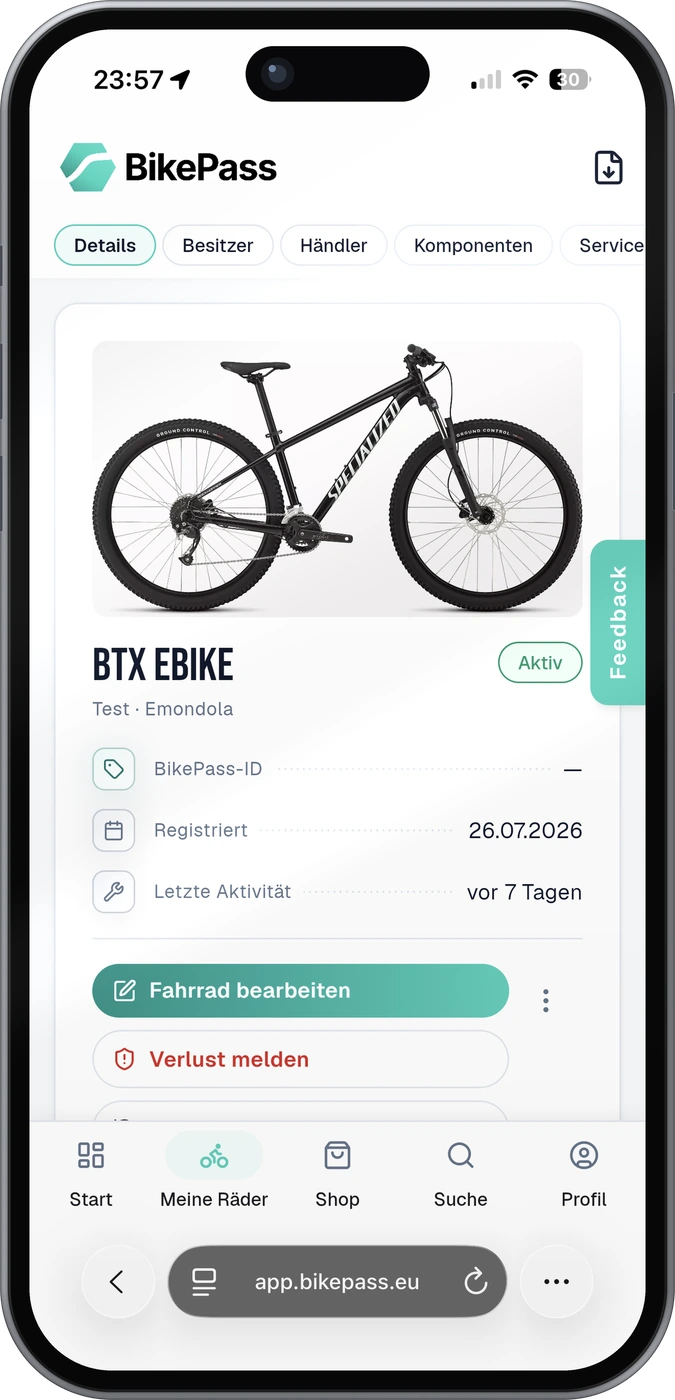
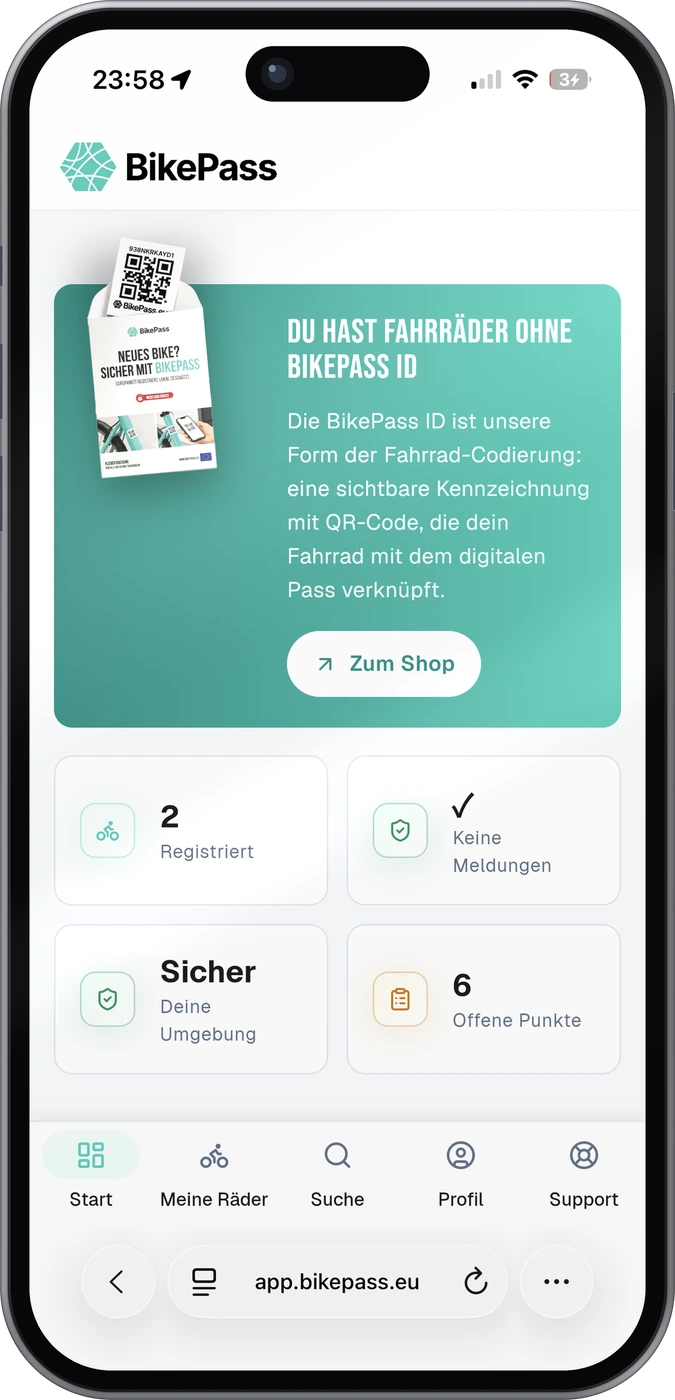
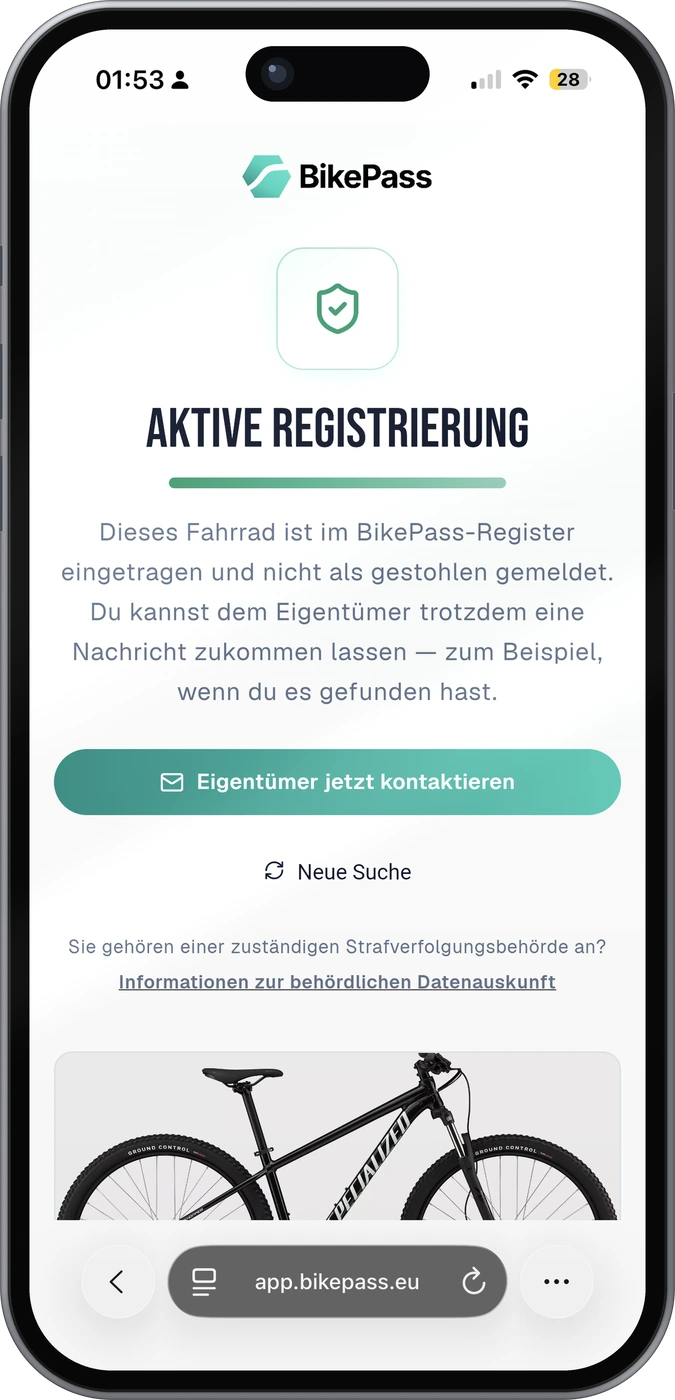
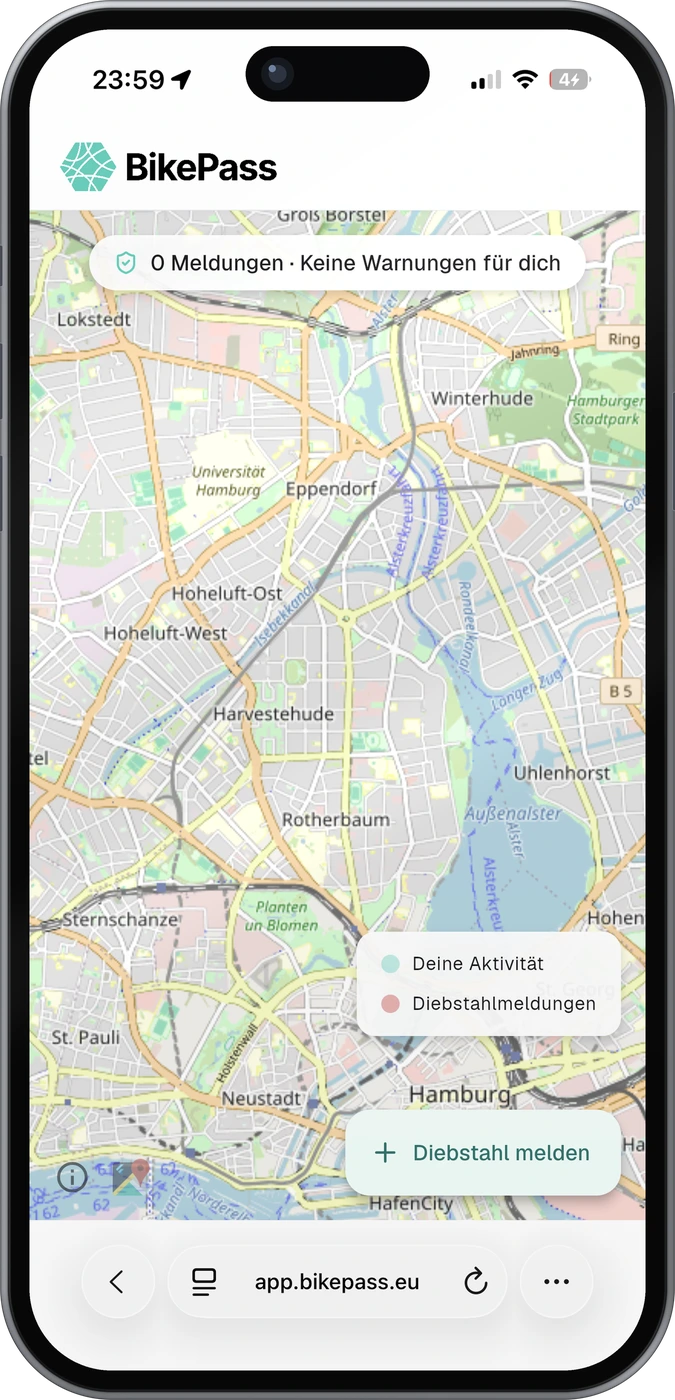
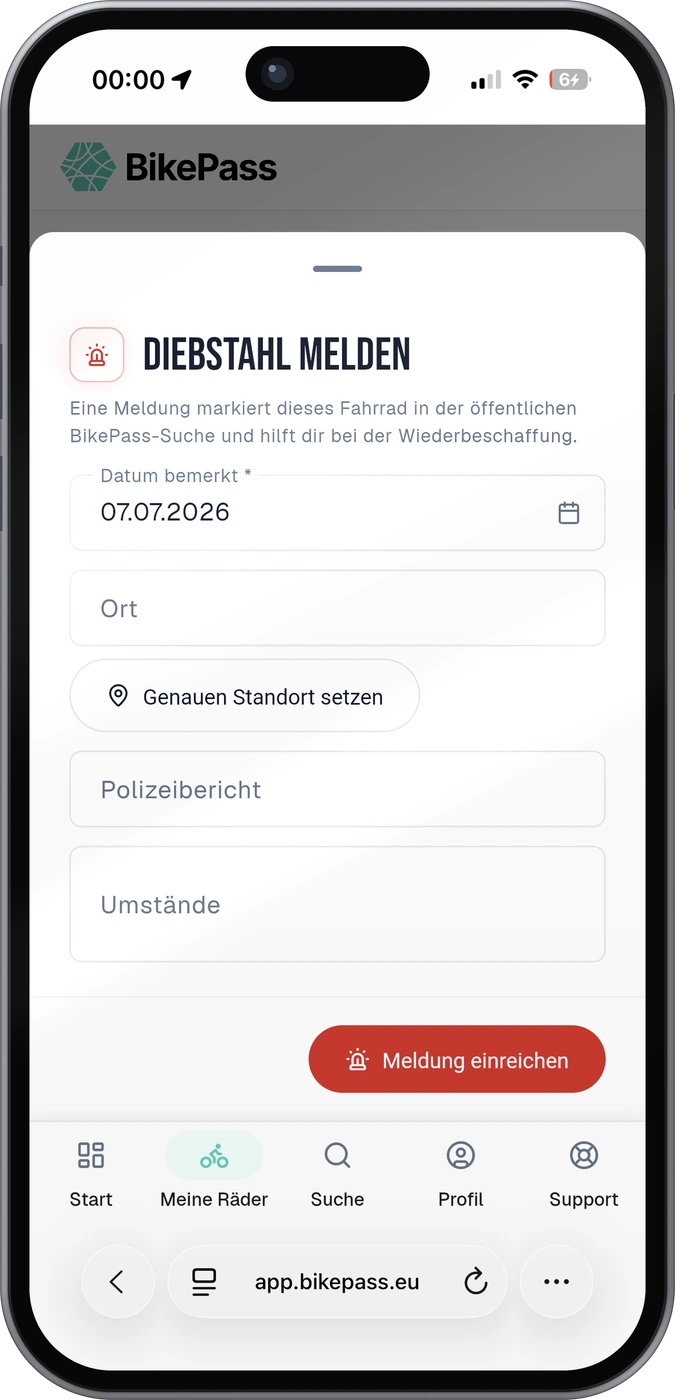
The difference between a relaxed claim and a gruelling one lies in whether these documents are already together beforehand. With BikePass you store your frame number, photos and purchase receipts free as digital proof of ownership, in under three minutes and for as many bikes as you like. If the worst happens, you share the whole package directly with the police and your insurer instead of rummaging through drawers. If the bike is already gone, you report the theft in the web app: the ID becomes visible to the authorities, and honest finders can get in touch anonymously.
Back to the empty bike rack at the station. The evening goes completely differently for two people, even though the same thing happened to both: one knows her bicycle clause, has the frame number and receipt on her phone and files the report in ten minutes. The other starts by looking for the invoice. The difference is not created at the bike rack, but long before it.
Your insurance checklist
- Dug out your home contents policy and checked it for a bicycle clause?
- Worked out the compensation limit in euros and compared it with the new value of your bike?
- Looked for the night-time clause and checked whether your parking habits fall inside that window?
- For an e-bike or a high-value bike: costed out specialist bicycle insurance including theft of parts?
- Read the lock requirement in the contract and using a suitable lock?
- Stored the frame number, photos and purchase receipts digitally, separately for each bike?
We write about bike theft, security marking and digital theft protection – practical, without scaremongering and with real steps you can take.
See all guides