In short
You report a bike theft either online through your federal state’s internet police station or in person at the station. A frame number, purchase receipt and photos turn a vague report into a usable police report. Without a case reference number, no insurer pays out.
At the station, the front wheel is still in the rack, locked as always. The rest of the bike is gone. In that moment you realise you do not know which frame number was actually on the frame.
You are far from alone: in 2025, around 214,000 bike thefts were reported in Germany, 13 % fewer than the year before, and roughly one in nine cases was solved (clearance rate around 11 %, source: the German police crime statistics (Polizeiliche Kriminalstatistik) 2025). The police report is still the first step you must not skip.
First, a definition: a criminal complaint for bike theft is an informal notification to the police that puts the theft on record, enters your bike into the wanted database via the frame number and gives you a case reference number for your insurer. It is not an application that someone approves or rejects, but a report that every station must accept. What it is not: a search operation. Nobody drives off to look for your bike. The report ensures your bike gets an entry that any patrol can see during a check. It opens doors, it does not bring anything back.
01Is it better to report online or at the station?
Both routes lead to the same police report with a case reference number; they differ only in convenience and speed. Each federal state runs its own online station, usually called “Internetwache” or “Onlinewache”. You find it by searching that term together with the name of your federal state. We deliberately do not list specific addresses here, because portals move and forms get renamed.
Going to the station is always worthwhile when the case is still fresh or complicated.
The comparison shows how to judge that. Focus less on the effort involved and more on the question of whether your case invites follow-up questions:
| Route | What it can do | What it cannot do | When it makes sense |
|---|---|---|---|
| Your federal state’s online station | Take your report around the clock, without waiting, giving you time to look up the frame number and receipt. | Cannot resolve follow-up questions in conversation or arrange forensic work at the scene. | The theft happened hours or days ago and you have all the details to hand. |
| Local police station | Clear up uncertainties on the spot, take witness statements, advise you on what to do next. | Not staffed around the clock; waiting time is possible. | You have witnesses, leads on the offender, or are unsure what to enter. |
| Police emergency number | Send officers immediately if the theft is happening now or you are being threatened. | Cannot replace the later police report. | Offender still in sight, threatening situation, theft just happened. |
For the standard case, the unspectacular Monday morning with an empty bike rack, the online report is the more convenient route. You gather your details calmly and type them in at the kitchen table, instead of reconstructing them from memory while standing up. If you have only just noticed your bike is missing, work through the emergency guide “Bike stolen, what now?” first. Then come back here.
02What details do the police need for a bike theft?
The police need six details to turn your theft into a workable case: frame number, purchase receipt, photos, time of the offence, place of the offence and a description of the lock. The rest is optional.
The frame number is the only detail that distinguishes your bike from thousands of identical ones. It is usually stamped into the bottom bracket, the seat post or the head tube. Our guide “Find & check your frame number” explains exactly where.
The following table shows what each detail is needed for in the process and what happens if it is missing. Read the right-hand column above all, because that is where the price of every gap is listed:
| Detail | Why the police need it | If it is missing |
|---|---|---|
| Frame number | Unambiguous listing in the wanted database. | Your bike stays a nameless black trekking bike among many. |
| Purchase receipt or invoice | Proof of ownership and current value. | The insurer asks questions and the claim stalls. |
| Photos of the bike | Recognition by paintwork, components, scratches. | A recovered bike is harder to match to you. |
| Time of the offence | Placing it within series of offences and patrol patterns. | The case has no time anchor; a time window is perfectly enough, though. |
| Place of the offence | Jurisdiction of the station, analysis of hotspots. | The case gets passed around until the right unit has it. |
| Condition of the lock | Legal classification of the offence and proof that the bike was secured. | The insurer doubts whether it was locked at all. |
Witnesses are the seventh, optional point. Even a vague lead such as “the neighbour saw someone at the rack around seven” belongs in the form, because the police decide whether anything comes of it, not you.
Tip: Lay out all six details side by side before you open the form. Many online stations end the session after a while, and then you type everything again.
03How does the online report work step by step?
In every federal state, the online report consists of four stages: find the portal, choose the theft form, enter the details, save the confirmation. The button labels differ, the process does not.
Find the portal. Search for “Internetwache” plus your federal state. Each state runs its own portal; responsibility generally lies with the state where the offence happened, not the one where you live.
Choose the form. Most portals offer “Anzeige erstatten” and behind it a selection by offence. Take “Diebstahl” or, if available, “Fahrraddiebstahl” directly.
Enter the details. First your personal data, then the time and place of the offence, then the bike with frame number, make, colour and distinguishing features. At the end comes a free-text field for what happened. Write there in full sentences what you know, and separate observation from assumption clearly.
Save the confirmation. After submitting, you receive an acknowledgement by email. Save it, print it if necessary, and note the case reference number somewhere you will find again in four weeks.
Two special cases are common. First, some federal states require a personal signature at the station for the final report; the form will say so. Second, you can usually submit the form without a frame number. In that case, enter everything else as precisely as possible and supply the number later, as soon as you get it from old paperwork or from your dealer.
04What does the police report actually achieve?
The report does three things, and none of them is getting your bike back. It creates the evidence for your insurer, it puts your bike into the police search database and it classifies the offence legally. If you mix those up, you will be disappointed later.
The table sorts out what you can expect from each effect. The middle column is the honest one:
| Effect | What really happens | What does not happen |
|---|---|---|
| Evidence for the insurer | You get a case reference number, and hardly any insurer settles without one. | The report alone does not trigger a payout; proof of value and deadlines remain your job. |
| Entry in the police search database | Your bike is listed via its frame number and shows up during a check. | Nobody actively looks for your bike; a hit is a chance find. |
| Legal classification | A forced lock usually makes the offence a particularly serious case of theft (§ 243 StGB). | The classification speeds up neither the investigation nor your compensation. |
The first point is the one you notice most. Whether your home contents policy applies at all, and what conditions come with it, is covered in our guide “Home contents insurance and bike theft”. And if the settlement drags on, “Insurer refuses to pay” helps you object.
05What happens after the report?
After the report, the police open an investigation and list your bike as wanted. After that it usually goes quiet, and that silence is not a fault in the system.
Bike thefts are rarely solved by classic investigative work. The typical hit happens when a patrol checks someone, queries the frame number and the entry comes up. That is exactly why the quality of your details decides your chances, not how often you follow up.
You should still get in touch in two cases: when you have new information, such as a listing with your bike on a classifieds site, and when you need confirmation for your insurer. Always quote the case reference number, otherwise finding your file takes longer than the call. How to search systematically yourself, without casting suspicion on yourself, is shown in “Recovering a stolen bike”.
If your bike turns up, the police do not call you automatically. They match the find via the frame number, and if that number is missing from the file or was mistyped, your bike ends up in the property store and eventually in a lost property auction. This gap is the most common silent loss after a theft.
06Which mistakes cost you the most?
Four mistakes come up again and again, and all four happen in the first hours after the theft.
Waiting too long. The later you report, the blurrier the time and place of the offence become in your memory. Some insurers also tie settlement to a prompt report. File on the same day, even if some details are missing.
Reporting without the frame number. A report without a frame number is better than none, but it does not create a usable search entry. Submit the number as soon as you have it.
Not saving the case reference number. It is in the confirmation of receipt, not in a separate letter. Delete that email and you will spend a lot of time on the phone later.
Speculating too much. If you accuse a person in the free-text field without having observed them, you push the case in a direction that does not help you. Write down what you saw. The police assess the rest.
07Where does the report not help you?
Time for the uncomfortable truth: the report is admin, not rescue. With a clear-up rate of around 11 % (German police crime statistics, PKS 2025), most cases end without an offender and without a bike.
Three expectations therefore regularly go wrong. The report does not replace proof of ownership: if you only claim a frame number but have neither a receipt nor photos, you stand weak before the police and the insurer. The report also does not speed up any tracking, because the police do not access your GPS tracker and, for a bike, will generally not send a patrol to a home address. And it does not protect you next time.
What remains is the part you control yourself: a good lock, a sensible parking spot, a properly documented bike. The basics are on our page about theft prevention for bikes.
08How do you file the next report in five minutes?
A report takes as long as it takes to find the paperwork. Everything else is typing. If your frame number, receipt and photos are all in one place beforehand, you are done in a few minutes; if you first go through boxes and old emails, you lose half an evening and still type in something inaccurate.
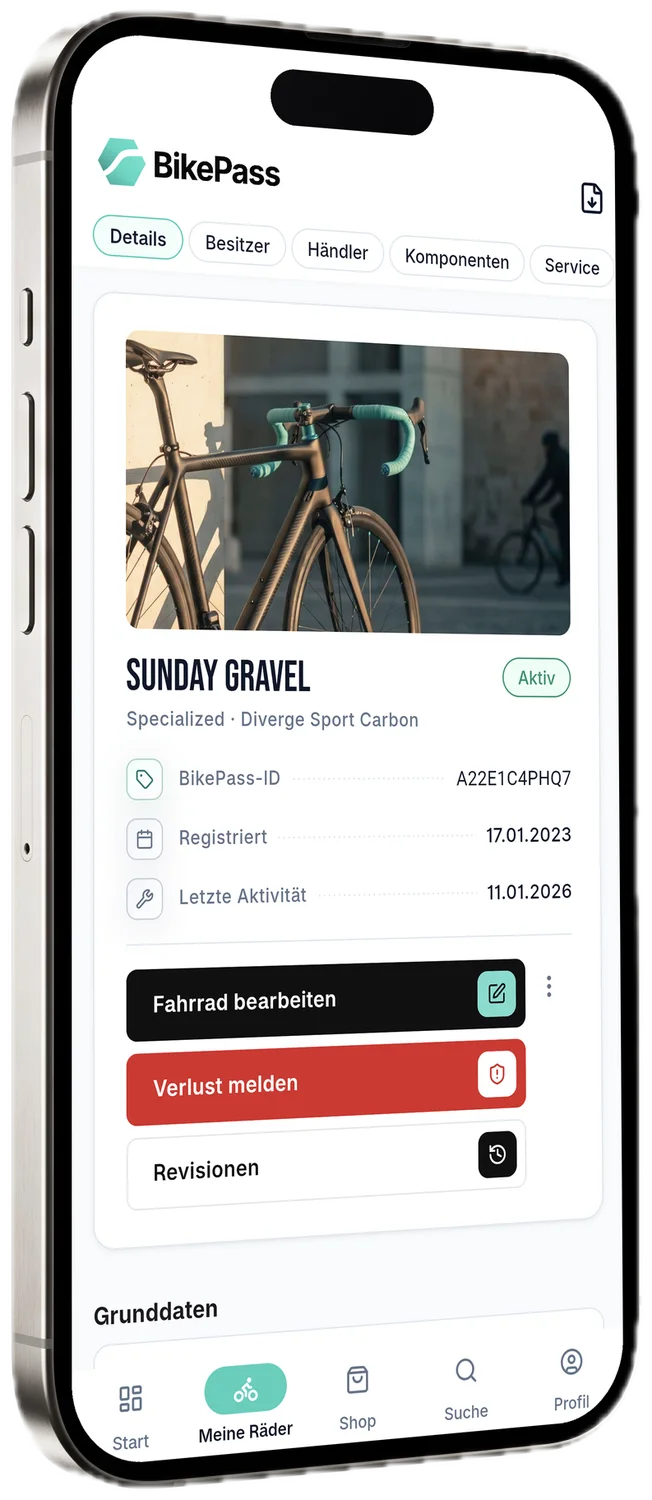
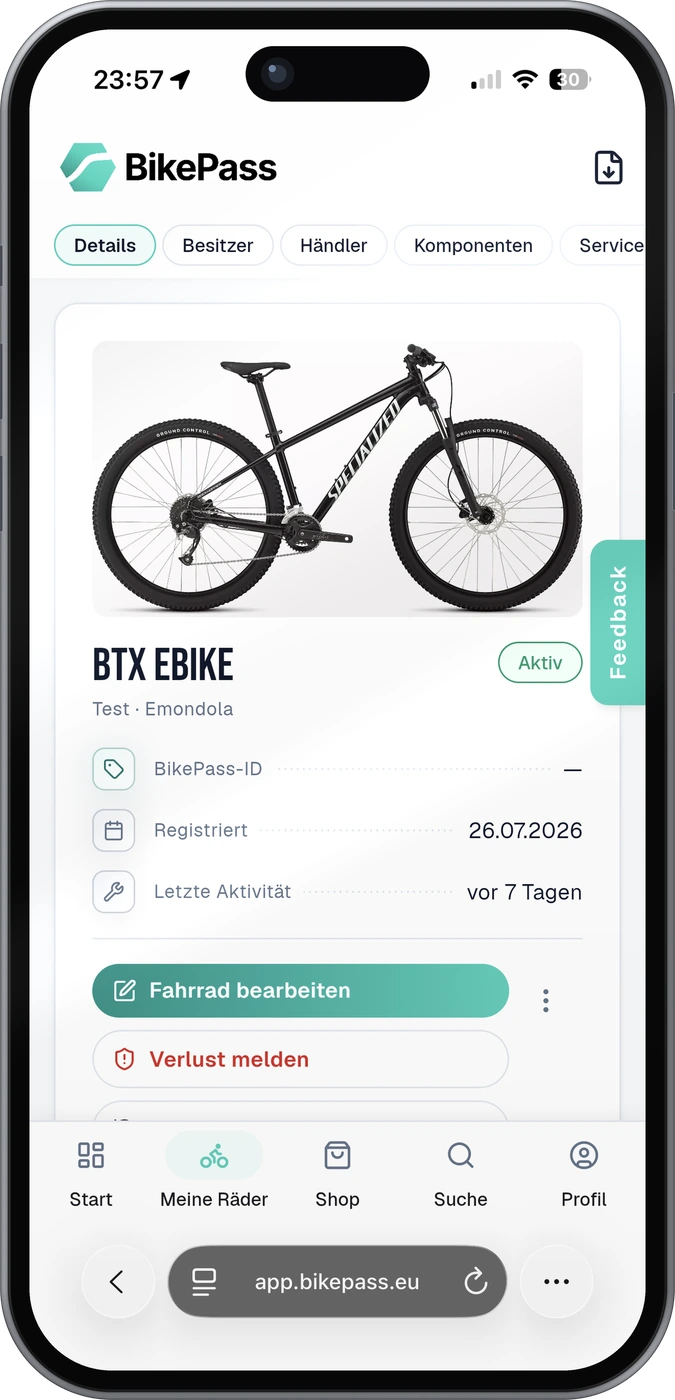
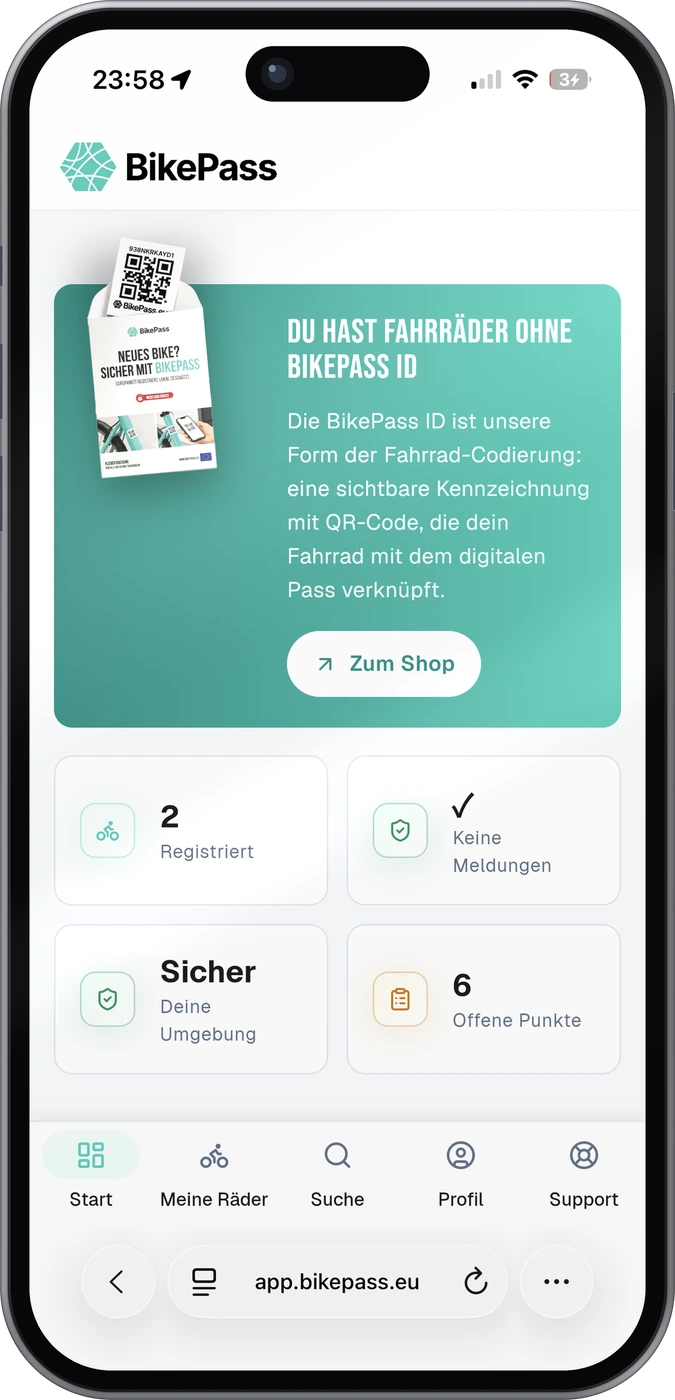
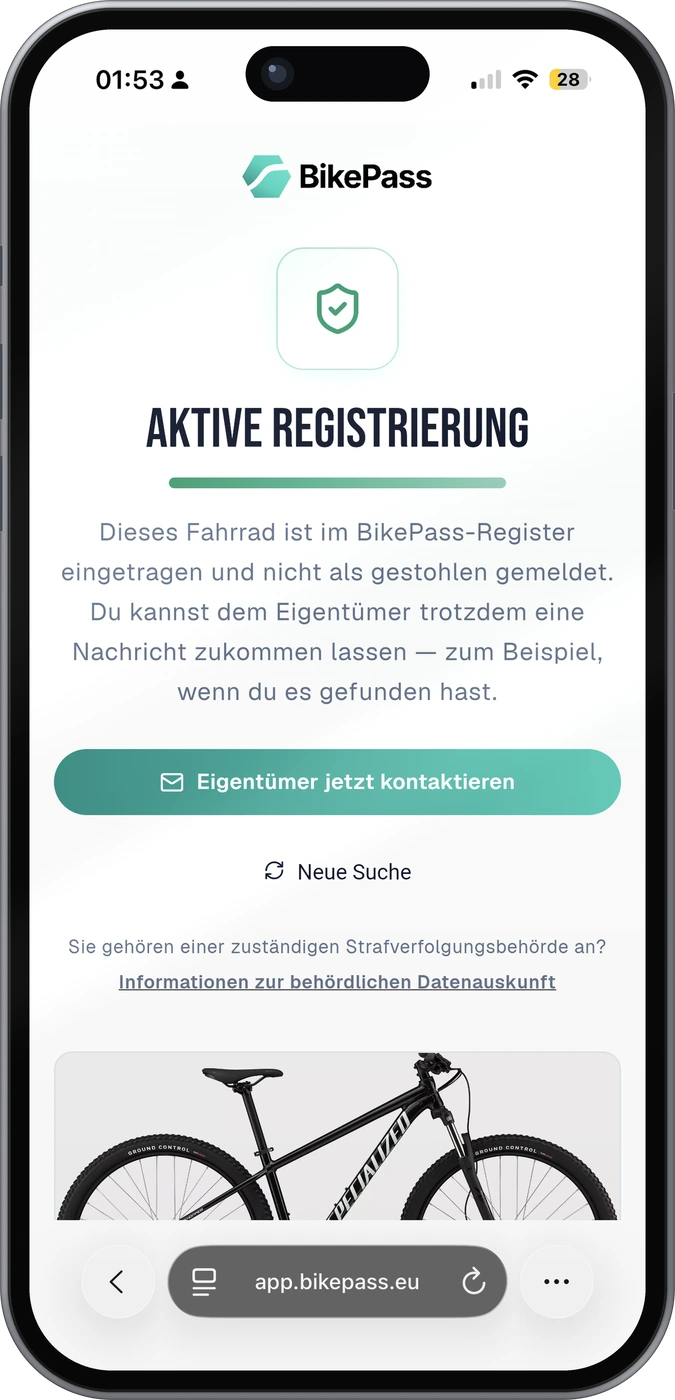
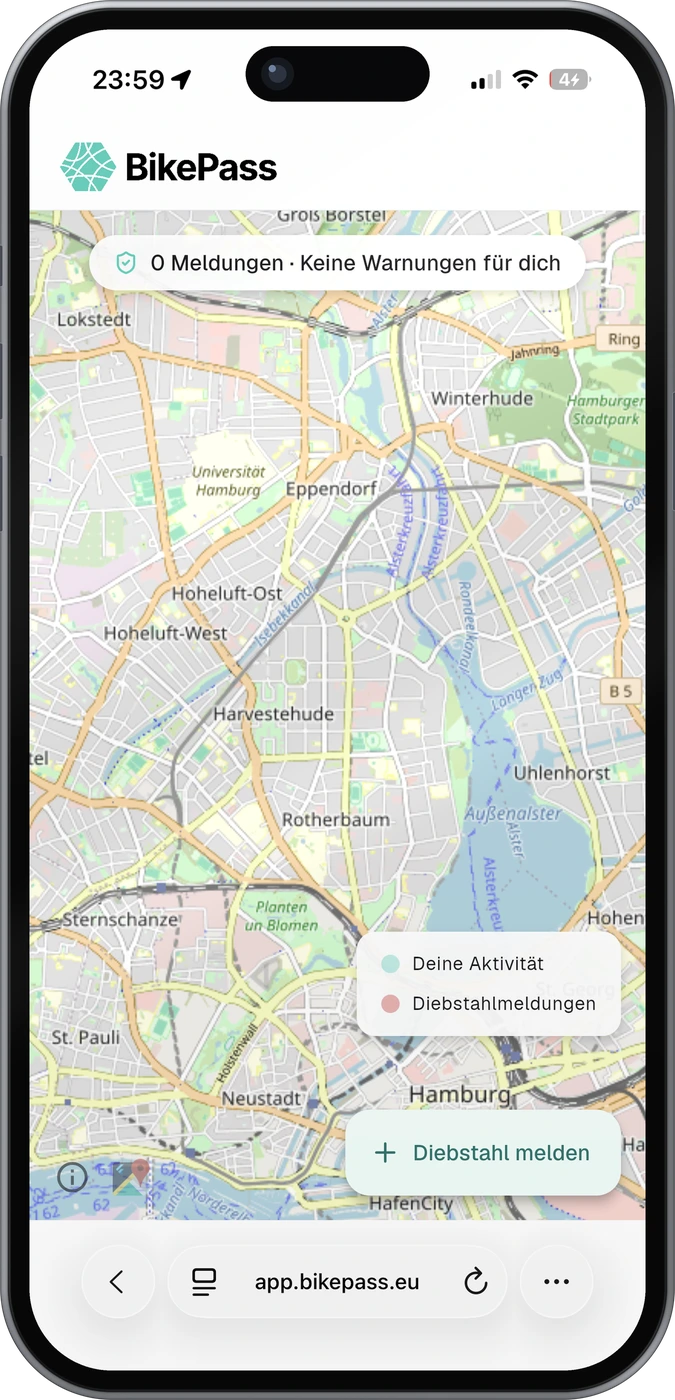
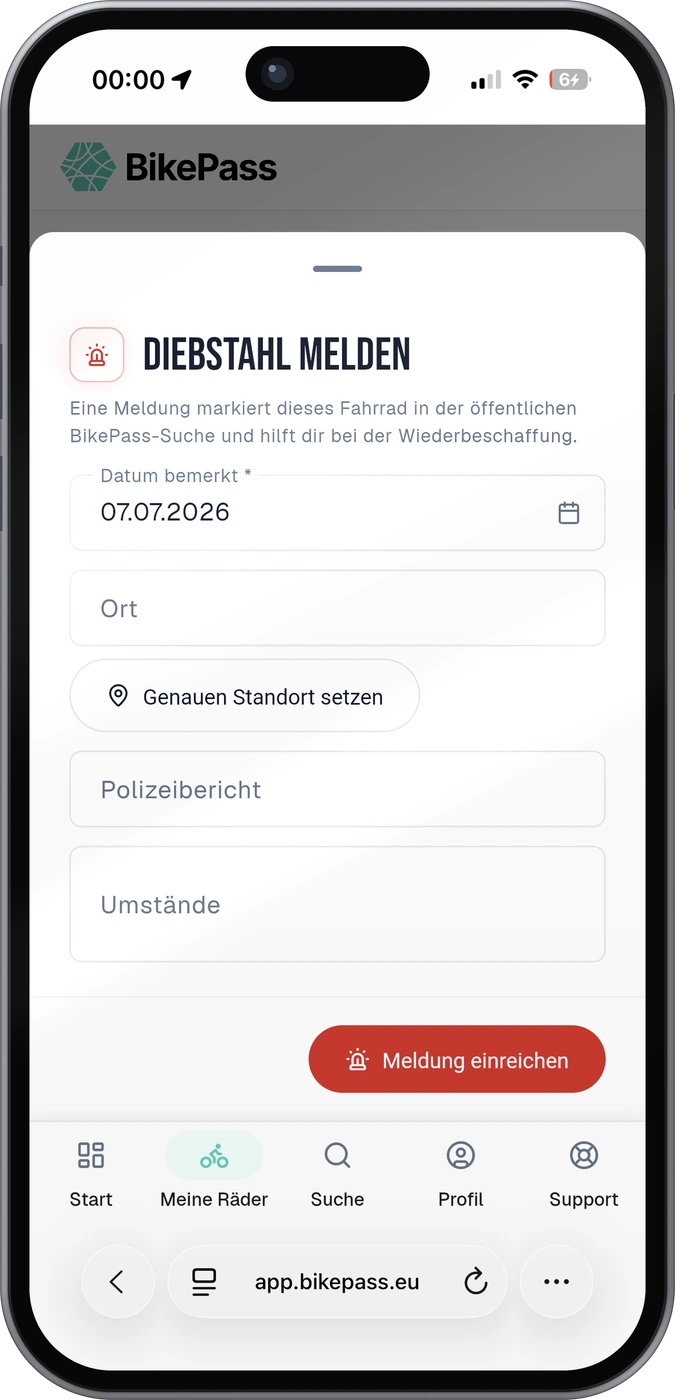
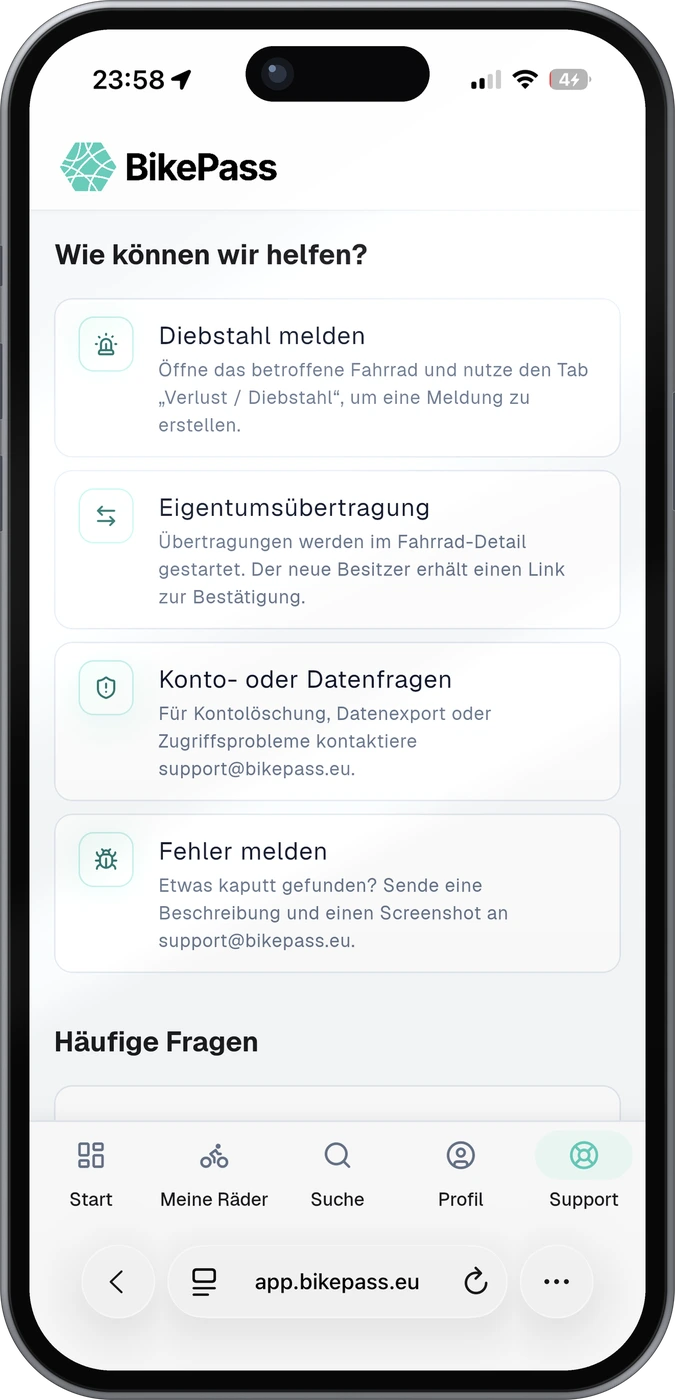
That is exactly what a digital bike passport is for. With BikePass you store your frame number, photos and receipts free of charge in the web app, for as many bikes as you like, hosted in Europe. If the worst happens, you report the theft directly in the app, the BikePass ID becomes visible to the authorities, and finders can get in touch anonymously. The data the report form asks for is then already side by side, ready to pass on to the police and your insurer.
Back to the station and the lone front wheel in the rack. The difference between a bad day and a bearable one is not whether your bike is gone. It is whether you already have the frame number on your phone when you fill in the form, instead of searching your memory for a photo you never took.
Checklist: reporting a bike theft
- Frame number, receipt and photos to hand?
- Time of the offence narrowed down as a window and place as precisely as possible?
- Condition of the lock noted and, if possible, photographed?
- Found the online police station for your federal state or been to the station?
- Free text cleanly split into observation and assumption?
- Confirmation of receipt saved and case reference number noted?
- Insurer informed and case reference number passed on?
We write about bike theft, security marking and digital theft protection – practical, without scaremongering and with real steps you can take.
See all guides