
In short
Security marking means an individual code on the frame that links your bike to an owner. You can have your bike marked at ADFC local groups, at events run with the police, sometimes at specialist dealers, or digitally from home. It only becomes effective once the code is stored together with the frame number, photos and proof of purchase.
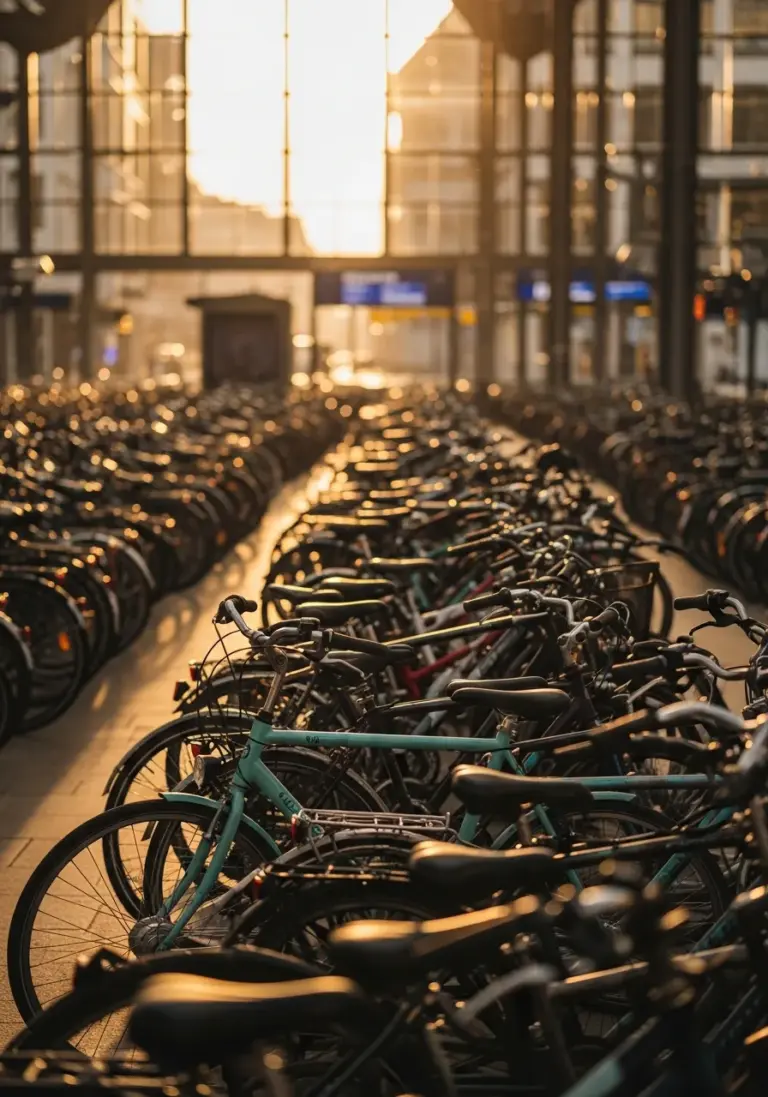
In the found-bicycle depots of local authorities, bikes stand in rows. Good bikes, well-maintained bikes, bikes with child seats. And almost none of them can be linked to anyone.
That is the quiet side of the statistics: in 2025, around 214,000 bicycle thefts were reported in Germany, and only about one case in nine was solved, a rate of roughly 11 % (source: German police crime statistics (PKS) 2025). How these cases are spread across cities is shown in our guide to the bicycle theft statistics for Germany. This is exactly where security marking comes in.
So that we mean the same thing: bicycle security marking is an individual identifier on the frame that clearly links your bike to an owner, makes an inconspicuous resale harder, and gives the police a starting point when a bike is found. It is not a frame number and not a tracking system: the frame number is assigned by the manufacturer and says nothing about who owns the bike. The code, by contrast, points straight to that. But it does not hold anyone back and it does not report in when your bike rolls away. It labels, it does not protect.
What does bicycle security marking really achieve?
Security marking works at two points: before a theft as a deterrent, after a find as identification. The deterrent part is the one you can see yourself. A visibly marked bike is awkward for handlers of stolen goods, because every buyer can read the code and ask questions. Bikes without any marking sell more easily outside the station.
The second part happens without you, often months later. If a bike is seized, the police look for something unique on the frame. If they find a code, it leads to a register and, in the best case, to your name. If they find nothing, the bike ends up in exactly the depot from the start of this article.
In Germany, the most widespread standard is the owner identification number, EIN for short. It encodes the holder’s place of residence and name in a string of characters that trained staff can decode. That also explains a quirk many people trip over: an EIN code is tied to your address. If you move, it no longer matches.
Security marking is therefore no substitute for a lock and none for proof of ownership. It is the tag on the suitcase, not the lock on it. How to secure your bike against theft is shown in our guide “Locking your bike properly”.
Where can you have your bike security-marked?
The four usual routes are ADFC local groups, marking events run with the police, individual bike dealers and digital providers. They differ less in the result than in the effort you have to put in. The table sorts them by what you have to invest and where things typically fall down:
| Where to go | How it works | What you get | The catch |
|---|---|---|---|
| ADFC local group | Marking event on fixed dates, usually with registration. | Code on the frame plus a certificate, entry in the organiser’s register. | Events only take place on a few days each year, and places are limited. |
| Event with the police | Prevention event, often together with a club or a local authority. | Code plus advice on theft protection on the spot. | Many stations do not mark bikes themselves but support events run by others. Dates vary a great deal by region. |
| Bike dealer | As an additional service, sometimes only for bikes bought there. | Code on the frame, often done straight away with the purchase. | Not every dealer offers it, and they charge for the labour time. |
| Digital providers | The set arrives by post and you fit it yourself. | Tamper-proof code plus entry in the digital register. | No engraving tool involved, so no engraving either, if that is exactly what you want. |
There are no fixed nationwide dates for any of these options. You will only find them reliably from your ADFC local group, your local police station or your dealer. Anyone searching online for a calendar will be searching a long time.
How does a police or ADFC marking appointment work?
A marking appointment usually takes only a few minutes; the preparation decides the rest. Without documents your bike will not be marked, and that is not red tape: the marking body has to be sure it is not putting a stolen bike into a new name.
You normally need to bring photo ID and proof of ownership for the bike, so a purchase contract, invoice or comparable document. On site the frame number is checked and compared with your details, then the code is assigned and applied. At the end you receive a certificate showing the code and frame number together.
The most common reason why someone rides home empty-handed: the proof of purchase is at home in a folder they have not seen since they moved. So it pays to check beforehand, not on the day of the event. Where to find the frame number is explained in our guide “Find & check the frame number”.
Tip: Photograph the marking certificate right after the appointment and store it digitally together with the frame number and proof of purchase. Paper certificates reliably disappear at exactly the moment you need them for a police report.
What does it cost to have a bike security-marked?
There is no fixed price for bicycle security marking; the range runs from free to a workshop rate. At ADFC events, members usually pay less than non-members, and some local groups mark bikes for members without a fee. At prevention events with the police, marking is often free or available for a small contribution. Specialist dealers bill it as a service including labour time, so it costs more.
We deliberately give no amounts here. Conditions differ from local group to local group, from federal state to federal state, and change with every season. Anyone who brings a figure from the internet and quotes it on the day will embarrass themselves with a price from another city.
So ask where you want to have the marking done. One phone call saves more than any amount of research.
Engraving, sticker or registration: what can each method do?
The three options often get lumped together, yet they solve different problems. Read the table not as a ranking but as a division of labour, because every “What it cannot do” column shows what the next method has to take on:
| Method | What it can do | What it cannot do | When it makes sense |
|---|---|---|---|
| Engraved security marking | Puts the code permanently into the material, clearly visible and practically impossible to remove. | Does not suit every frame, depends on an appointment and goes out of date when you move house. | Sturdy aluminium or steel frames, if you want maximum permanence. |
| Sticker or QR marking | Marks the bike without touching the material, is instantly scannable and you fit it yourself. | Needs a clean surface to stick to and does not replace an entry in a register. | Carbon frames, leasing and company bike models, or when no appointment fits. |
| Registration | Links frame number, photos and receipts to you and can be shared if the worst happens. | Is invisible on the bike itself, so it deters nobody. | Always. It is the basis on which the other two only start to work. |
The difference between row one and row three is the most important point in this whole article: engraving and stickers mark the object, registration proves ownership. A code without a stored record is a string of characters that nobody can decode. A record without a code on the frame catches no buyer’s eye.
Only together do the two form a chain.
Police appointment or digital marking: which suits you?
The decision comes down to three questions: how fast do you need it, how much effort is the trip worth to you, and what is your frame made of? The classic event scores with face-to-face advice and a marking that sits deep in the material. The digital option scores because it happens today and not in April.
| Your situation | Classic marking event | Digital marking |
|---|---|---|
| An appointment fits your routine | Good if an event takes place nearby and you can get there. | Independent of that, the set arrives by post. |
| Carbon frame or leased bike | Often ruled out, because engraving affects the material or the warranty. | Possible, because the sticker sits on top instead of cutting in. |
| Several bikes in the household | Every bike needs its own slot at the event. | Any number of bikes in the same account, sets can be added one at a time. |
| A sale is on the horizon | Handing over the code runs through the organiser, re-registration is manual work. | Ownership can be transferred in a few clicks. |
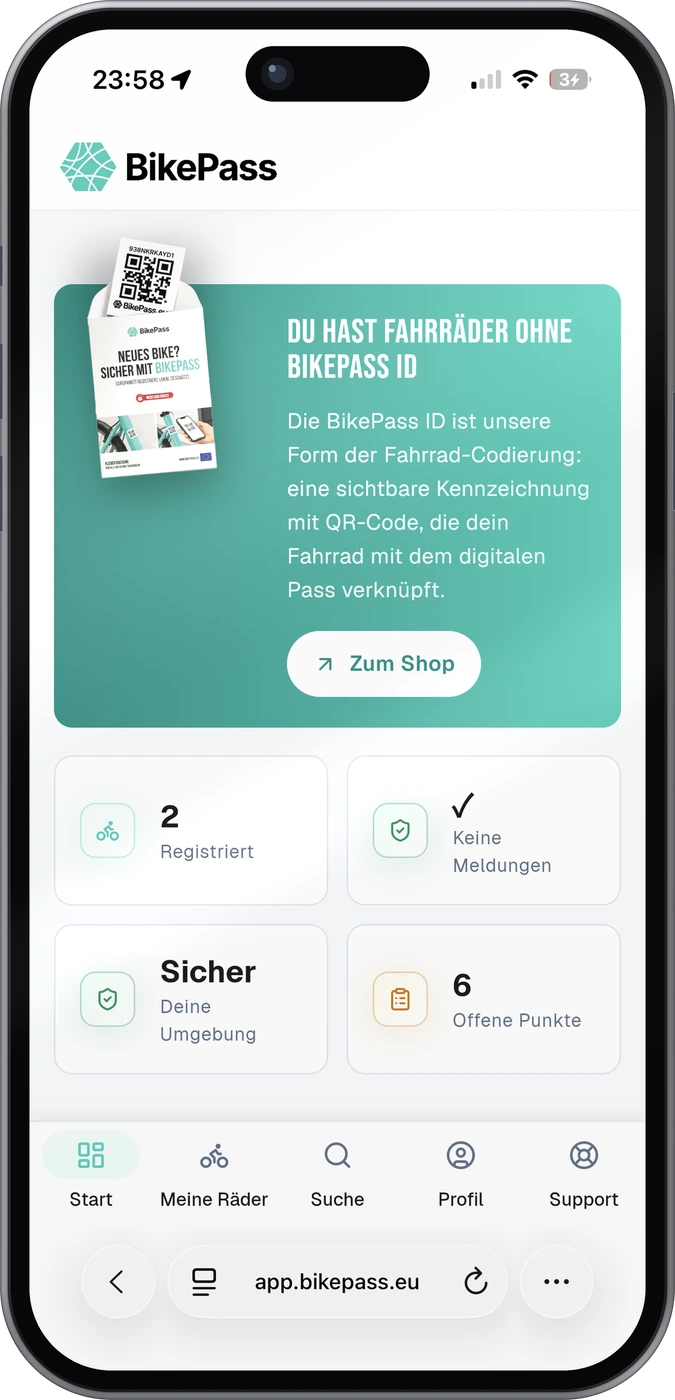
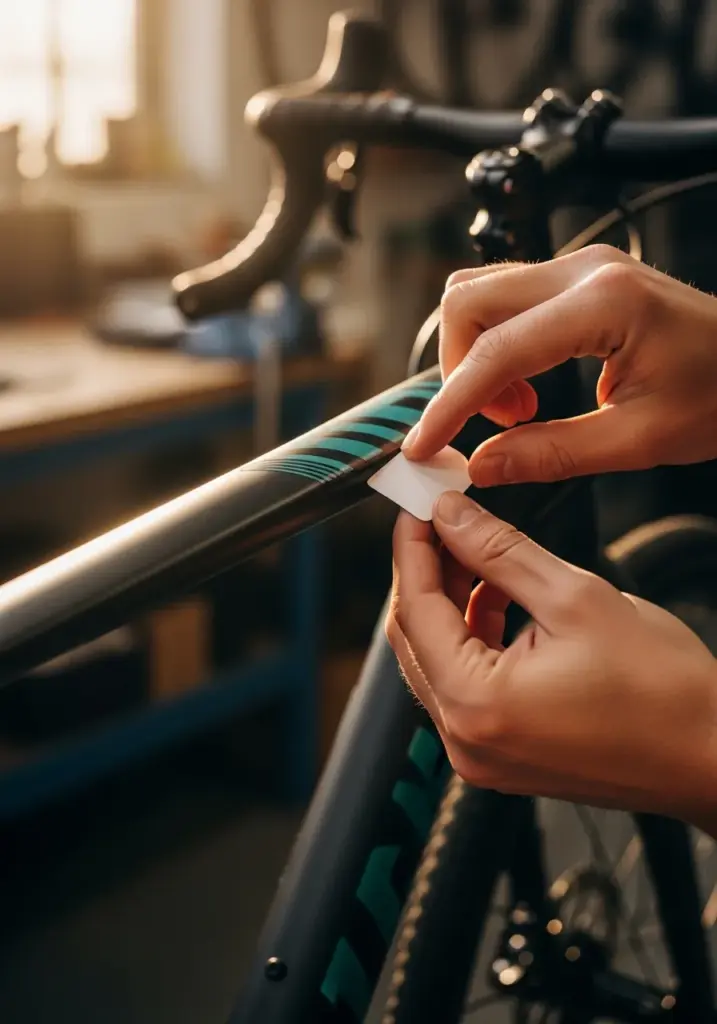
The BikePass ID is the digital option in this comparison: a tamper-proof sticker set with an individual QR code that you fit yourself at home, with no appointment and no tools. The stickers are UV- and weather-resistant and cannot be removed without leaving traces. You buy once, there is no subscription. Our page on bicycle security marking explains how it works together with the digital register.
And if your bike already carries a classic marking, nothing goes to waste. Existing codes and serial numbers can be added later and linked to your proof of ownership.
Where does security marking not help?
Security marking does not protect your bike in the moment it is stolen. It is a marking, not resistance. Four points that rarely come up at marking events:
It stops nobody. Anyone carrying bolt cutters does not read a string of characters on the seat tube. The lock is and remains the hurdle that counts on the spot. As a rule of thumb, budget around 10 % of the bike’s value for the lock.
The registers are scattered. There is no single national bicycle register in which every marking is recorded. Where your code is stored depends on the organiser. If a station in another region runs a check, it first has to know where to look.
An EIN code goes out of date. It encodes your address, and addresses change. After a move, the code points to a flat you no longer live in. Getting a new marking is possible, but hardly anyone thinks of it.
Without proof it stays a fragment. Even a clearly traceable code helps you little if you cannot produce a frame number, photos or a purchase receipt when you file the report. Our guide “Recovering a stolen bike” describes what counts in that situation.
How do you link security marking and proof of ownership?
The code on the frame and the file on your bike belong together, otherwise neither works properly. In practice that means: after the marking appointment, you enter the code and the certificate where your frame number, photos and purchase receipt already sit. Our guide “Register your bike” shows the full process.
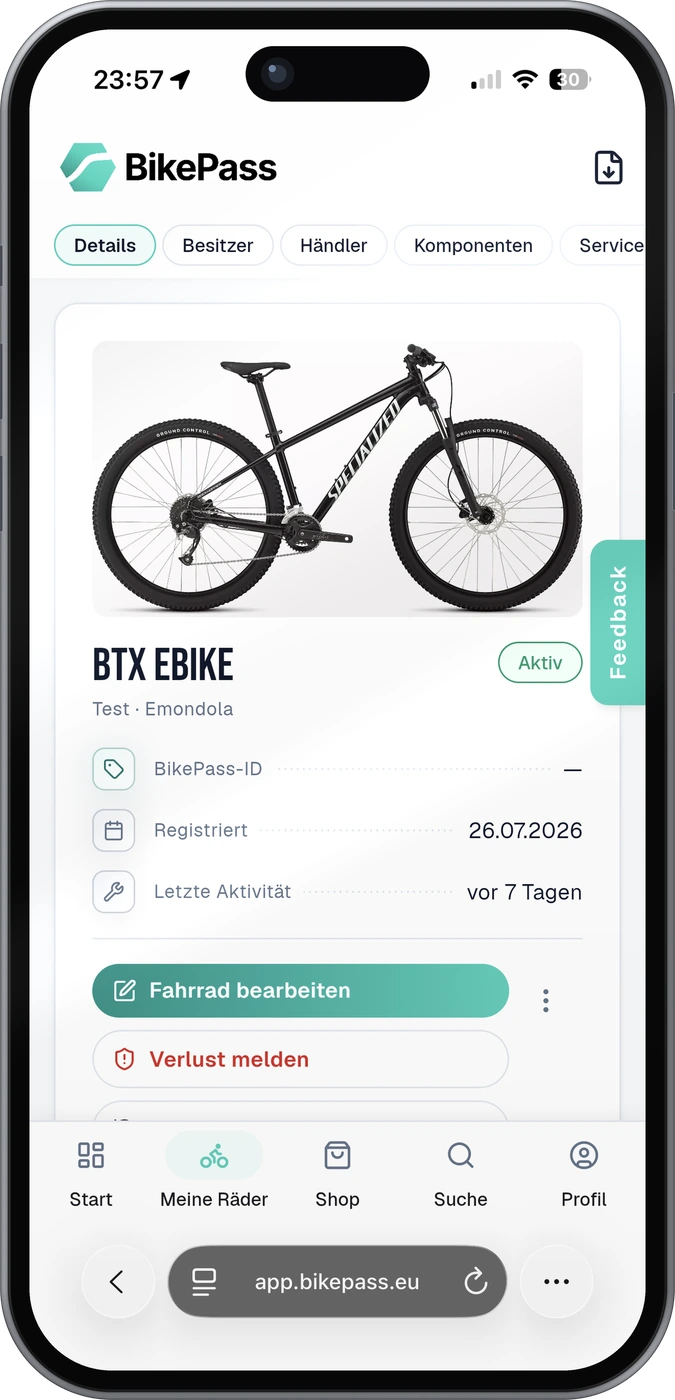
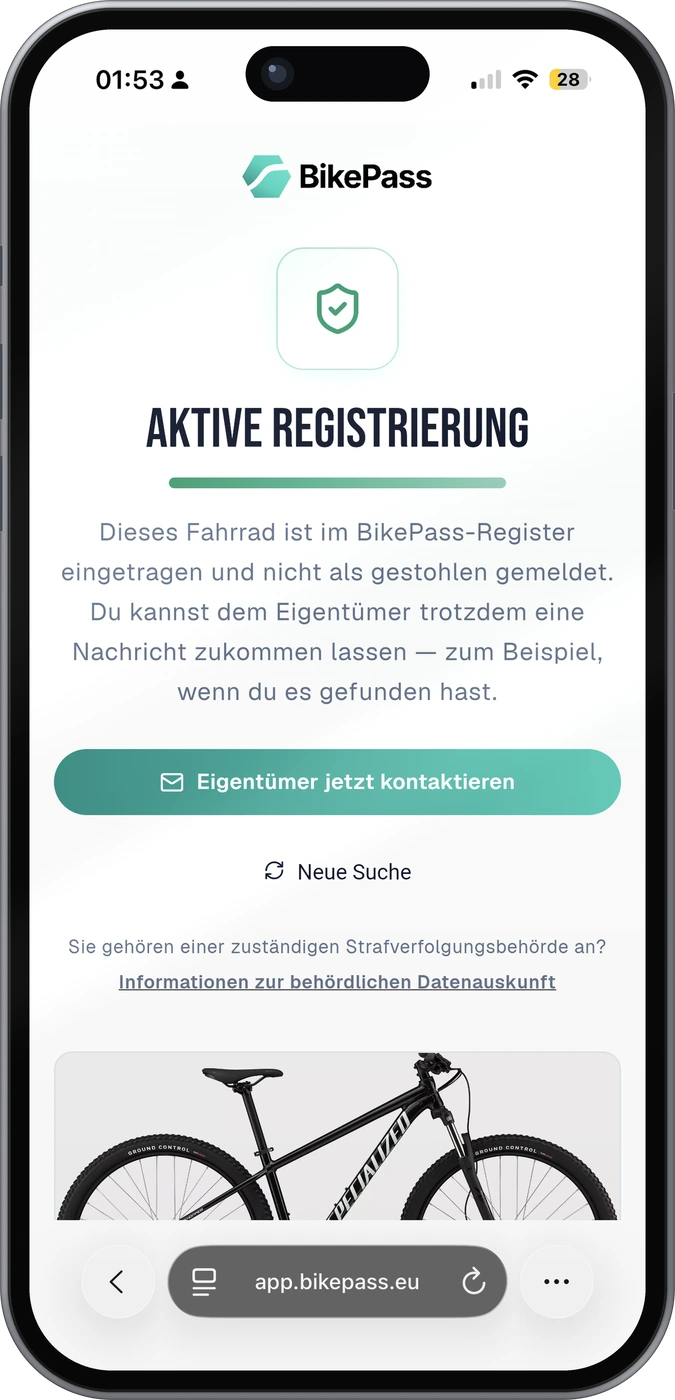
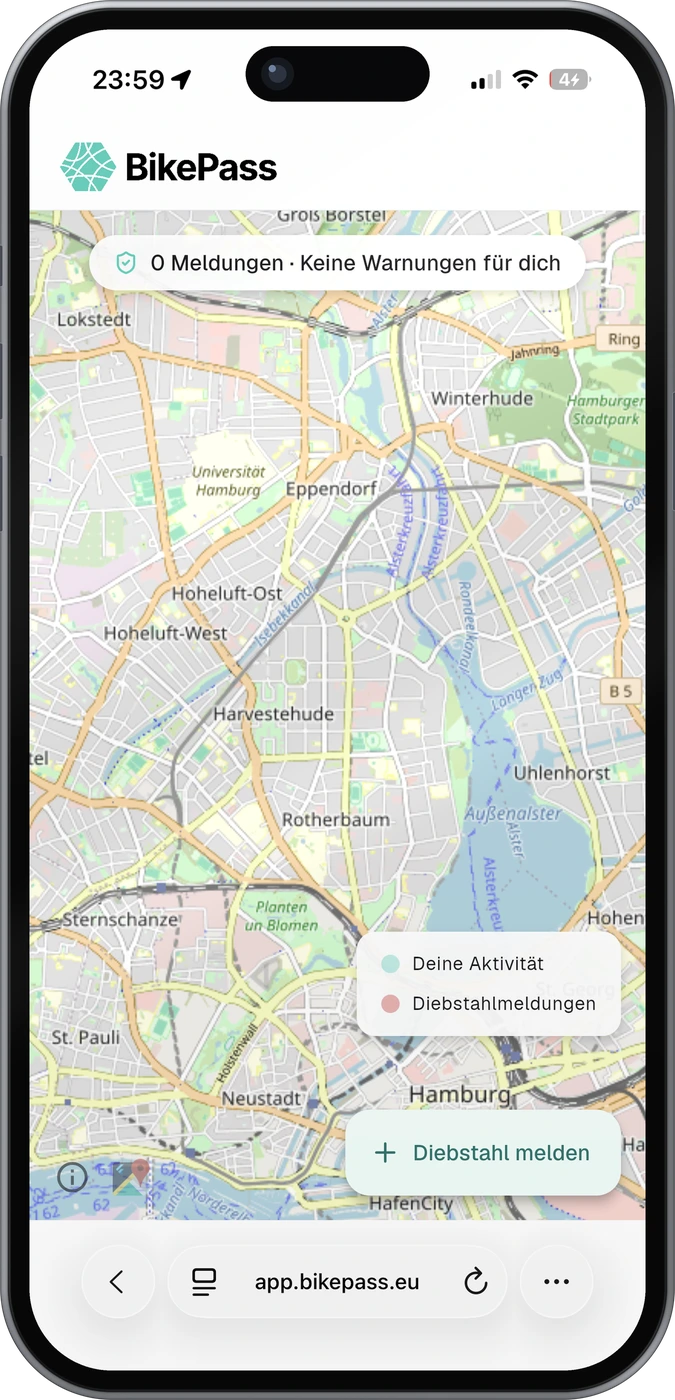
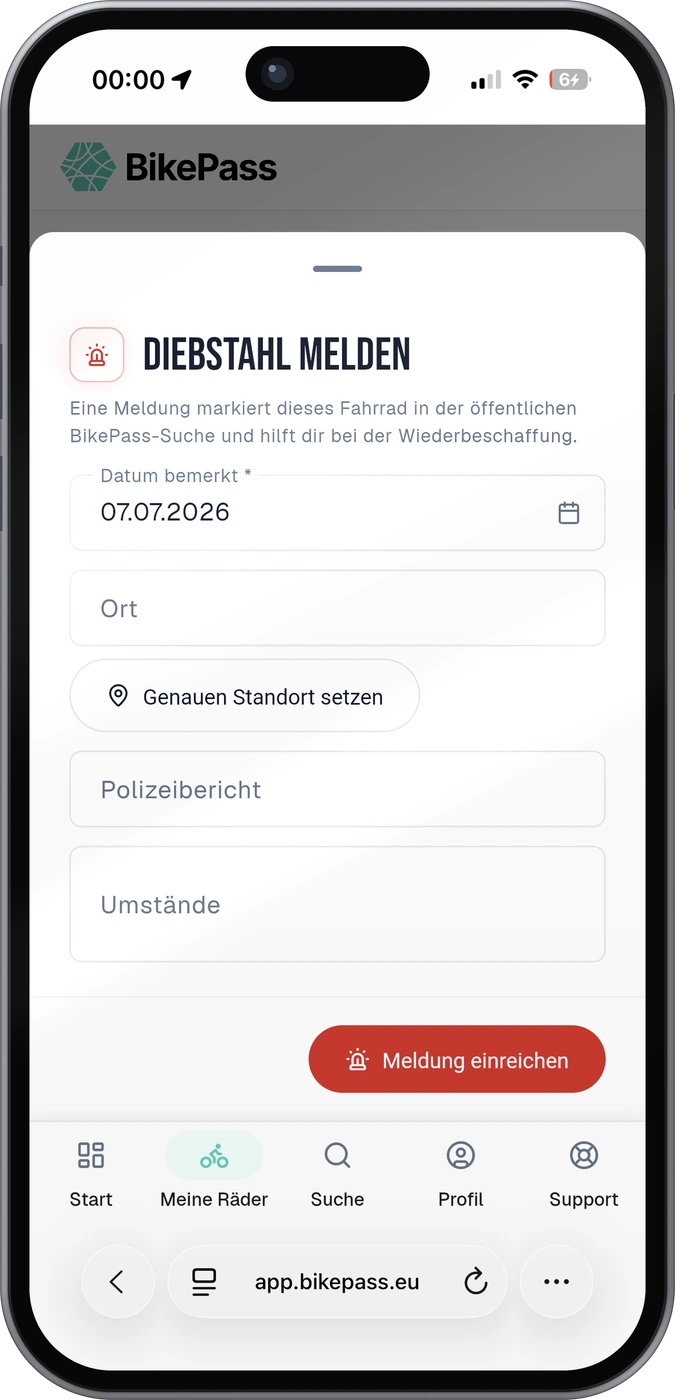
With BikePass you set up this file free of charge, in under three minutes and for any number of bikes. Frame number, photos and receipts sit together in a web app, hosted in Europe in line with the GDPR, and can be shared with the police or your insurer. If your bike disappears, you report the theft directly in the app: the ID becomes visible to the authorities, the Bikefinder search shows the theft status, and finders can get in touch anonymously.
The order does not matter. If you register first and have the bike marked later, you simply add the code afterwards. If you have it marked first, you fill in the rest later. Your file grows with every part, instead of being spread across a folder, a drawer and three photos on your old phone.
Back to the rows in the found-bike store. Most of these bikes have an owner who misses them, and not a single clue that brings the two back together. A code on the frame and a stored proof of ownership are exactly that clue. A bike that can be handed back does not stand in a store like that for long.
Your security marking checklist
- Decided where to go: ADFC local group, police event, dealer or digital?
- For the appointment: photo ID and proof of ownership packed?
- Terms checked by phone beforehand rather than taken from the internet?
- Frame material checked: is engraving allowed at all, or is a sticker better?
- Code and certificate stored digitally, together with the frame number and photos?
- After a move, remembered that an address-based code goes out of date?
- A tested lock in use, because security marking does not replace it?
We write about bike theft, security marking and digital theft protection – practical, without scaremongering and with real steps you can take.
See all guides