In short
A bike passport should contain the frame number, make and model, frame size, colour, distinguishing features, purchase details with receipt and photos. You will find every one of these details on the bike itself or on the invoice. Digitally, you have them with you when it matters and can share them with the police or your insurer in seconds.
The officer at the desk asks for the frame number. You swipe through your phone and find a blurry summer snapshot showing mostly your front wheel. This is exactly the moment that decides whether a bike passport is worth anything.
The reason is real: in 2025, around 214,000 bicycle thefts were reported in Germany, and only about one in nine cases was solved (source: the German police crime statistics, Polizeiliche Kriminalstatistik 2025). If you have your details to hand at that moment, you shift the odds a little in your favour. If you have to go looking for them first, you lose the hours in which a stolen bike is still nearby.
First, the definition: a bike passport is a data sheet for your bike that records the frame number, describes the make, model and distinguishing features, and backs up the purchase with a receipt, so that you can prove your ownership to the police and your insurer. It is not a vehicle registration document: no authority issues it, no rule requires it, and nothing goes in it without your input. Nor is it theft protection. A passport stops nobody. It proves.
Which details belong in a bike passport?
A bike passport needs seven details: frame number, make and model, frame size and frame shape, colour, distinguishing features, purchase date with price and receipt, plus photos. All of it is already in front of you, either on the bike or in your paperwork. The effort is not in finding it, but in writing it down.
The table tells you, for each detail, where to find it on your bike or in your papers and what it does when it matters. Read the third column above all: it explains why you should not simply skip a field.
| Detail | Where to find it | Why it counts |
|---|---|---|
| Frame number | Stamped or laser-etched into the frame, usually under the bottom bracket, on the seat tube or at the rear dropout. It is often on the invoice too. | The only unique identifier your bike has. Without it, any search leads nowhere; with it, a recovered bike can be matched to you. |
| Make & model | Lettering on the down tube, sticker on the seat tube, model name on the receipt. | Narrows the search down roughly. On its own it is not enough: a thousand other people ride your model in the same colour. |
| Frame size & frame shape | Sticker on the seat tube, detail on the receipt, otherwise measure the seat tube. You can see the shape: diamond, trapeze or step-through. | Describes your bike more precisely than the colour does. It still stands out even if a thief has resprayed the bike. |
| Colour & paintwork | On the bike, best photographed in daylight rather than described from memory. | Helps with sightings in classified ads or at the roadside. Loses its value as soon as someone changes the paintwork. |
| Distinguishing features | Basket, pannier rack, child seat, saddle, tyres, scratches, stickers, retrofitted parts. | They turn a production model into your bike. For recognition, three details beat any brand name. |
| Purchase date, price & receipt | Invoice from the dealer, order confirmation in your inbox, bank statement or card statement. | The proof that the bike belongs to you and what it was worth. Without it, the insurer estimates, and rarely generously. |
| Photos | You take them yourself: both sides in full, a close-up of the frame number, one picture per striking detail. | The fastest proof there is. A sharp photo of the number saves you spelling it out at the desk. |
| Security marking or registration number | Engraving or sticker on the frame, plus the paperwork from a security marking event, for example with the ADFC. | Shows that your bike has already been linked to an owner. However, a security marking without stored data is of little use. |
The most common stumbling block is the very first row. Our guide “Find and check your frame number” shows you exactly where the number sits on your frame and how to check it. Photograph it rather than typing it out. Handwritten zeros and eights mixed up have already made more than one police report useless.
For the photos you need no equipment and less than ten minutes. Four pictures are enough: left side, right side, frame number close up, plus your most distinctive detail.
Why does every single field count?
Every field in the bike passport serves a different moment after the theft, and none of those moments forgives a gap. The details feel interchangeable while you fill them in. They are not.
When you file the report, the frame number counts. Only with it does your bike go onto the wanted list as stolen, so that it shows up during a check. Make, colour and frame shape go into the description, so that officers can identify your bike even without a legible number. How such a report works and what you should bring is covered in the guide “Reporting a bicycle theft”.
With the insurer, the purchase date, price and receipt count. They decide whether a claim is settled at all and for how much. It is standard for insurers to want to see proof of ownership before they pay. Our guide to home contents insurance and bicycle theft explains which documents are typically required.
For recognition, photos and distinguishing features count. If a bike turns up in a classified ad, the make helps you little, while the worn saddle and the sticker on the down tube help immediately. These are exactly the details people forget when filling in the form, because they see them on their own bike every day and no longer notice them.
Three fields, three completely different jobs. That is why a half-filled passport is not half the protection, but a lottery on which case comes up.
Do you really need the receipt?
For the police report you do not need the receipt; for the insurer you almost always do. The police will take your report without an invoice. Settlement, by contrast, depends on you being able to prove ownership and value.
And if the receipt is gone? Then substitute evidence is worth more than most people think: the order confirmation in your inbox, the bank statement showing the amount, the card statement, and with a specialist dealer often a copy of the invoice from your customer account. If you bought used, the chat history with the sales listing and handover date helps, and an informal sales contract with the frame number is better still.
What you should not do: put off filling it in because one field is still missing. A passport with a frame number and photos is worth an enormous amount when it matters. A perfect passport you never created is not.
Tip: Photograph the receipt as soon as you have it in your hand. Thermal paper fades after a few years, and the amount is usually the first thing that becomes illegible.
What else belongs in the passport for an e-bike?
With an e-bike, the numbers of the drive components join the frame number, because they are traded separately and found again separately. Battery, motor and display each carry their own serial number, usually printed or laser-etched on the component and also noted on the invoice.
Also note the drive system with its model year, the key number of the frame lock and battery lock and, if your system includes a lock function, a note that it is activated. These details set your bike apart from thousands of identical ones and help you if only the battery disappears instead of the whole bike.
The reason for the extra effort is simply value. An e-bike costs more, an e-bike theft costs correspondingly more, and the insurer asks more detailed questions. What to do after an e-bike theft is covered in the guide “E-bike stolen: what to do”, and you will find the protective measures beforehand on our page about e-bike theft protection.
Paper bike passport or digital passport: which suits you?
Paper and digital store the same data, but they deliver it in completely different situations. What matters is not which version looks more complete, but which one you have with you the moment someone asks for the frame number.
The table compares the three usual routes. Look at the middle column: it shows what each version denies you precisely when it counts.
| Version | What it can do | What it cannot do | When it makes sense |
|---|---|---|---|
| Paper template to print out | Record all fields in a structured way, without an account and without internet. Sits safely in your folder. | Come along with you. The sheet is at home while your bike stands at the station. Lost templates are gone for good. | As a second copy in the folder, or if you deliberately want to store nothing online. |
| Photo or note on your phone | Always be with you. Frame number and pictures are shown in seconds. | Provide structure. After two years of camera roll you can no longer find the picture, and when you change phones half of it is often missing. | As an immediate step today, until you set up the passport properly. |
| Digital bike passport in a register | Call up data in one place on any device, share it, manage several bikes, transfer ownership on sale. | Prevent the theft. A digital passport is also a proof, not a lock. | For everyday use, for several bikes and whenever value is at stake. |
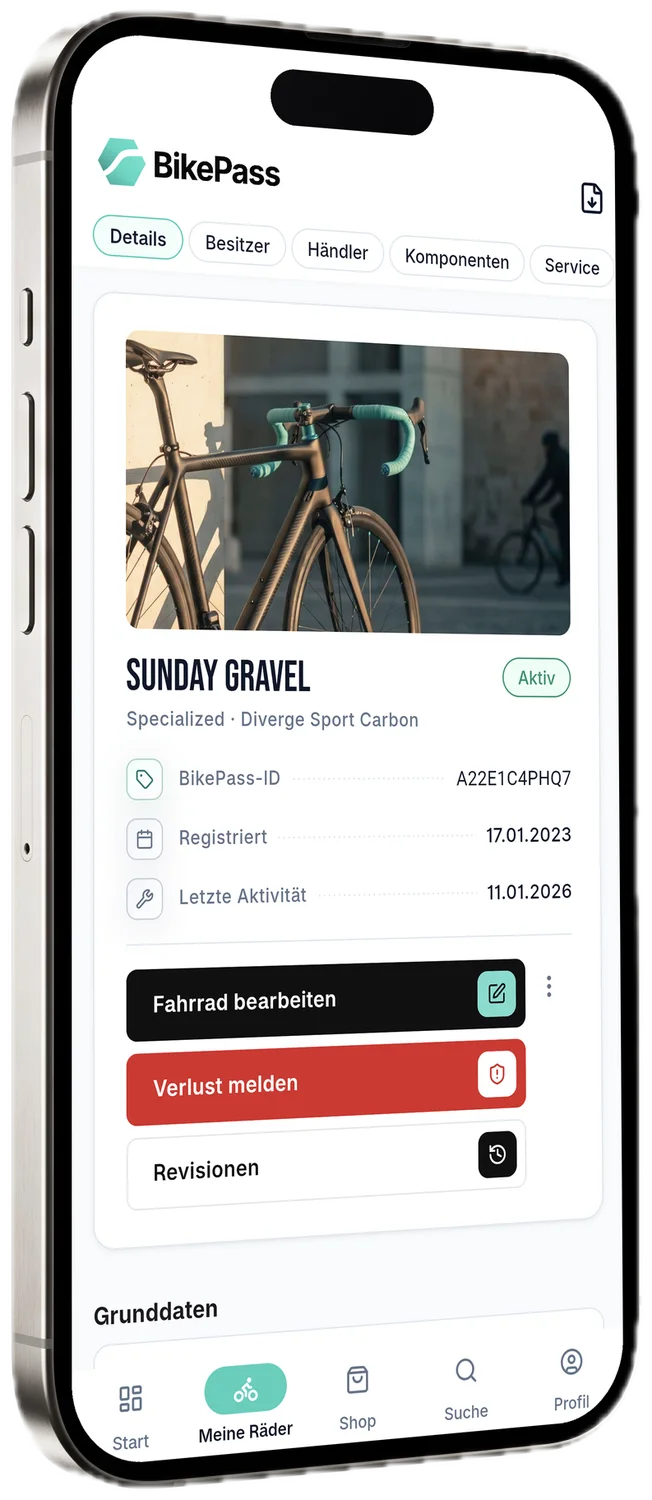
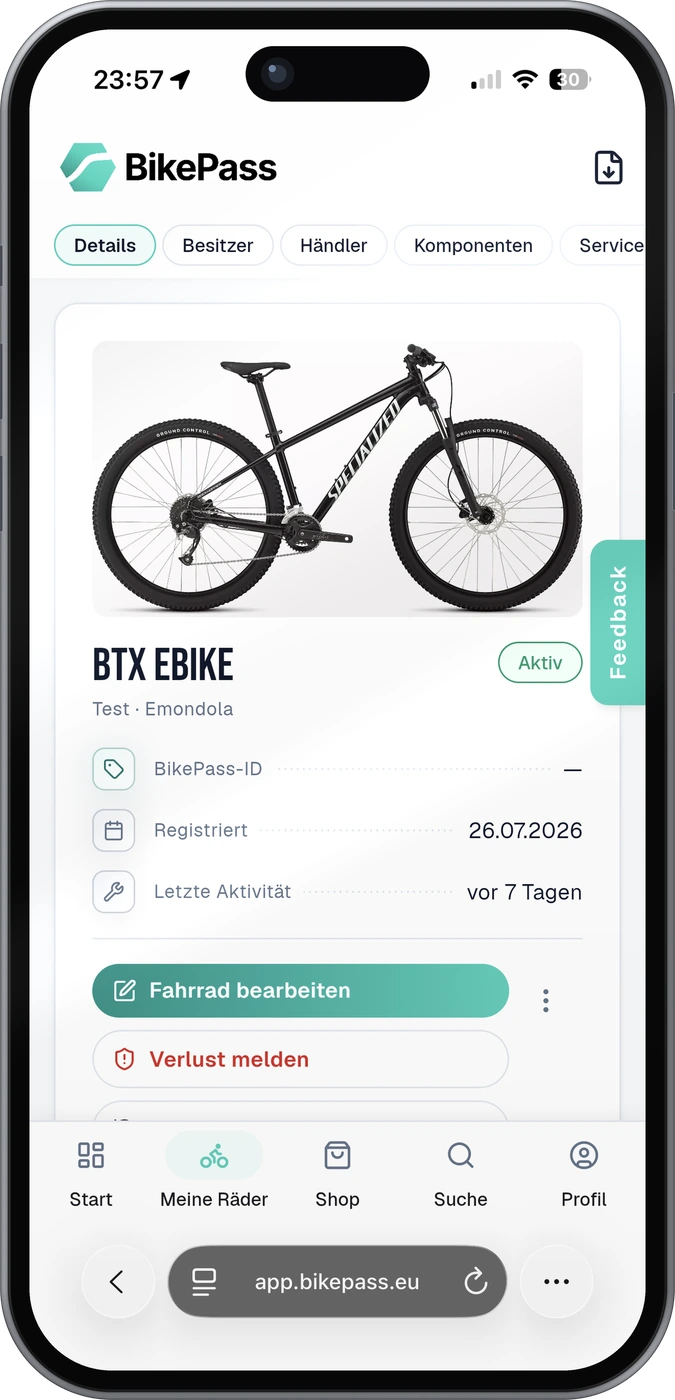
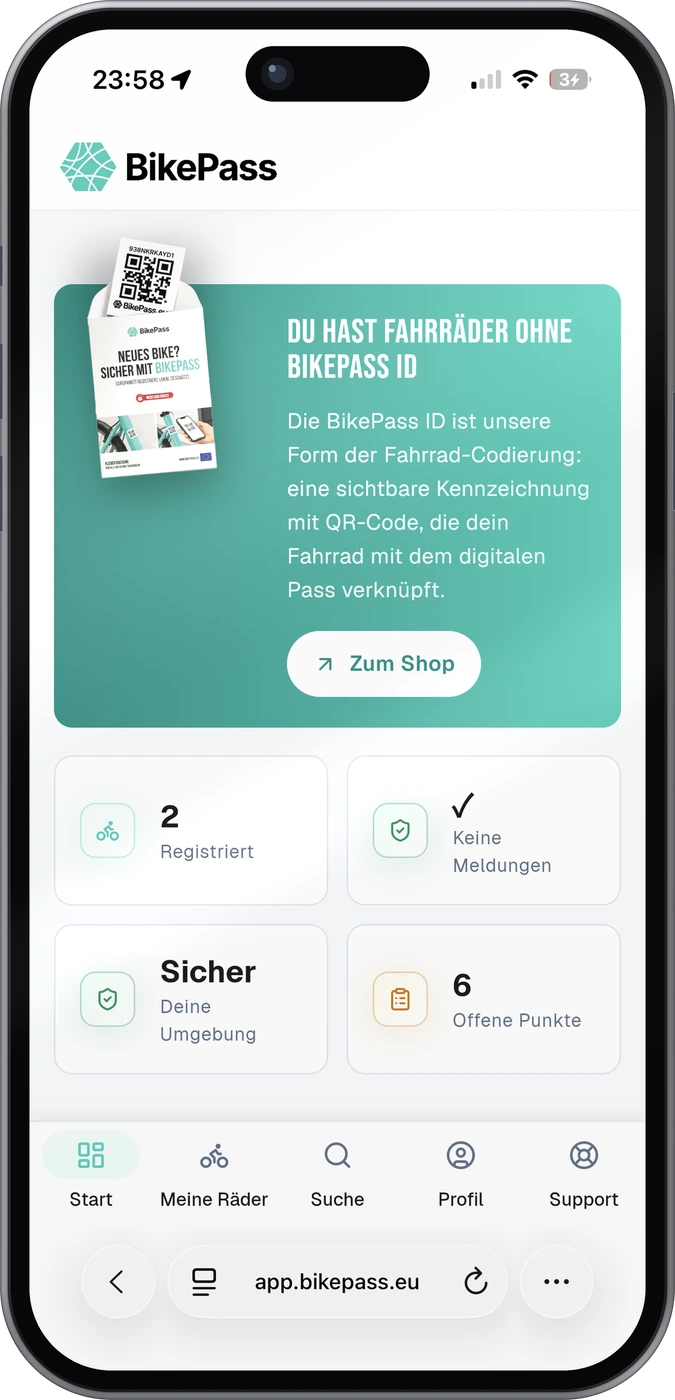
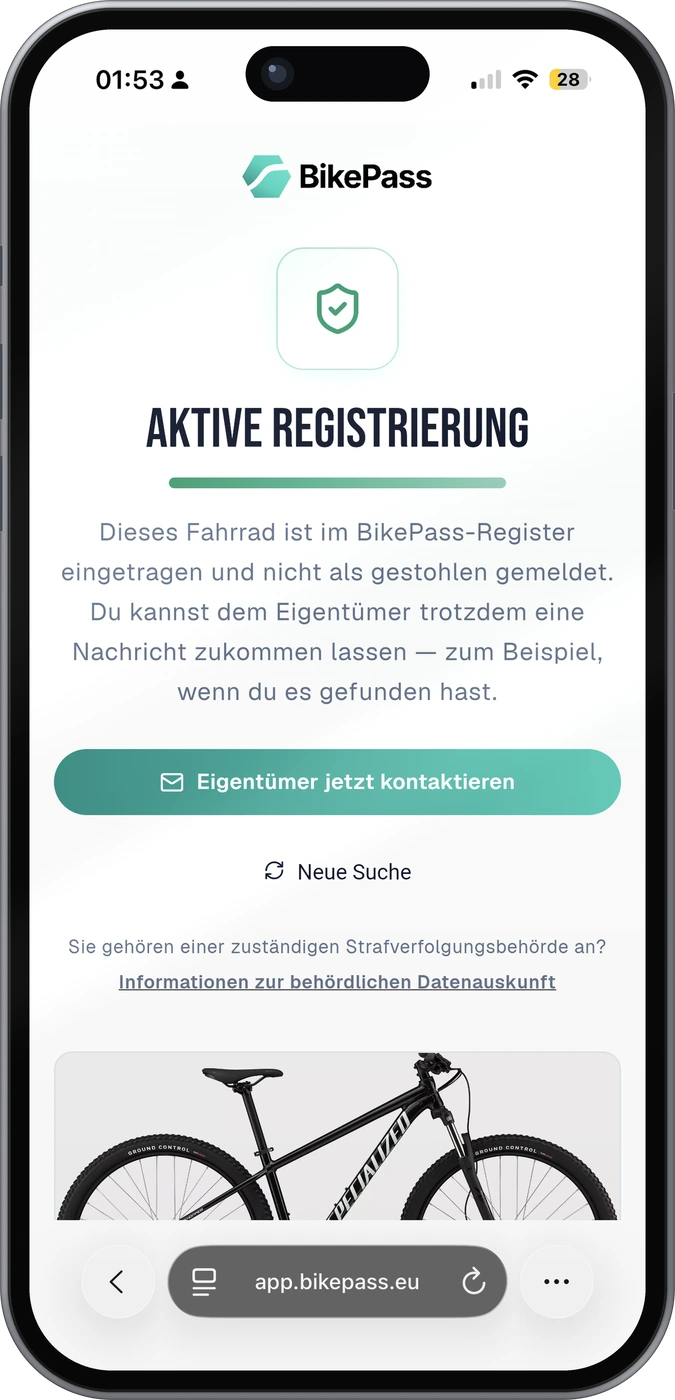
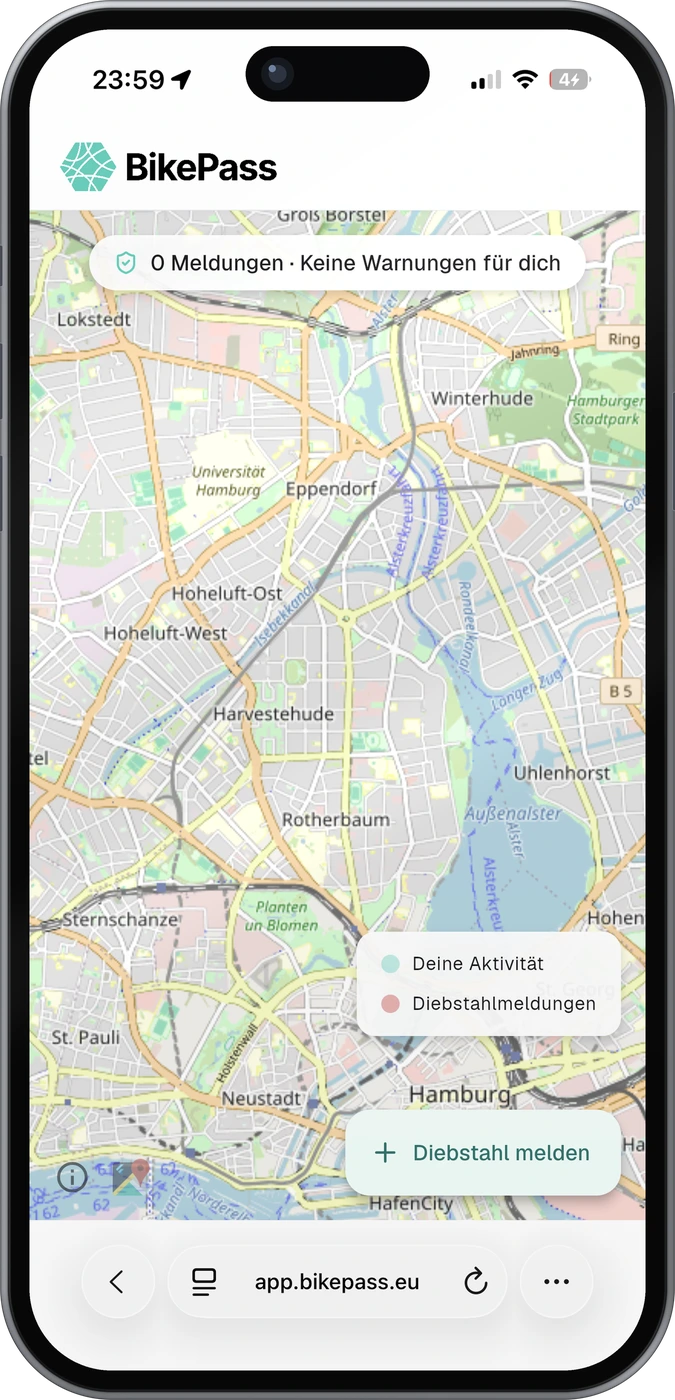
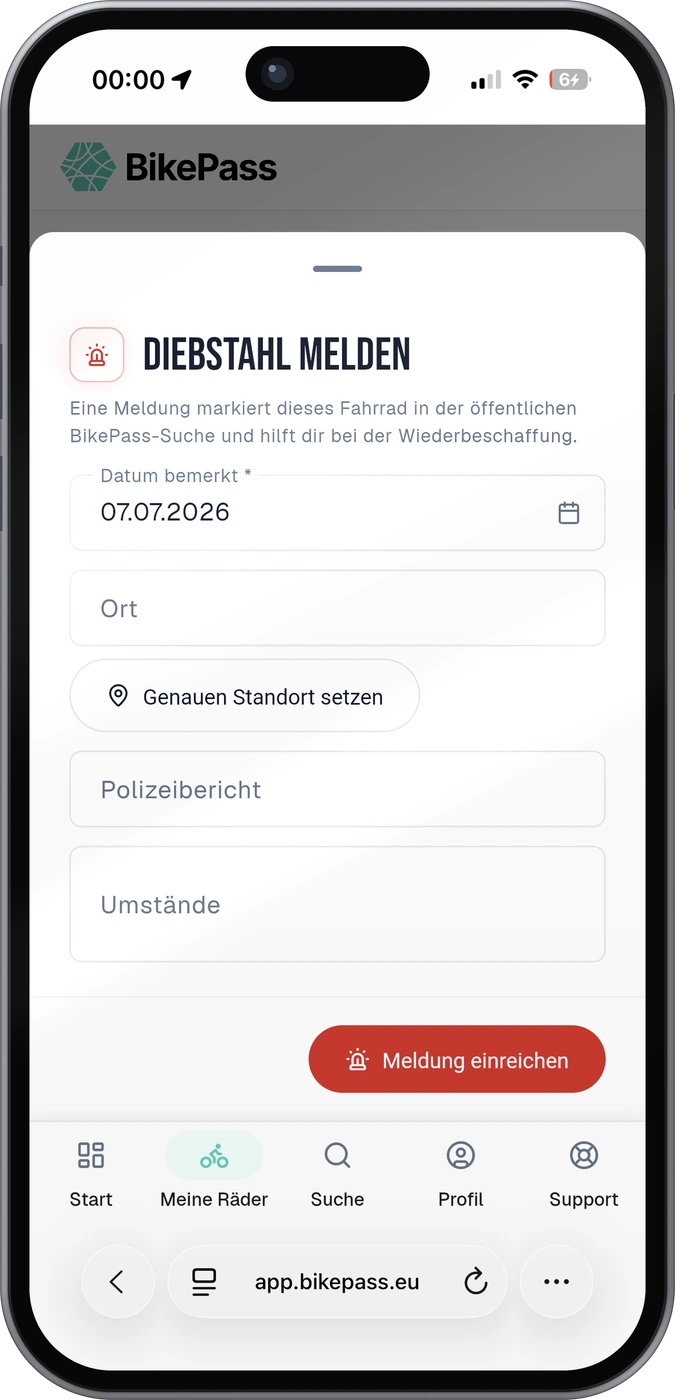
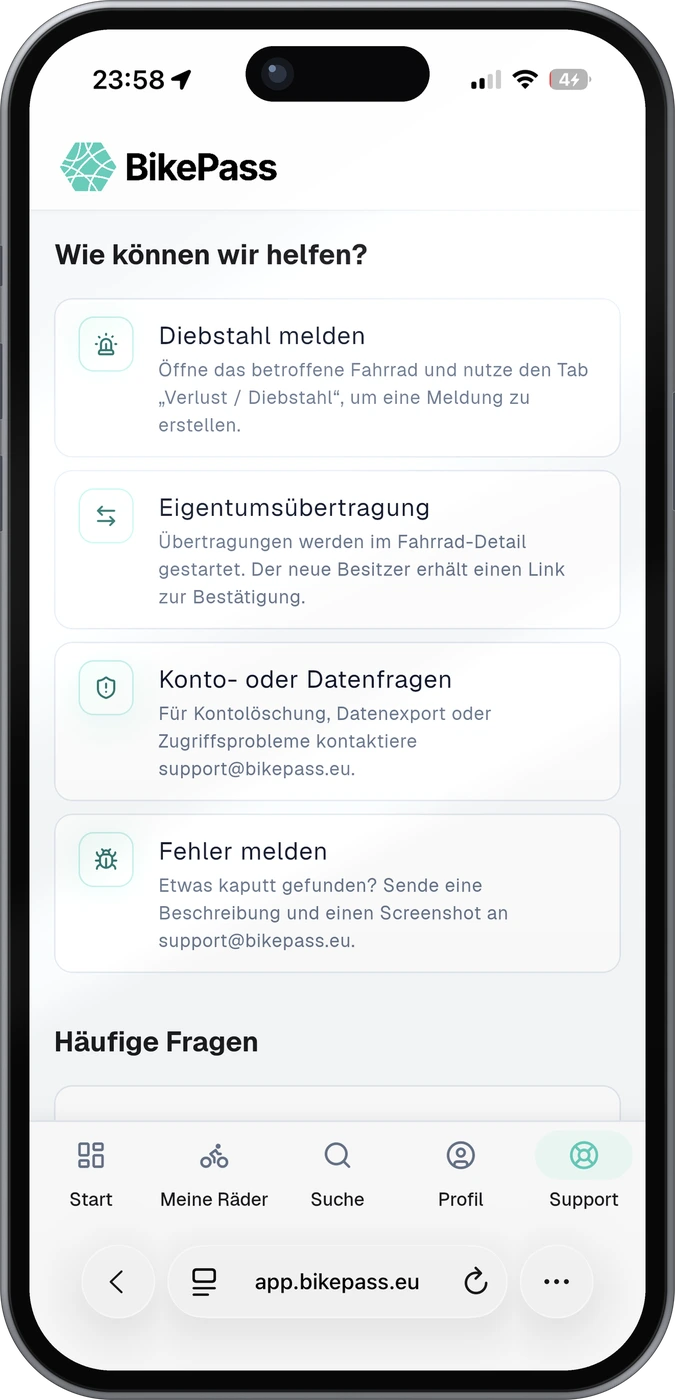
One detail decides the matter in practice: only the digital passport can be shared. You pass your details on to the police or your insurer in one bundle, instead of dictating fields and hunting down photos one by one. With BikePass this runs through the web app on any device, free, GDPR-compliant with hosting in Europe and for as many bikes as you like.
How do you fill in the bike passport in a few minutes?
It goes fastest if you stand the bike next to you and work through it in one go, instead of piecing the data together from memory. This order has proved itself:
- Roll the bike into daylight and photograph both sides completely.
- Search the frame for the number, expose it, clean it and photograph it close up.
- Take the make, model, frame size and frame shape from the bike or the receipt.
- Note distinguishing features and photograph every striking detail separately.
- Dig out the purchase receipt, photograph it, enter the date and price.
- For an e-bike, add the serial numbers of the battery, motor and display.
- Store everything in one place that you can also access when out and about.
The last step is where paper passports fail. Our guide “Register your bike” describes how to enter your bike into a register at the same time.
Where are the limits of a bike passport?
Time for the uncomfortable truth: a bike passport prevents not a single theft. It only takes effect afterwards, and even then only under conditions that people rarely talk about.
It only works if you can reach it. A passport in a filing folder does not help you at the counter. That is exactly why the storage location decides more about the benefit than the care you take filling it in.
It goes out of date. A new saddle, a different rack, a resprayed frame: every change you fail to record makes your description a little less usable.
It does not replace a marking. A passport describes your bike, it does not mark it. A thief cannot see anything on it. The protection only becomes visible with security marking or a sticker on the frame that signals to every buyer that this bike is assigned to someone.
It is no use if nobody can query it. A passport in your drawer is a private note. Only when your data sits in a register that authorities can also access can a recovered bike be matched to you, without you finding out by chance.
So a passport is not a shield. It is your evidence.
What happens to the passport on sale or conversion?
When you sell, the passport belongs with the bike, not in your drawer. Anyone who hands over the complete history with frame number, receipts and photos sells more easily and for more, because the buyer sees that the bike carries no risk of being stolen goods.
On paper this usually ends badly. The sheet stays behind, gets lost or travels to the new owner with your old data. Digitally you transfer ownership in a few clicks, your data disappears from the entry, and the bike stays in the register.
And with conversions: take five minutes twice a year and compare the passport with the bike. Enter new add-on parts, replace old photos, attach receipts for expensive components. If you upgrade your e-bike or have the frame resprayed, you should touch the passport the same day, otherwise it describes a bike that no longer exists in that form.
Back to the counter. The question about the frame number always comes, and it always comes when your nerves are already thin. The difference between a blurry summer photo and a finished passport is five minutes that you invest one quiet evening. After that you answer the question on the spot. It takes no more than that.
Your bike passport checklist
- Frame number found, noted and photographed sharply?
- Make, model, frame size and frame shape entered?
- Colour and all distinguishing features described, from scratches to add-on parts?
- Purchase date, purchase price and receipt stored, if necessary as a replacement receipt?
- Both sides, frame number and details photographed?
- For an e-bike, serial numbers of battery, motor and display added?
- Everything in one place that you can also access when out and about?
We write about bike theft, security marking and digital theft protection – practical, without scaremongering and with real steps you can take.
See all guides