
In short
A D-lock offers the highest security, a folding lock the best compromise between protection and handling. Chain locks are flexible but heavy; cable and spiral locks only work as a second lock. As a rule of thumb: spend around 10 % of the bike's value on the lock.
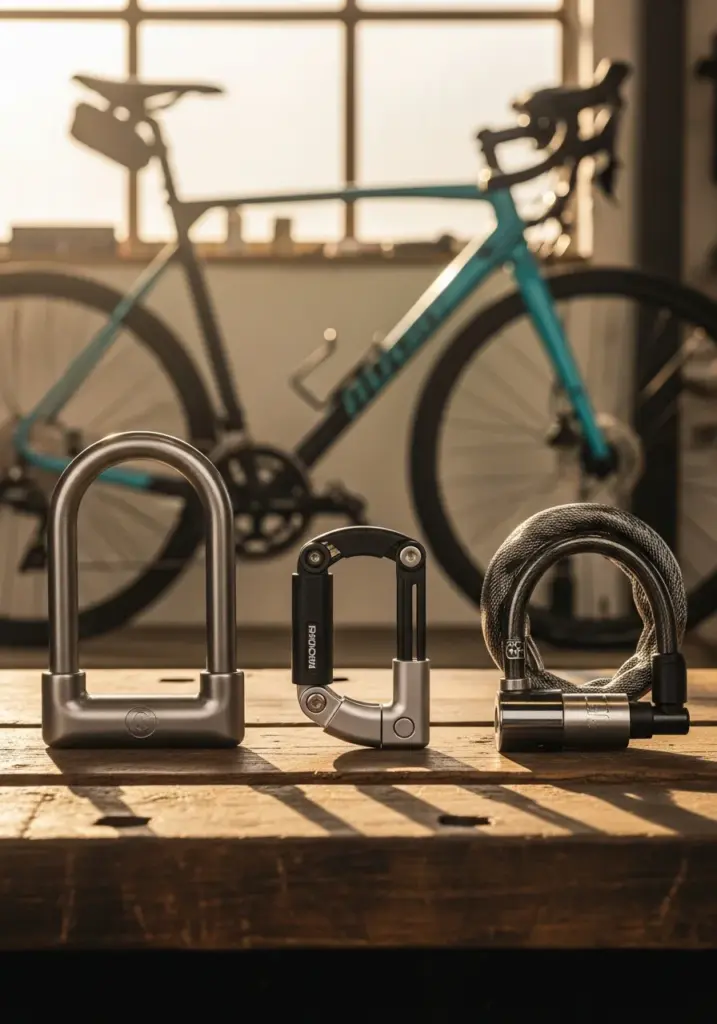
They all hang side by side on the lock wall in the bike shop: a chunky steel shackle, a folded package of metal links, a chain in a fabric sleeve, a colourful spiral ring for small money. All four carry the word lock in their name. Between the first and the last, however, lie worlds.
The starting point is well known: around 214,000 bike thefts were reported in Germany in 2025, and roughly one in nine cases was solved (clearance rate around 11 %, source: German police crime statistics (Polizeiliche Kriminalstatistik) 2025). In the vast majority of cases, exactly one object stood between the bike and the thief. The lock.
So that we are talking about the same thing: a bike lock is a mechanical security device that fixes your bike to a solid object, delays tool attacks and makes thieves take the next bike instead. It is not a guarantee against theft, but a time brake: every lock can be opened with enough tools, enough time and enough quiet. The difference between the designs lies in how much of all three a thief needs. A lock sells time.
What actually makes a bike lock secure?
A bike lock is secure when it survives an attack for longer than a thief is willing to risk at the parking spot. Three components decide this: the material the thief has to cut through, the geometry he needs for leverage, and the lock cylinder he could bypass.
The material is the obvious part. Hardened steel resists bolt croppers; soft wire gives way in seconds.
The geometry is the part most people overlook. A lock that dangles loosely around the frame and the stand gives the thief room for pipe extensions and car jacks. A lock that sits tightly gives him nothing. That is why a D-lock that is too long is often weaker than a short one, even though the steel is the same.
And the cylinder is the quiet weak point. Simple cylinders can be drilled out or picked with tools from the DIY store, even if the shackle above them is flawless. High-quality locks therefore use disc cylinders with drill protection. Our guide “Breaking a bike lock: how to protect yourself” shows which attack routes thieves actually take.
Incidentally, breaking a lock is legally no minor offence, but usually a particularly serious case of theft under § 243 StGB (German Criminal Code). That changes nothing for your bike. For the police report, it does.
How secure is a D-lock really?
Of the four basic designs, the D-lock is the most secure, because it leaves leverage tools almost no surface to attack. A solid, usually hardened steel shackle locks into a compact body. Anyone who wants to crack it needs heavy equipment and time in a place where he will be seen.
The price for that is the rigid shape. A D-lock does not fit around every lamp post, not around every thick stand hoop, and the inner space rarely covers the frame and both wheels at the same time. In practice that means: frame plus front wheel to the anchor point, and the rear wheel needs a second lock or stays unsecured.
This is what it looks like day to day: if you park your bike at the same stand every day, you will quickly get the hang of the D-lock. If you park at changing locations every day, you will regularly stand in front of an anchor point the shackle will not reach around. Security yes, convenience no.
When is a folding lock the better choice?
A folding lock is the better choice as soon as you lock up at changing locations and still do not want to give up a high level of protection. Several flat steel links are connected by joints, fold up into a handy package and stretch out into a long arc. That lets you reach anchor points where a shackle fails.
The catch sits in the joints. On cheap models, the riveted connections between the links are made thinner than the rest of the lock and therefore become the preferred point of attack. On high-quality folding locks, exactly these connections are reinforced, and the protection level comes close to a good D-lock.
For commuters, the folding lock is therefore usually the most sensible solution. It goes into the frame bag, works at every station stand and costs you no thought while you are out.
Who is a chain lock worth it for?
A chain lock is worth it wherever the weight does not matter and the anchor point is bulky. Hardened steel links in a fabric sleeve wrap around the tree trunk in the back yard, around the wrought-iron railing, around the post in the underground car park. No other type of lock is so forgiving about its surroundings.
The weight is the objection. Chains with sufficiently thick links quickly reach one to two kilograms, and you feel that in your backpack every day. This is exactly where thin lightweight chains lie: they look like their heavy siblings and give way under bolt croppers like a bike cable. With a chain, the link thickness decides, not the looks.
The honest recommendation: chain at the parking spot, lighter lock on the bike. At home in the cellar, in the bike room or at the company site, the chain is strong, because the extra weight bothers nobody there. As a daily travel companion it becomes a burden that many eventually leave at home. A lock in the hallway protects nothing.
What are cable, spiral and frame locks still good for?
Cable, spiral and frame locks are add-ons, not main locks. Cables and spirals consist of braided wire strands under a plastic sleeve. They are light, flexible and cut through in seconds with cable shears, without anyone noticing in a busy place.
They still make sense, though, as a second layer: a cable through the front wheel and saddle stays, connected to the main lock, secures exactly the parts that are otherwise removed with two quick movements.
The frame lock on the rear stays is a different case. It blocks the rear wheel and makes riding away impossible, but it fixes the bike to nothing. Anyone who lifts it and carries it takes it away, lock and all. As an add-on on bikes that stand in the same place for long periods it is practical; as the sole security device it is an invitation. You will find more on electronic add-ons of this kind in the guide bike alarm and immobiliser.
How do the lock types compare directly?
The matrix below ranks the designs against the criteria that matter day to day. Look less at the security column alone and more at the ratio of security to handling: a lock that is too heavy or too bulky for you stays at home and then protects nothing at all. The price guidance is deliberately qualitative, because models and rates vary widely between manufacturers.
| Lock type | What it can do | What it cannot do | Weight & handling | Price guidance |
|---|---|---|---|---|
| D-lock | Highest resistance to levering and bolt cutters, minimal surface to attack. | Often does not reach around thick stands or trees, rarely covers frame and both wheels. | Heavy, rigid, takes practice to fit. | high |
| Folding lock | Long reach with a compact packed size, high protection level in a good design. | The joints are the weak point, and cheap models give way there first. | Medium weight, very good handling, fits in the frame bag. | medium to high |
| Chain lock | Wraps around almost any locking point, thick links offer noticeable resistance. | Thin lightweight chains fall to bolt cutters, and carrying it on the bike is awkward. | Heavy to very heavy, but maximally flexible. | medium to high |
| Cable / coil lock | Secures a wheel, saddle or accessories as a second layer, weighs almost nothing. | Does not hold up as a main lock, cable cutters are enough. | Very light, bends any way you like. | cheap |
| Frame lock | Blocks the rear wheel, makes riding off without tools impossible. | Connects the bike to nothing, useless against lifting and carrying away. | Fixed to the bike, no weight to carry. | cheap to medium |
Read the second and third columns side by side and the pattern jumps out: no design covers everything. Security and convenience pull in opposite directions, and every lock is a point on that line. That is why many cyclists combine two locks with different strengths.
Tip: Two different lock types are stronger than two of the same. A thief carrying bolt cutters gets further with a chain than with a D-lock. Anyone who had to beat both would need two tools and twice as much time. How to fit both correctly is covered in the guide “Locking your bike properly”.
Which lock suits which bike?
The right lock type depends less on taste than on the value of the bike and where you park it. The table gives a recommendation for each type of bike, plus the limit that even that recommendation does not cross.
| Type of bike | Recommendation | Why | Where even that is not enough |
|---|---|---|---|
| Everyday bike, low value | A solid folding lock or a compact D-lock. | Covers typical opportunistic theft without outstripping the value of the bike. | Overnight in a quiet corner, any single lock stays vulnerable. |
| Commuter bike, changing locations | Folding lock as the main lock, cable lock for the wheel. | Reaches around thick stands and secures the parts that come off quickly. | Against a cordless angle grinder, even this combination only buys time. |
| E-bike | High-quality D-lock or folding lock, plus the manufacturer's locking system. | The high value justifies the extra weight, and the lock-out makes the bike unattractive. | A locked motor does not stop the bike being loaded into a van. |
| Cargo bike | D-lock on the frame plus a chain at the parking space. | Bulky frames need reach, and fixed parking spaces can take the weight. | An open courtyard often lacks a genuinely solid locking point. |
| Road bike, sporty bike | Light folding lock out on the road, heavy lock at home. | Every gram counts, and long stationary periods usually only happen in the cellar. | Out on the road protection stays limited, so keep the bike in sight. |
If you take away only one line, take this one: the best lock is the one you actually have with you. Where you park the bike afterwards matters almost as much as the design itself, as our guide parking your bike safely shows.
What should you look for when buying a lock?
Four things matter when buying, and price is not the first of them. As rough guidance, the old rule of thumb applies: around 10 % of the bike's value for the lock. It is no substitute for thinking, but it prevents the most common bad investment, namely the expensive bike with the cheap lock.
First, the rating. Many manufacturers award their own security levels as a number or star system. These scales only apply within a single brand and cannot be converted between brands. Independent test seals say more, because they test to a standard against levers, bolt cutters and drills.
Second, the cylinder. Drill protection and disc cylinders cost extra and are worth it, because a picked cylinder opens the lock without any noise.
Third, the length. It must be enough to secure the frame and ideally one wheel together to a fixed point, and still leave no slack. If in doubt, measure your usual locking point before you order.
Fourth, the insurance side. Whether your bike is covered at all depends, under many policies, on it having been locked and on which lock you used. If there was no lock, that can be judged as gross negligence and make settlement harder, as our guide “When your insurer refuses to pay after a bike theft” describes. The specific requirements vary by provider, so it pays to check your own policy.
Where does a lock's protection end?
No bike lock is uncrackable, and every manufacturer knows it. You should know three limits before you rely on a lock.
The cordless angle grinder. No D-lock holds out indefinitely against an angle grinder. What counts here is the noise: a thief with a grinder works loudly and conspicuously, and that is exactly why where you park also determines how much protection you get. A busy spot is part of the lock.
Being carried off. If the bike is only locked but not attached to anything, the best design helps nothing. Two people lift a bike into a van and break the lock later at their leisure. Only attaching it to a fixed object closes that gap.
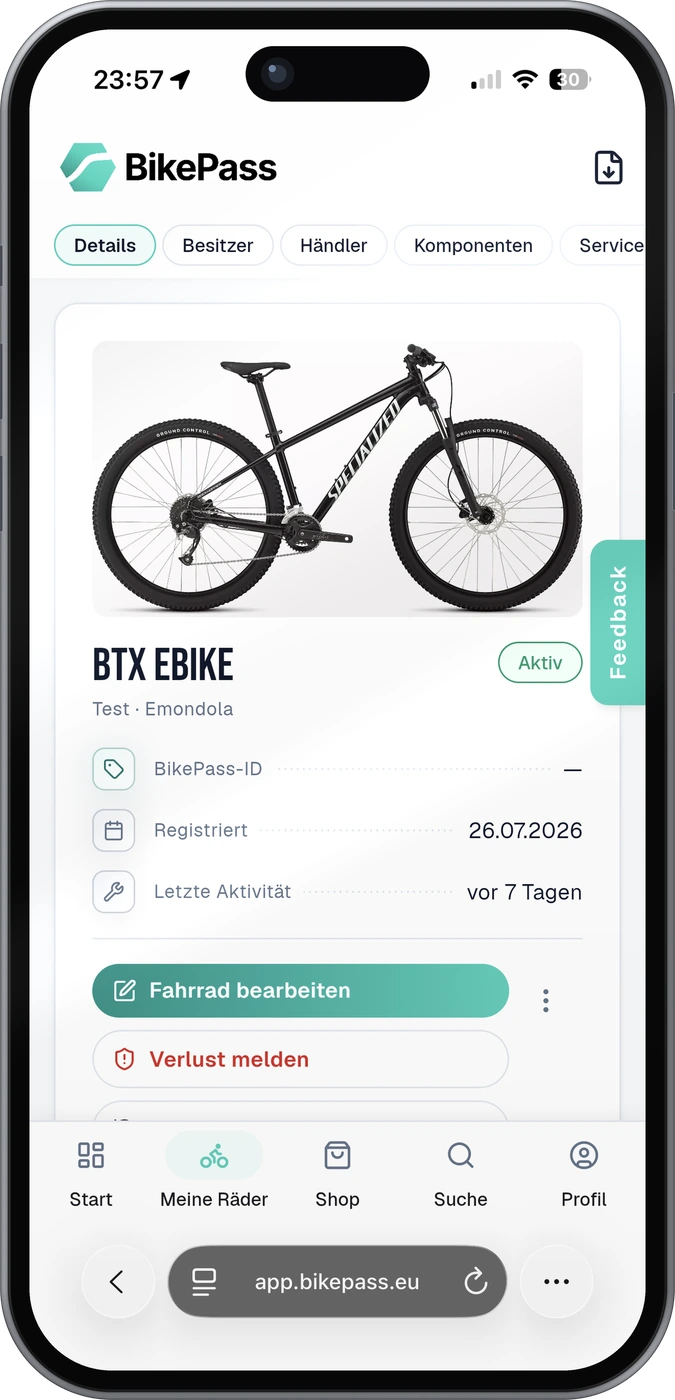
The day after. If the bike is gone despite everything, the lock has lost its job. From that point on, all that counts is whether you can prove the bike is yours. Without a frame number, photos and receipts, even a recovered bike often stays with the police, because no owner can be identified. With BikePass you store this data free of charge as digital proof of ownership, shareable with the police and your insurer. Our page on theft prevention for your bike gives an overview of all the other building blocks.
Back to the wall of locks in the shop. The four designs there are not quality levels from bad to good, but four different answers to the question of how much time you want to take from a thief and how much weight you carry for it every day. Anyone who knows both of those numbers reaches for the right shelf without hesitating.
Your lock checklist
- Lock type chosen to match the bike's value, where you park and your route?
- Budgeted around 10 % of the bike's value for the lock?
- Checked for an independent test seal rather than just the manufacturer's own level?
- Lock cylinder with drill protection, not a simple standard cylinder?
- Length enough for frame plus wheel, without leaving unnecessary slack?
- Second lock planned for the wheel or saddle?
- Frame number, photos and purchase receipts stored digitally?
We write about bike theft, security marking and digital theft protection – practical, without scaremongering and with real steps you can take.
See all guides