
In short
An AirTag locates your bike through Apple's “Find My” network, meaning through other people's iPhones nearby, and not live by GPS. That helps you track it down, but there is a catch: iPhones automatically warn their owners about an unknown AirTag travelling with them. The best hiding place is therefore inconspicuous and firmly fitted.
It is Tuesday morning, the bike is no longer in the yard, and a blue dot glows on your phone three streets away. That dot is the moment you screw an AirTag onto your bike for. Whether it appears is decided in the first few minutes after the theft.
First the technology, so we are talking about the same thing: an AirTag is a coin-sized Bluetooth transmitter that continuously sends out a signal, is reported on anonymously and encrypted by other Apple devices nearby, and shows you the last known location of your bike in the “Find My” app. So it does not measure its own position, as a GPS tracker does, but relies on others to report it. If nobody with an iPhone comes past, the map stays empty. That is the limit on which everything else depends.
How does an AirTag on a bike work?
An AirTag on a bike works like a message in a bottle that keeps addressing new finders: it sends out a quiet Bluetooth signal, every unknown iPhone within range picks it up and reports the location anonymously and encrypted to Apple's “Find My” network. In your app, that becomes a location with a time stamp.
This works well where plenty of iPhones are about: in the city centre, at the station, in a densely built-up residential area. On lonely paths, in a warehouse on the edge of town or at night in a back yard, no report comes in. The AirTag is not silent because it is broken. It is just that nobody is listening.
The strengths are obvious: small, cheap to buy, no ongoing subscription costs. The weaknesses belong on the table before you buy. There is no live GPS with a continuous location trace, modern iPhones automatically warn their owners about an unknown AirTag travelling with them, and the full package of tracking, Lost Mode and Precision Finding is only available within the Apple ecosystem.
A tracking aid, not a guard dog.
Which hiding place suits which bike?
A hiding place has to pass three tests: it does not stand out at a quick glance, it lets enough Bluetooth signal out, and it copes with vibration and rain. The table shows where each of the seven proven spots is strong and where it falls short, so you decide by your bike rather than by gut feeling.
| Hiding place | In favour | Against | Especially suits |
|---|---|---|---|
| Seatpost / frame tube | Completely invisible from outside, no add-on part gives anything away. | Metal and thick carbon noticeably dampen the signal. | Bikes with thin-walled aluminium tubing |
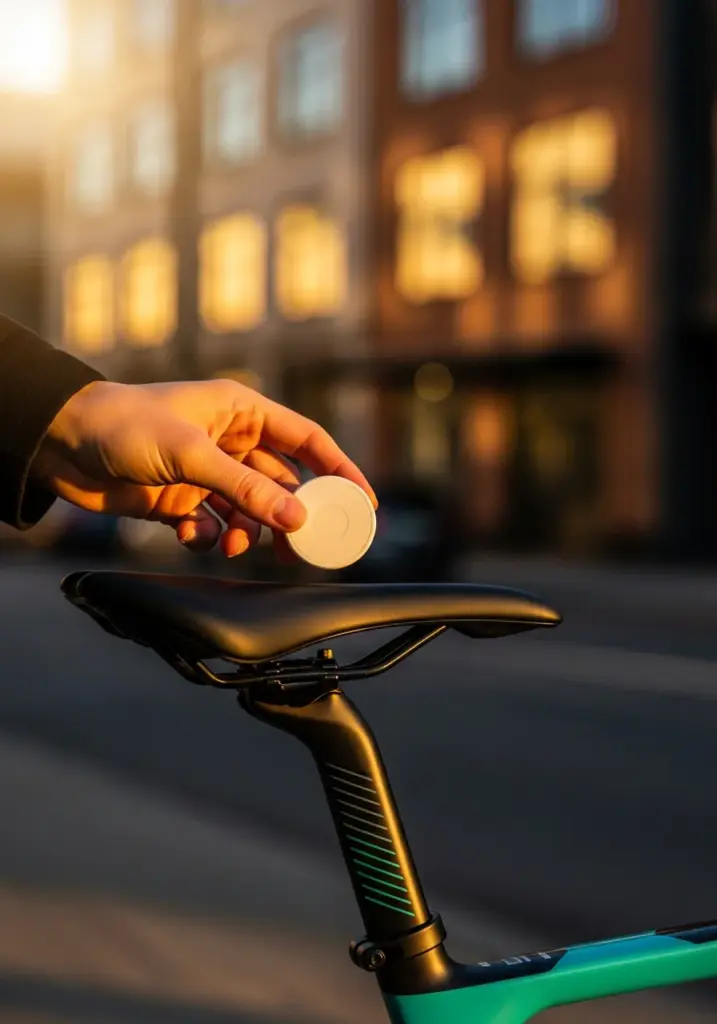
| Under the saddle | Clear signal to the outside, covered from above and from the side. | Little space, the mount has to fit the saddle model. | Sports bikes with open saddle rails |
| Rear light housing | Sits in a part that is firmly bolted to the bike anyway. | Only possible with enough internal space, contact with the battery causes problems. | Everyday bikes with battery-powered lights |
| Behind the reflector | A reflector never looks out of place, it is standard equipment. | Glued versions come loose in cold weather and under UV exposure. | Bikes with a rack or saddle stay |
| Bottle cage base | Weatherproof, hidden and without giving up the bottle cage. | Needs matching frame bosses and correct torque. | Road and trekking bikes |
| Bell | Easy to reach on the handlebar, nobody checks a bell. | Sits well forward, a thief reaches there first. | City and Dutch bikes |
| Handlebar end / grip | The cavity is already there, the end cap does not stand out. | A loose cap loses the AirTag while you ride. | Bikes with hollow handlebars and no internal cable routing |
We deliberately do not go into specific mount models, because the range on offer changes constantly and the fit depends on the bike. The question of where to hide it matters more than the question of which product anyway.
01How well does the seatpost hide an AirTag?
The inside of the frame is the most inconspicuous hiding place on the whole bike, because not a single part on the outside gives it away. With a suitable sleeve, the AirTag sits firmly in the seatpost or in the open end of the frame tube and does not rattle.
The catch: thick carbon or solid metal dampens the Bluetooth signal, thin-walled aluminium is less critical. Choose a mount that clamps or bolts the AirTag in place. Simply dropped in loose, it slides down while you ride and, in the worst case, blocks the seatpost.
02How good is the spot under the saddle?
Under the saddle you get the best signal of all seven spots, because there is no tube in the way. There is little space between the saddle rails, but enough for a flat specialist mount, and you see nothing from above or from the side.
The type of fixing matters. Choose a mount that fits your saddle model and bolts the AirTag in place rather than just clipping it. Glued solutions give way faster in wet conditions and vibration than you would think. Bolted beats glued.
03Does an AirTag fit in the rear light?
Battery-powered rear lights often have more internal space than their electronics need. If the AirTag fits inside, you have a hiding place that is already firmly attached to the bike, because nobody unscrews a rear light without reason.
Make sure there is enough clearance from the battery and circuit board, so nothing wobbles or loses contact. A rear light with a screw fastening is preferable to a pure clip mount, because it does not open when you ride over a kerb.
04How inconspicuous is the hiding place behind the reflector?
A reflector is the dullest part on the bike, and that is exactly its strength as a hiding place. Special reflector mounts look like a normal reflector and take the tracker in a cavity behind it.
Bolt the mount firmly to the rack or saddle stay instead of just sticking it on. Adhesive comes loose in cold weather and under UV exposure, a screw does not. Check that it is still secure when you check your tyre pressure.
05What does the bottle cage base offer?
Some bottle cages have a hidden compartment right at the mounting base, underneath the visible cage. The AirTag sits there protected from the weather and from view, and you do not have to give up your bottle cage.
Before you buy, check whether the mount fits your frame bosses, and tighten the bolts to the correct torque. Overtightened, the thread in the frame strips, and that damage costs more than any tracker.
06How securely does an AirTag sit in the bell?
A bell is part of the familiar look of a bike, so nobody looks twice. AirTag bells combine the normal function with a cavity for the tracker and mount on the handlebar like any other bell.
The drawback is the position: the handlebar is the first place a thief reaches when looking for add-on parts. A bolted bell at least cannot be pulled off with one tug, a glued one can. Check that it is still firmly seated from time to time.
07Why is the handlebar end a strong hiding place?
Many handlebars are hollow inside, and special end-cap mounts use exactly that space. From the outside you see a normal handlebar end cap, inside the AirTag sits dry and protected from dirt.
Make sure the cap really clamps firmly into the handlebar or is bolted in place. A loose end cap will lose the AirTag at some point on a cobbled stretch, and you only notice when you need it.
Tip: Do not hide the AirTag where the internet is currently touting “the one secret spot”. Anyone who knows their way around trackers also knows the usual hiding places. Two different spots on two bike parts are safer than one that everybody knows.
Where does an AirTag on a bike reach its limits?
A well-hidden AirTag is no cloak of invisibility, and that uncomfortable truth rarely appears on product pages. You should know three limits before you rely on tracking.
The alert. Modern iPhones automatically warn their owners when someone else’s AirTag travels with them for a longer period. If you do not use an Apple device, you can search for one deliberately with detection apps for Android. Anyone who really looks will almost always find a tracker with a little patience.
The coverage gap. An AirTag does not report in by itself, only when another device passes within Bluetooth range. If your bike stands in a garage on the edge of town, the last location can stay the same for days. The AirTag does not deliver seamless live tracking.
The moment afterwards. Even a perfectly working AirTag does not hold on to a bike. It replaces neither a properly locked bike nor a police report. And it does not answer the question that stands at the end of every recovery: can you prove the bike belongs to you?
AirTag or GPS tracker: what can each one do?
The two devices look similar and yet answer different questions. The table places them alongside two measures that many people mention in the same breath, so you can see which gap each one leaves open.
| Measure | What it can do | What it cannot do | When it makes sense |
|---|---|---|---|
| AirTag | Show a rough location as soon as other iPhones are nearby, with no running costs. | No location measurement of its own, no report without another device, no protection against being found. | Everyday bike in the city |
| GPS tracker | Send the location actively and continuously, independent of other smartphones. | Needs power and usually a SIM card with a subscription, and does not stop the thief either. | High-value bike, e-bike, cargo bike |
| Lock | Hold the bike mechanically to a fixed object and deter thieves. | Does not tell you where the bike is once it has gone. | Always, as the basis |
| Registration & security marking | Prove ownership clearly, make the bike unattractive to handlers, allow the police to identify the owner. | Does not prevent the theft and shows no location. | Always, as the last resort |
For most everyday bikes, a well-hidden AirTag is enough as an extra safeguard. For high-value bikes and e-bikes it is worth looking at the alternative: you will find the detailed comparison in the guide to GPS trackers for bikes, and our page on e-bike theft protection describes the complete package. If you also want to deter rather than only locate, alarms and immobilisers offer the right addition.
Tracking is plan B. The lock stays plan A.
What do you do when the app shows a location?
If the Find My app shows a location, the rule is: document it instead of driving there. Take screenshots of the place and time, note the address and give both to the police for the record. Thieves may react aggressively if you surprise them, and a bike is not worth that risk.
Also expect an inaccuracy of a few metres. The blue dot shows a building, not a flat, and a location alone is rarely enough for the police to enter it. The more you can supply alongside it, the stronger the case becomes: frame number, purchase receipt, photos.
What counts after that is set out in the guide Recovering a stolen bike.
Why does no tracker replace proof of ownership?
At best, an AirTag leads you to the bike, but it tells nobody who owns it. That is exactly where returns fail: recovered bikes sit with the authorities because there is no way to identify the owner. Frame number, photos and purchase receipts decide whether a seized bike becomes your bike again.
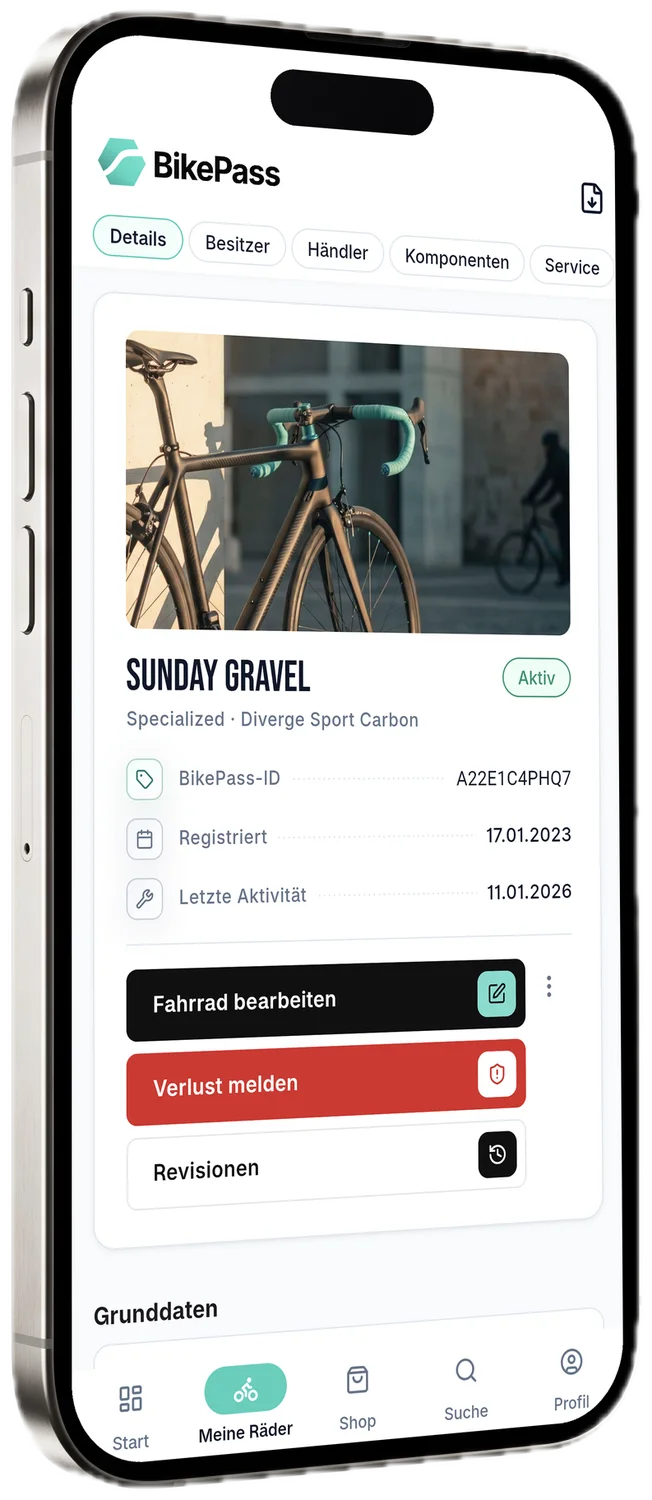
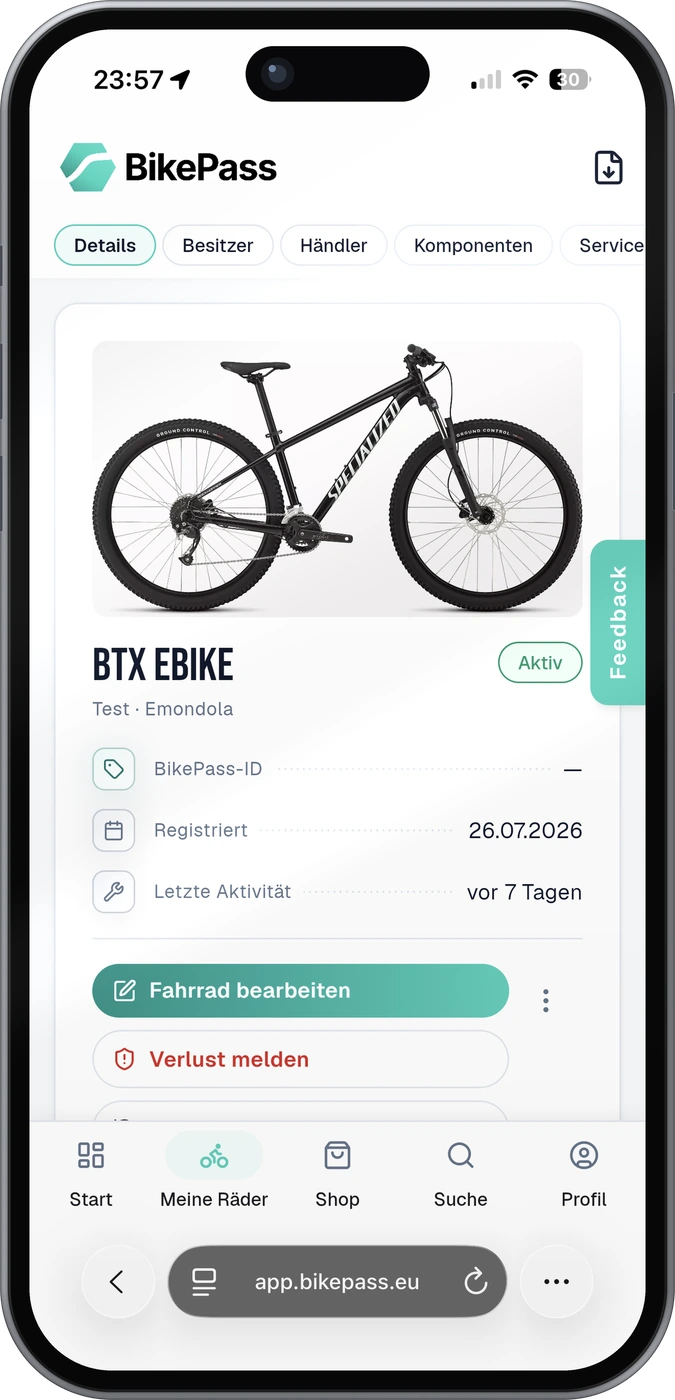
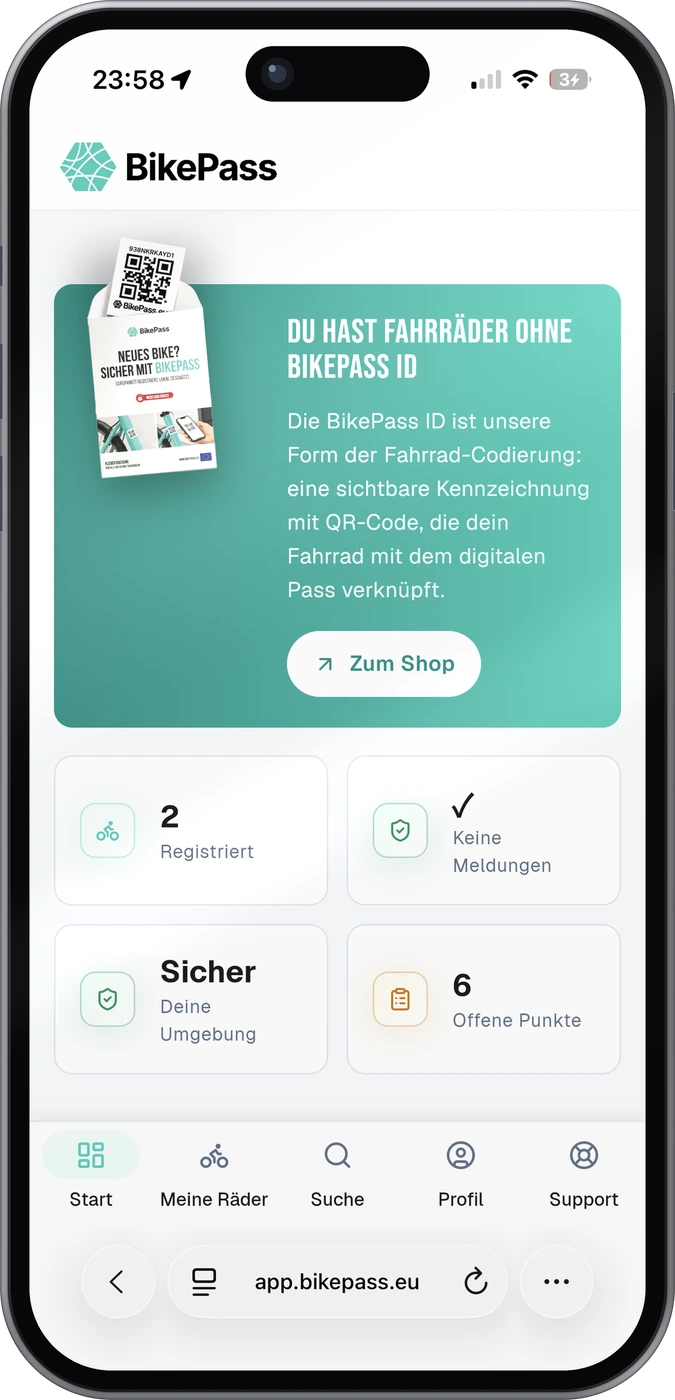
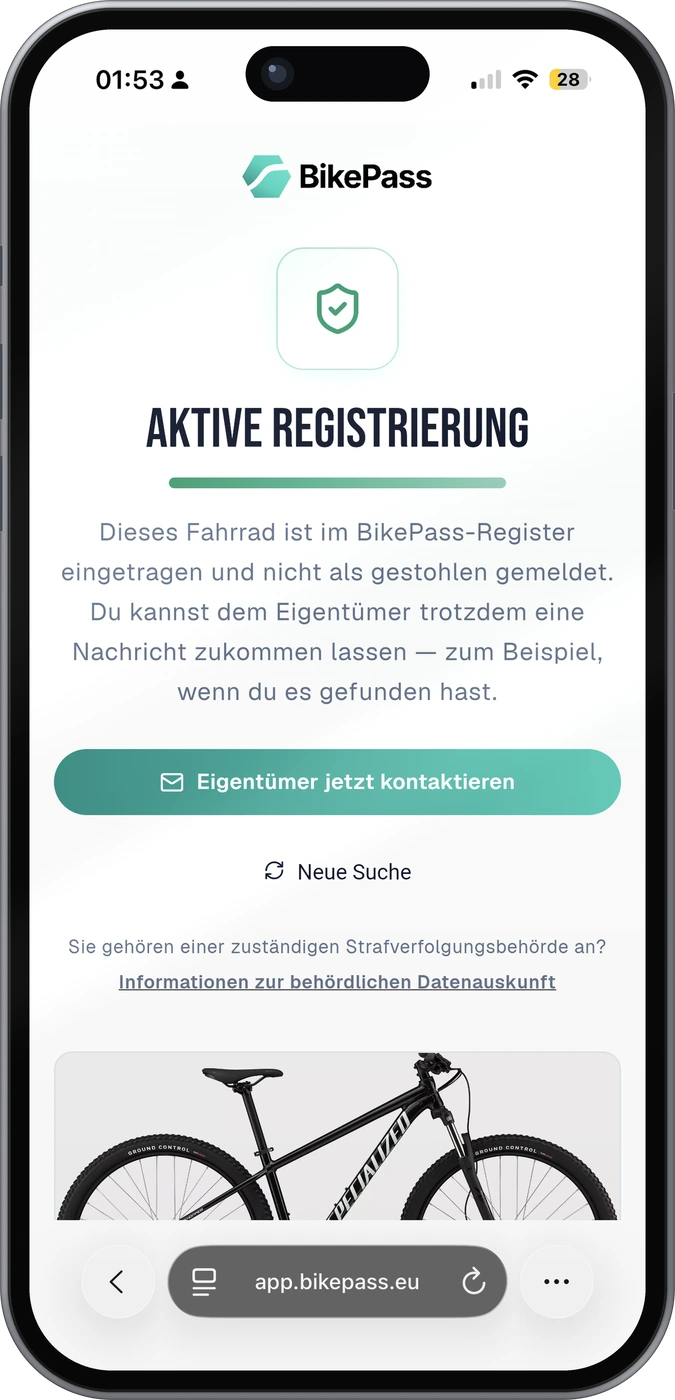
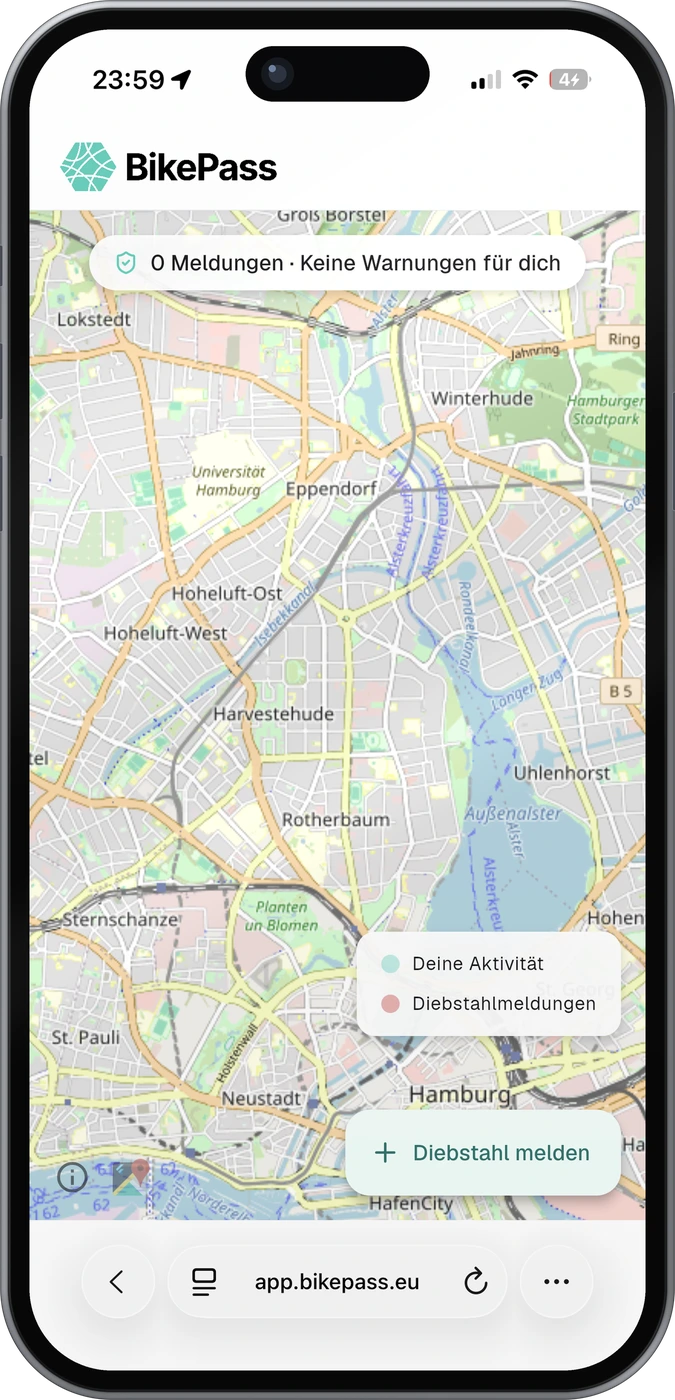
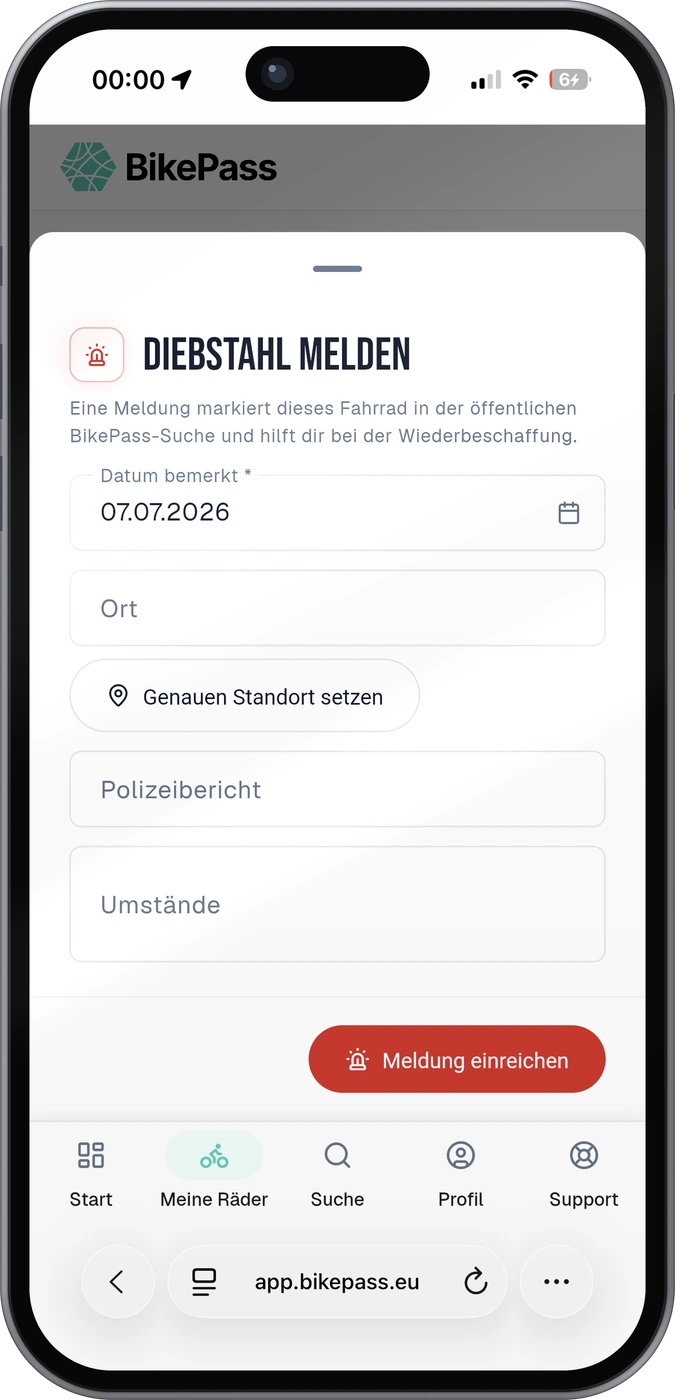
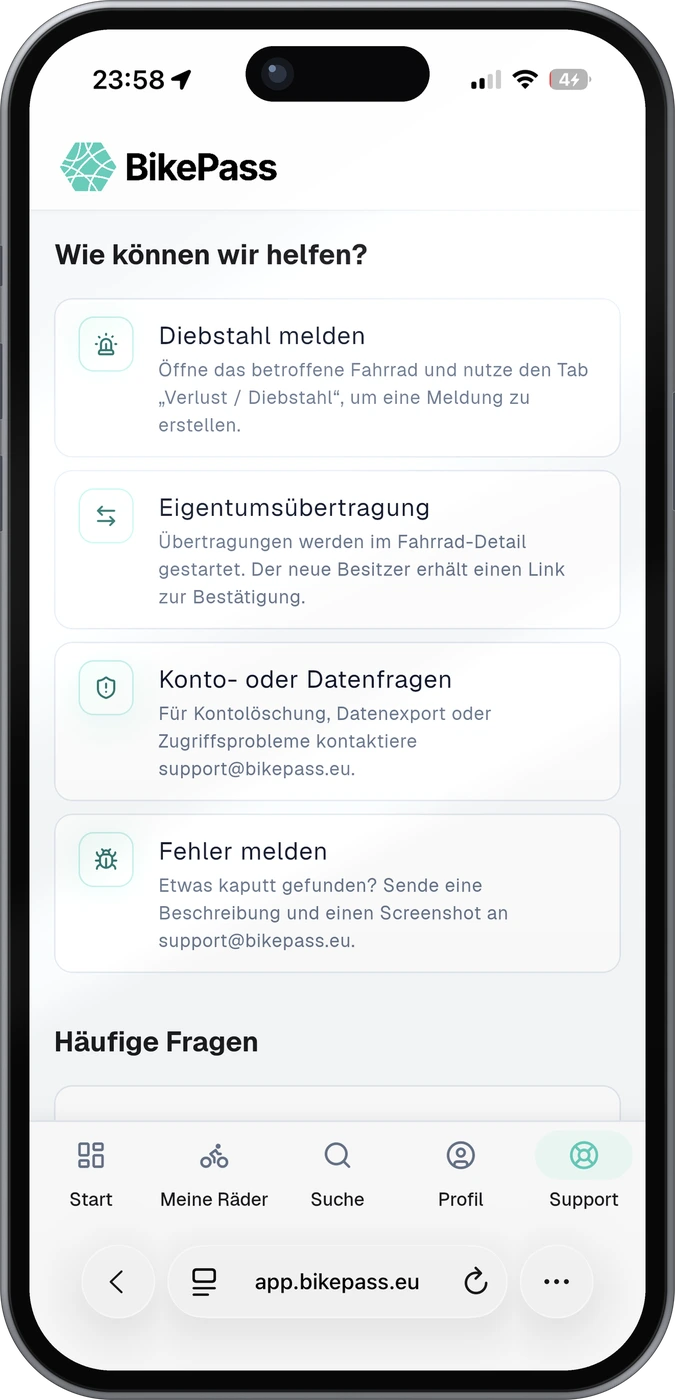
With BikePass you store this data free of charge as digital proof of ownership, in under three minutes, for as many bikes as you like. If you report a theft in the web app, the ID becomes visible to the authorities, and finders can get in touch anonymously. If you wish, you can add a tamper-proof security marking set with a sticker and QR code that you fit yourself at home, with no appointment and no tools.
And the blue dot three streets away? It only appears if the AirTag survived the first few minutes, fitted firmly inside a component that nobody touches. Everything after that is decided not by the map, but by your proof.
Your hiding-place checklist
- Hiding place chosen that suits the Bluetooth signal (no thick carbon or metal around it)
- Mount bolted on rather than only glued
- AirTag sits firmly and does not rattle while riding
- Tracking tested once via the Find My app
- Second hiding place on another bike part considered
- Bike additionally secured with a tested lock
- Frame number, purchase receipt and photos stored digitally
We write about bike theft, security marking and digital theft protection – practical, without scaremongering and with real steps you can take.
See all guides