
In short
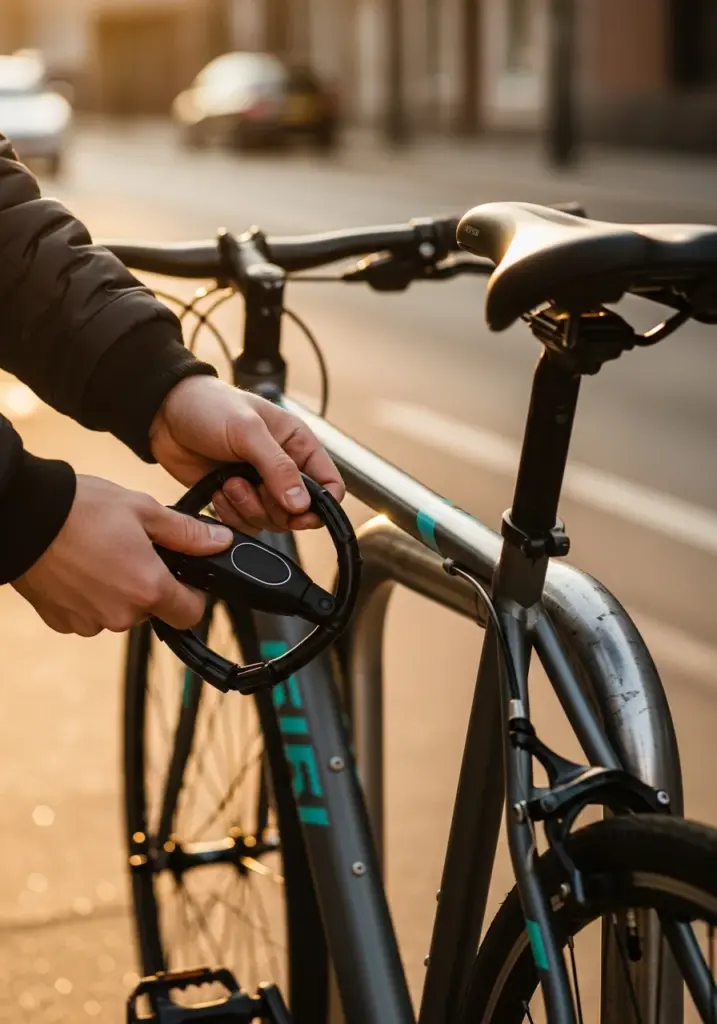
Always secure the frame to a firmly anchored object, not just a wheel. Fit the lock high up, tightly and with the cylinder facing down, and choose a busy, visible parking spot. Anything that comes off without tools is better off coming with you.
A front wheel stands outside the supermarket. Neatly locked, good lock, all tidy; the rest of the bike is gone. Passers-by think bad luck, but it was a user error.
Errors like this are the reason thefts so often succeed. In 2025, around 214,000 bicycle thefts were reported in Germany, and roughly one in nine cases was solved, giving a clearance rate of about 11 % (source: the German police crime statistics (PKS) 2025). Thieves rarely look for the weakest lock. They look for the most convenient mistake.
Locking a bike properly means securing the frame with a tested lock to a firmly anchored object, fitting the lock high up and without slack, and taking with you every part that comes off without tools. The difference lies in two words. Locking only blocks the bike; securing ties it firmly to its surroundings. A locked bike can be carried away, a secured one cannot. Securing it is the whole trick.
You will see the following eight mistakes at every station. Sorted from “happens to everyone” to “an invitation with a bow on top”.
01Why is locking just the front wheel not enough?
If you only lock the front wheel, you secure the cheapest part of your bike. Two quick releases opened, frame and drivetrain carried off, and what stays behind on the stand is exactly what you saw outside the supermarket earlier. The frame carries the frame number, the drivetrain and most of the value.
So always secure the frame. If the lock is long enough, take the frame and rear wheel together; add the front wheel with a second lock or a short chain. One bike, one lock, one mistake.
02What should you lock your bike to?
A bike belongs to an object that is anchored in the ground and over which the lock cannot be lifted off upwards. It sounds obvious, but every day it fails on slanted road signs and on fences that come apart with two quick movements. Do the shake test before you walk away: give the object a short pull, then the bike.
Not every anchor point is equally good. This overview helps you decide quickly in unfamiliar surroundings what holds and what only looks like it does:
| Anchor point | What speaks for it | What makes it unsafe | When it makes sense |
|---|---|---|---|
| Bike stand | Set in concrete, high enough for frame plus wheel. | Nothing, as long as it is not loose in the paving. | Always first choice where available. |
| Lamp post | Deeply founded, available almost everywhere. | Smooth posts without a taper: the lock can be slipped off upwards. | As an alternative to a stand, if there is a projection at the top. |
| Railing or fence | Long run, many anchor points. | Individual segments are often only slotted in or bolted. | Only if the segment is firmly welded. |
| Road sign | Firm in the ground, usually visible at the roadside. | Signs can be unbolted, and short posts cleared upwards. | Short stop, never overnight. |
| Tree | Does not move. | Damages the bark, and young trunks can be cut through. | Only in an emergency and only on thick trunks. |
The best anchor point is little use if the bike lies next to it instead of standing at it. Park the bike so that the lock and the stand touch.
03Why must the lock not lie on the ground?
A lock on the tarmac gives the thief a counter-bearing. He puts a foot on the shackle, applies the tool and uses the ground as an anvil, instead of having to lever freely in the air. The difference in the force he has to apply is considerable.
So fit the lock as high up as possible, ideally at frame height. Turn the cylinder downwards so that rain and dirt cannot run in and nobody can work on it comfortably. High up, not handy.
04How much slack may be left between lock and frame?
As little as possible, because every free centimetre inside the shackle is room for a car jack or a pipe. A dangling lock can be spread open, a snug one cannot. So choose the anchor point deliberately rather than the first one you see, and then shift the bike into place once more.
A shackle that is too big is one of the few situations in which a smaller lock is the better one. A good folding lock solves the same problem through its link design. The comparison of bike lock types shows how the designs differ.
05Which lock suits which bike?
As a rule of thumb, budget around 10 % of the bike’s value for the lock. A cable lock on a high-quality bike is like a tiny advent-calendar padlock on your front door, and thieves recognise the design from five metres away. Before you choose a model, choose a design.
Every type of lock solves exactly one problem well and another not at all. This overview sorts them by what counts in everyday use:
| Type of lock | What it can do | What it cannot do | When it makes sense |
|---|---|---|---|
| D-lock | High resistance to levers and bolt cutters, compact to carry on the frame. | Short shackle: thick posts, or the frame plus both wheels, often will not fit. | Daily parking in public spaces. |
| Folding lock | Good resistance with plenty of reach, folds down small. | The joints are the weak point; it does not replace a heavy D-lock. | Changing anchor points, daily commuting. |
| Chain lock | Great length, encircles frame, wheel and thick objects in one go. | Heavy to carry, and thin chains give way quickly. | Fixed location, cellar, yard, cargo bike. |
| Cable lock | Light, flexible, good as a second lock for the front wheel. | Practically useless as a main lock, cut through in seconds. | Only in addition, never alone. |
| Frame lock | Blocks the rear wheel, always on the bike, no searching. | Secures the bike to nothing: it can be carried away or loaded up. | As an addition for short stops. |
Two different types of lock are better than two of the same, because a thief then needs two kinds of tool. You can read how thieves tackle each design in the guide “How thieves break bike locks”.
06Does it hurt to always park your bike in the same place?
If you put your bike in the same rack at the same time every working day, you become predictable. Organised thieves watch stations and university car parks for days, note which bike is worth taking, and come back when the owner is safely at the office. A bike that stands here one day and there the next fits far less neatly into that routine.
More important than changing spots is the quality of the spot: busy, lit, visible. A dark courtyard gives a thief exactly what he needs, namely time without an audience. Which spot at the station, on campus or in the cellar really works is covered in the guide “Parking your bike safely”.
Tip: Locking your bike to something protects you twice over, including with your insurer. A bike that is merely locked rather than locked to a fixed object can be treated as gross negligence. What insurers usually expect is set out in the guide on home contents insurance and bike theft; terms vary by provider, so check your policy.
07How do you secure quick releases on wheel and saddle?
Quick releases are meant for you, but they work just as well for everyone else. A wheel or seatpost comes off in seconds, with no tools at all, and a bike without a saddle stays at the stand until you collect it.
Three things help: swap quick releases for bolted or coded thru-axles, attach the front wheel to the frame with a second lock, or tie the seatpost to the frame with an old chain. The swap costs you effort once and never a thought again.
08Which attachments are better taken with you?
Anything that comes off without tools is best removed by you, before someone else does it. That means lights, cycle computer, handlebar bag, child seat padding and, on an e-bike, above all the battery. A battery is expensive, light and easy to carry away discreetly under one arm.
On an e-bike it is also worth activating the drive system’s lock function, if yours offers one. It makes the bike less attractive, but it stops nobody from carrying it away. There is more on this on the page about e-bike theft protection.
Where does locking up properly stop helping?
No lock in the world is uncrackable; it is always only about time and noise. Anyone who turns up with the right tools, has enough time and fears nobody will get any bike free. Locking up properly shifts the probability, it does not remove it.
Three situations remain open, no matter how well you lock up. When a bike is loaded into a van, no lock counts any more, only whether the bike is later recognised. In a shared bike cellar the best stand helps little if the cellar door stands open anyway. And with a resale through classified ads, the only thing that counts is whether you can prove ownership.
Legally, incidentally, the matter is clear: breaking a lock is generally an especially serious case of theft (Section 243 of the German Criminal Code, StGB). At the moment of loss that changes little for you. It only matters once your bike turns up again.
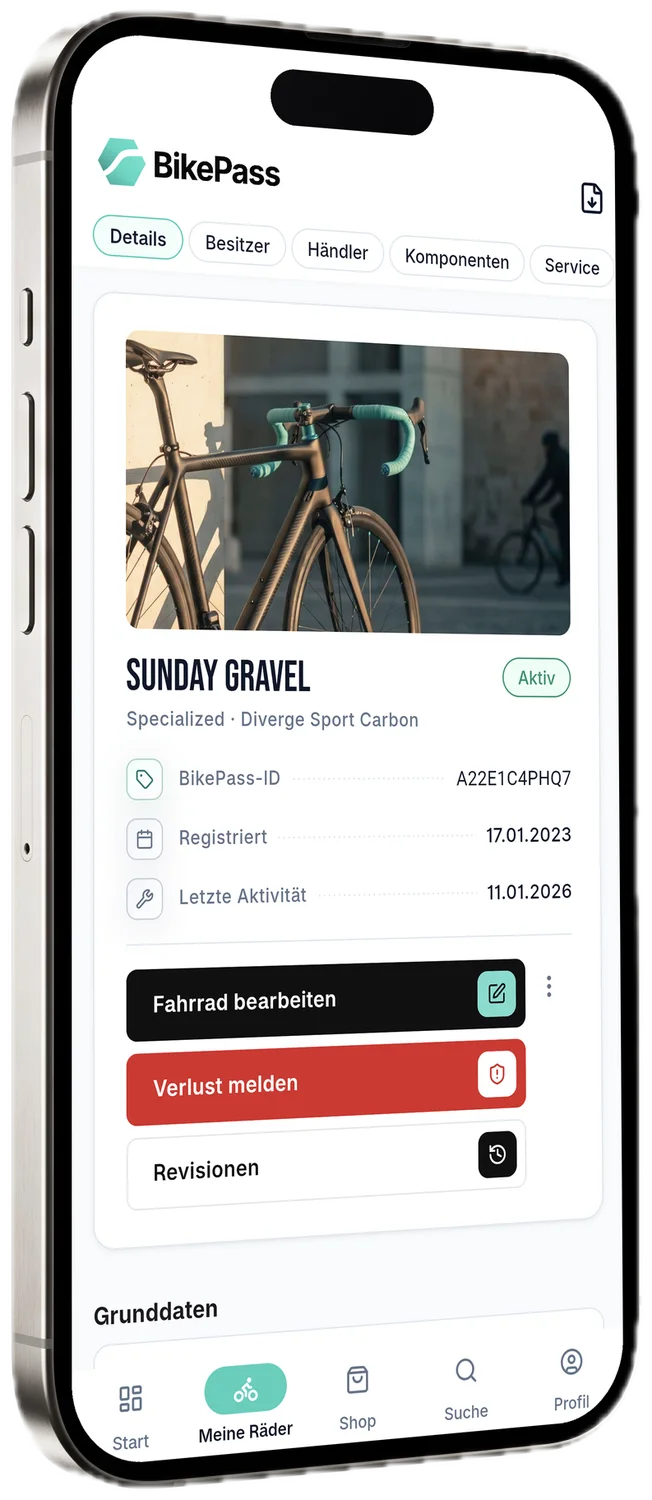
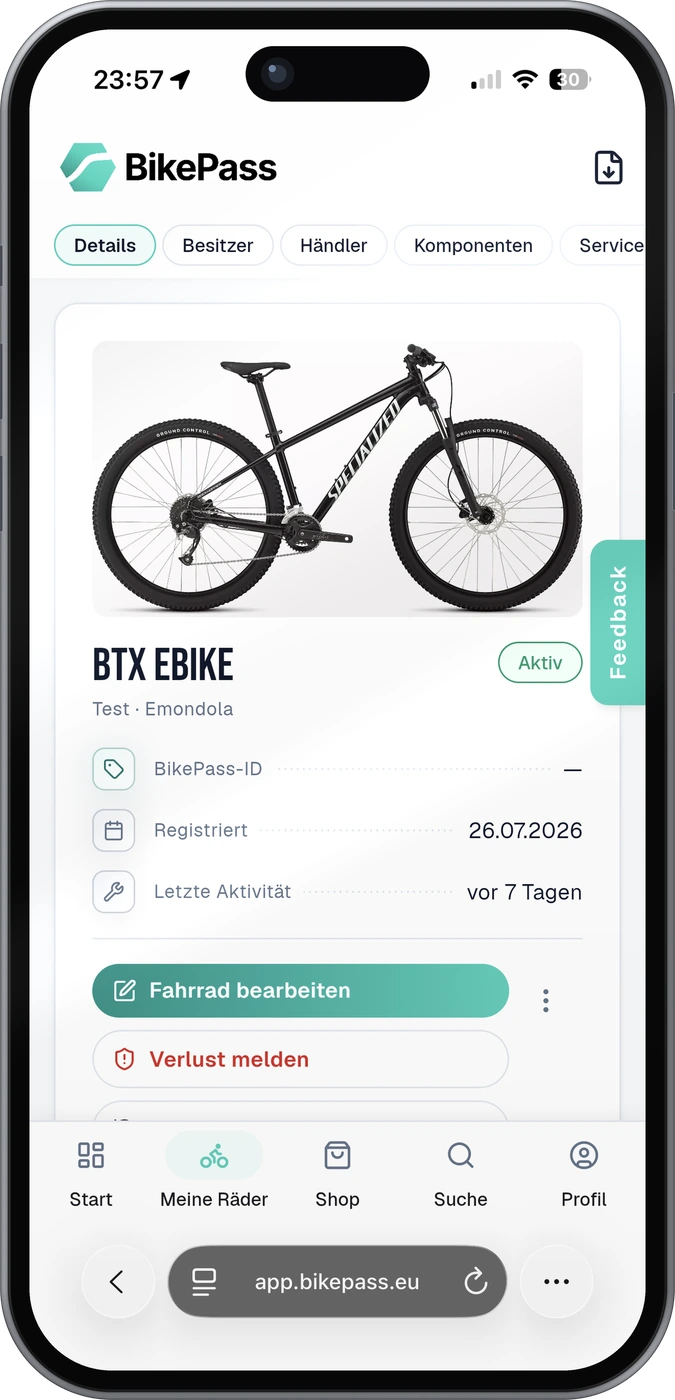
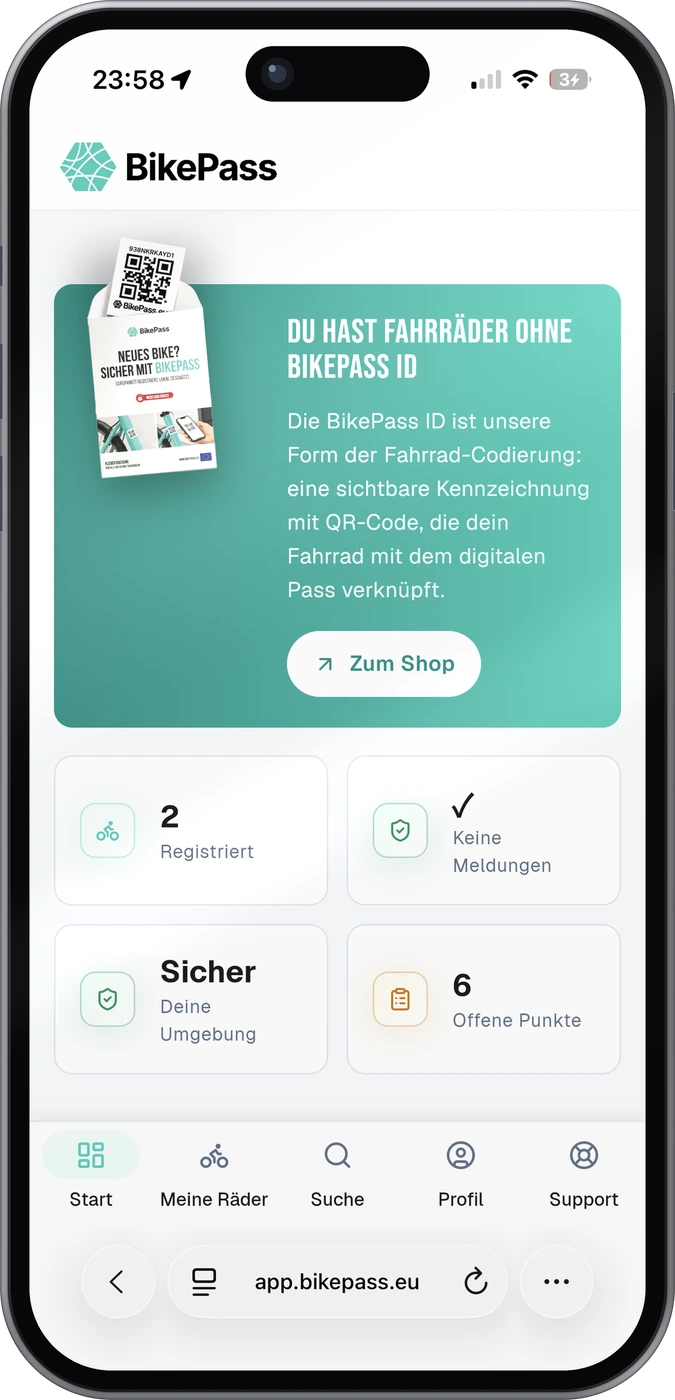
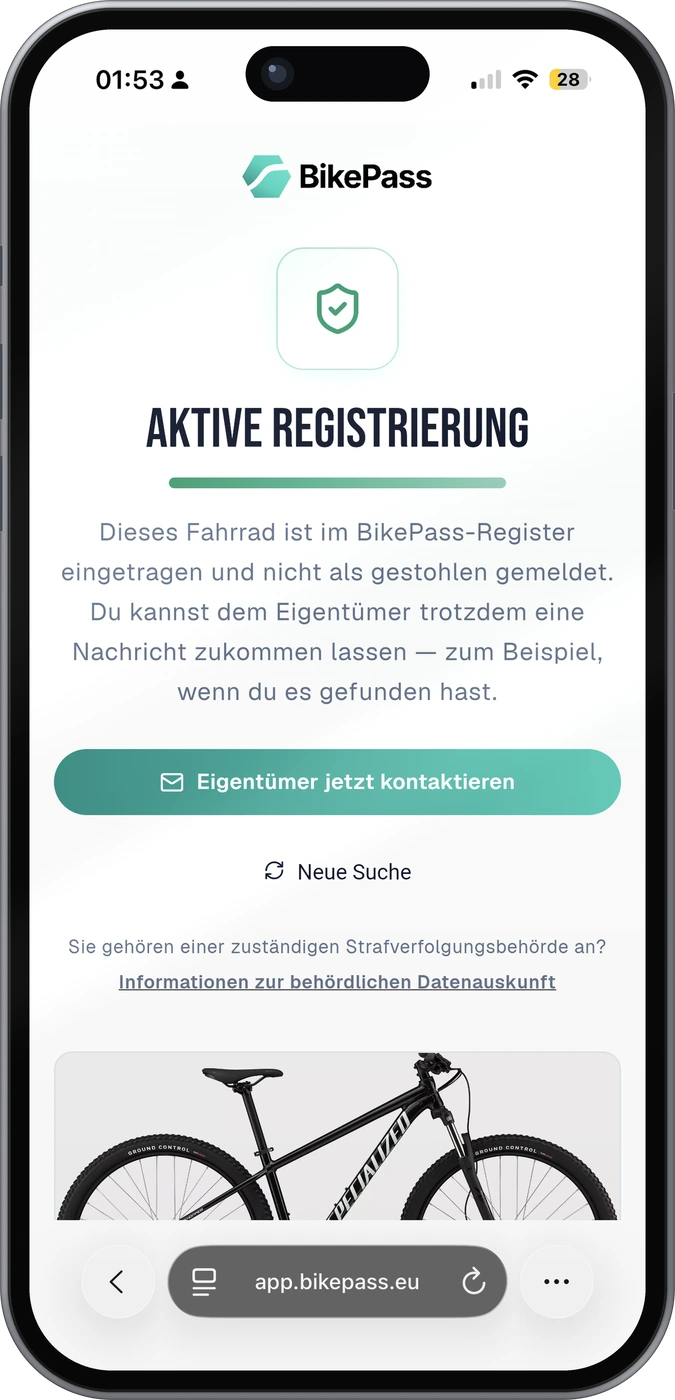
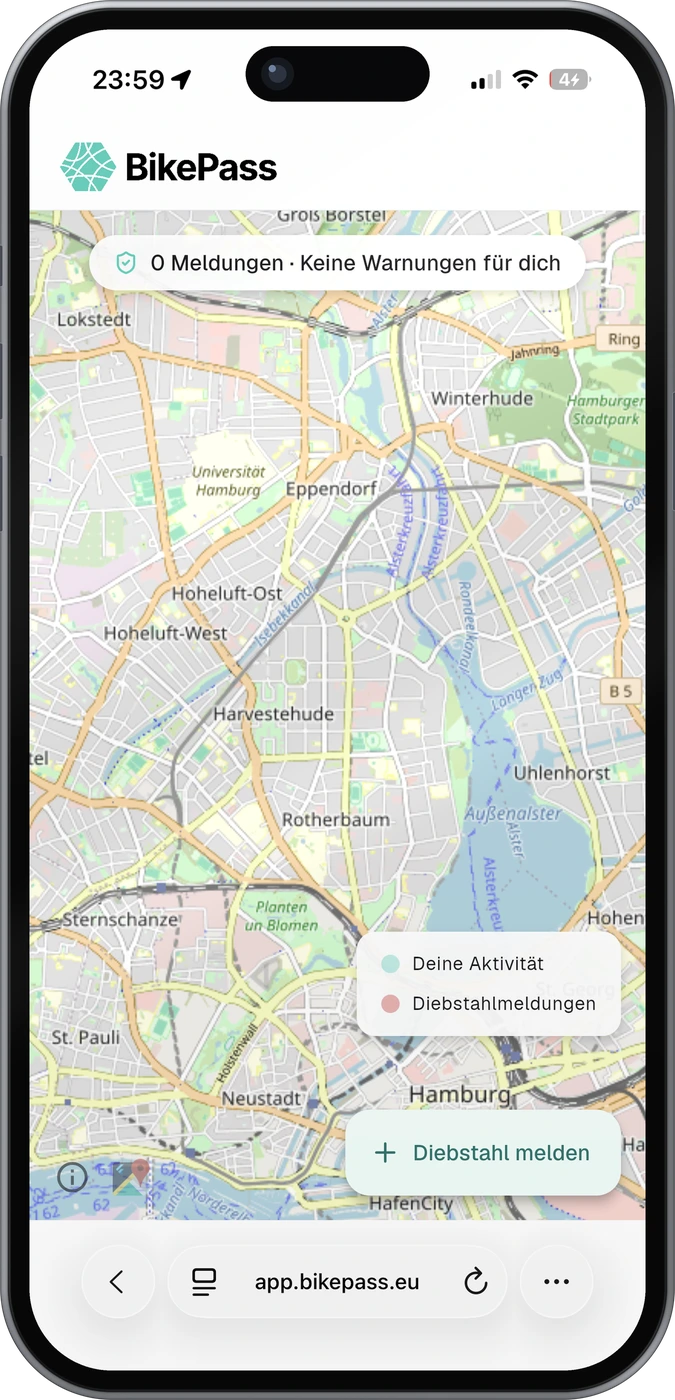
This is exactly where the last building block comes in. A bike whose frame number, photos and receipts are on record can be clearly assigned by the police; a bike without proof stays where it is, even when it is found. With BikePass you create this digital proof of ownership free of charge, in under three minutes, for as many bikes as you like. If you also want to mark your bike visibly, you will find the options under security marking, and the complete kit of lock, parking spot and proof on the page theft prevention for your bike.
And that lonely front wheel outside the supermarket? What it needed was not a better lock, but a lock around the frame, a stand instead of a fence and an owner who knows the frame number. Ten seconds more when you park, every time. That is all it takes.
The 10-second check when you park
- Frame locked to the object, not just a wheel
- Firmly anchored object, shake test passed
- Lock high up, no slack, cylinder facing down
- Lock type matches the bike’s value, second lock for the front wheel
- Busy, lit, visible parking spot
- Quick releases secured, battery and attachments taken with you
- Frame number, photos and receipts stored digitally
We write about bike theft, security marking and digital theft protection – practical, without scaremongering and with real steps you can take.
See all guides