In short
A U-lock offers the highest level of security, while a folding lock provides the best balance between protection and ease of use—chain locks are flexible but heavy, and cable or coil locks are only suitable as secondary or occasional protection. As a rule of thumb, spend about 10% of your bike’s value on a lock.
The 2025 Police Crime Statistics report records approximately 214,000 bicycle thefts—only about one in nine of these cases is solved (clearance rate of about 11%, source: 2025 Police Crime Statistics). The lock is often the only barrier between a thief and your bike, and not every lock offers the same level of protection. We’ve ranked the four most common types of locks based on security, weight, and suitability for everyday use—so you’ll know which one is right for your bike and where you park it.
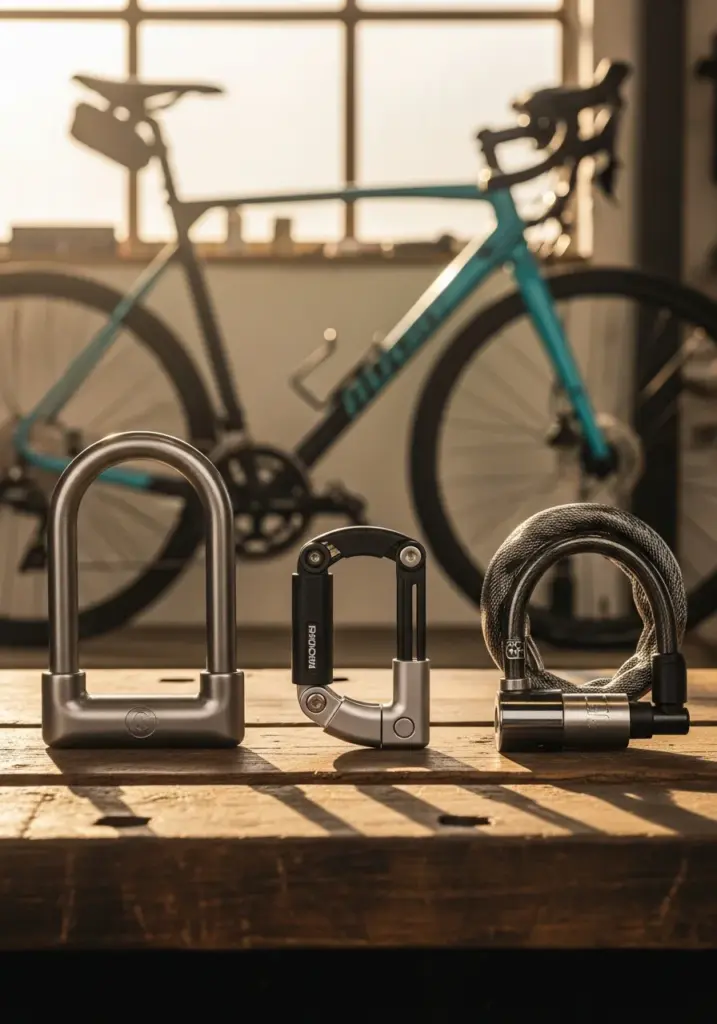
U-lock: The Gold Standard in Security
The U-lock consists of a solid, usually hardened steel shackle that locks into a compact lock body. It is precisely this design that makes it difficult for thieves: The surface area vulnerable to prying tools is minimal, and a hardened shackle is virtually impossible to cut through with ordinary bolt cutters. Anyone attempting to break it open needs time and heavy-duty tools—both of which act as a deterrent in public spaces.
The downside is its rigid design: A U-lock won’t fit around every lamppost or thick bike rack, and there’s often not enough room inside to secure both the frame and the wheel at the same time. In practice, this often means securing the frame and front wheel together to the locking point, while the rear wheel remains unsecured or requires a second lock. For maximum security at a fixed parking spot—such as the same bike rack every day—the U-lock is still the top choice. However, for those who are on the go a lot and park at different locations, the U-lock’s lack of flexibility becomes much more noticeable in everyday use.
Folding Lock: The Balance Between Security and Everyday Use
A folding lock consists of several sturdy metal links that are hinged together and can be unfolded into a long, flexible U-shaped lock. When folded, it fits compactly into a frame bag or backpack; when unfolded, it offers significantly more reach than a rigid U-lock—ideal for securing the frame, wheel, and a thicker attachment point all at once.
The weak point lies in the joints: On cheap models, the riveted joints between the links are thinner than the rest of the lock, making them a prime target for prying tools. On high-quality folding locks, the joints are reinforced, and the security level comes close to that of a good U-lock. For commuters who lock up at different locations every day, a folding lock is usually the most practical solution.
Chain lock: flexible, but heavy
A chain made of hardened steel links—usually sheathed in a fabric sleeve—can be wrapped around just about any anchor point, from a narrow railing to a thick tree trunk. This flexibility makes the chain lock a good choice as a basic lock at home, in the basement, or at a permanent parking spot, where weight isn’t an issue.
And weight is the key issue: Security chains with sufficiently thick links can easily weigh one to two kilograms—which isn’t very convenient for carrying on your bike every day. Security depends directly on the thickness of the links: Thin, lightweight chains can be cut relatively easily with bolt cutters, while thick links offer noticeably more resistance. Anyone who wants to carry a chain lock while out and about should carefully weigh the extra weight against the increased security it provides. As a secondary lock at home, however—combined with a lighter lock when on the go—the chain lock offers all its advantages without any drawbacks.
Cable and coil locks: only as a secondary lock
Cable and coil locks consist of thin, braided strands of wire or a coiled steel spiral with a plastic coating. They are lightweight, inexpensive, and can be wrapped around frames, wheels, or saddles as desired—and that is precisely their only practical use.
They aren’t suitable as the sole main lock: Thin cables can be cut in seconds with a simple pair of cable cutters without anyone even noticing in busy areas. A cable lock makes sense as a secondary lock that secures the wheels or saddle in addition to a U-lock, folding lock, or chain lock—parts that could otherwise be removed in just a few simple steps.
A Comparison of All Types of Castles
The following overview categorizes the four types of locks based on the criteria that really matter in everyday life. The price classification is intentionally qualitative—specific prices and models vary widely depending on the manufacturer. Think of the table as a starting point: If you combine two types of locks, such as a U-lock and a cable lock, you can offset the weaknesses of one with the strengths of the other.
| Security | Weight | Handling | Price Classification | What it's suitable for | |
|---|---|---|---|---|---|
| U-lock | very high | high | rather inflexible | high | Main lock for frames, high-quality bikes, and e-bikes |
| Folding lock | high | medium | Very good, compact | moderate to high | Commuters, varying parking locations |
| Chain lock | moderate to high | high to very high | flexible, but heavy | moderate to high | Basic lock for home use, large mounting points |
| Cable/Coil Lock | low | low | very good | inexpensive | Second Lock for Bike Frame & Saddle |
What to Look for When Buying
Many manufacturers classify their locks into security levels, usually using a numerical or star-rating system—the higher the level, the more resistant the lock is to break-in attempts using prying tools, bolt cutters, or drills. Also look for independent certification marks that test locks specifically for these types of attacks: They provide a more reliable assessment than mere marketing claims.
Just as important, but easy to overlook: the quality of the lock cylinder. Simple cylinders can be picked or drilled open with common tools, even if the padlock or chain itself is high-quality. High-quality locks rely on disc cylinders with anti-drill protection and precisely fitted keys.
With U-locks and chain locks, length is also a key factor in their suitability for everyday use: It must be long enough to secure both the frame and, if possible, a wheel to a fixed anchor point. If it’s too short, you can only secure the frame on its own; if it’s too long, thieves have more leverage to pry the lock against the ground or a post. A long U-lock that’s too loose is easier to pick than one that fits snugly.
Last but not least, the lock also plays a role when it comes to your insurance: If you don’t have a suitable lock or if the bike wasn’t properly secured, this can be considered gross negligence—and make it harder to get a claim paid. Our guide , “When Insurance Won’t Pay for Bicycle Theft, ” explains what this means in the event of a claim.
How to Use the Best Lock Correctly
Even the most expensive lock will only protect your bike if you use it correctly. The key is to secure your bike to a solid, anchored object—not just lock it. Our guide , “How to Lock Your Bike Properly, ” explains how to properly secure the frame, wheel, and locking point.
Just as important: No lock is truly unbreakable, but you can make it as difficult as possible for thieves. To learn about the tricks thieves use and how you can specifically protect yourself against them, read our guide “How to Prevent Your Bike Lock from Being Broken—Here’s How to Protect Yourself.” Our page on bike theft prevention offers an overview of additional security measures for your bike.
Your Lock Checklist
- Did you choose a lock type that's appropriate for the value of your bike and where you park it?
- Has it been certified for security level or received an independent certification seal?
- High-quality lock cylinders (drill-resistant, disc-type cylinders)?
- Is the length sufficient for the frame plus the wheel at the connection point?
- Have you invested about 10% of the bike's value?
- For a high-quality bike: Have you planned for a second lock for the wheel or saddle?
We write about bicycle theft, anti-theft coding, and digital theft protection—in a practical way, without scaremongering, and with concrete steps you can take.
View all guides →